I’ll be selling and signing m’books at the Brighton Comic Con this Saturday 14th June at the Amex Stadium. They’ve got some great guests, including one Brian Blessed, who I’ve not seen since he opened Waterstones in Epsom. As the staff prepared to have our photo taken with him for the local paper, he shouted ‘KNICKERS!’ in that voice and we all cracked up. If anyone should every come across that pic, do please send me a copy.
Anyhoo, if you’re in the Brighton area this Saturday, do pop in and say hi!
Twice a month, I run online sessions for writers called the Green Room. You can ask me questions about the craft of writing, your WIP, or the business of publishing. The sessions are fun and informal and chatty. You can send me questions in advance. They’re recorded live and saved on Kofi for exclusive access to Green Room supporters. Recent topics for the Q&A sessions include…
‘Show, don’t tell’
Writing for children
Dealing with feedback
Happy endings
Writing historical fiction around real events
And much, much more!
And once a month we have a 200 Word Workshop, where you can send me 200 words from your current project and I give it a critique.
I’m running this via Kofi, where you can join by clicking on the Green Room membership tier for £20 a month.
There’s no long term commitment. With Kofi, you can support for just a month, or for as long as you like.
My goal is to be able to give supporters advice that will make a real difference to their writing and career, because the way I see it: having worked in this industry as a salesperson, bookseller and author for over 30 years, I’ve made every mistake, so you don’t have to.
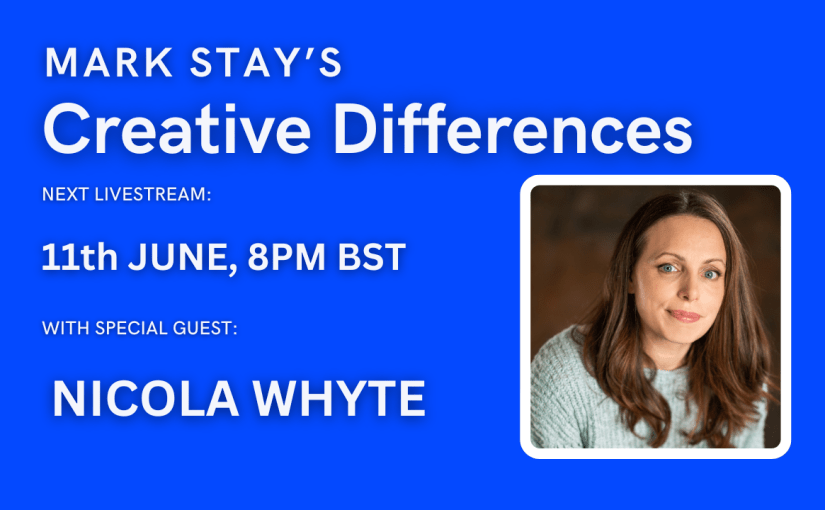
Nicola Whyte’s debut whodunnit 10 MARCHFIELD SQUARE has been getting rave reviews and I’m delighted that she’ll be joining me on the next livestream.
Nicola’s work has been listed for the Comedy Women in Print Prize, the Cheshire Novel Prize, the Daily Mail First Novel Competition, the BPA First Novel Award, and the Times Chicken House Children’s Fiction Competition.
Join us live to join the conversation about writing whodunnits, being a debut novelist, and all those little things that make a big difference to the creative process.
As always, it promises to be a fun evening, so pop that date in your diary…
Before you watch this clip, take a moment to describe a house (maybe even write it down), then watch this clip with bestselling author Sarah Pinborough whose novel WE LIVE HERE NOW is out now (and is set in a very spooky house!) and was partly inspired by this exercise — Credit to author Mark Chadbourn for the exercise!
TRANSCRIPT
SARAH: You know the author Mark Chadbourn?
MARK: Yes. Yes, yeah I do. Yeah.
SARAH: We were at an event somewhere, and he was doing this thing where you have to describe a house. So he was like, describe this house, da-da-da-da… And so, he goes, ‘Is there a path?’ ‘Yeah, it’s kind of a stone house.’ ‘Where is it?’ ‘It’s on its own, in the middle of nowhere. It’s quite a cold place. It’s quite forbidding. It’s kind of oppressive, doesn’t want you to come in and blah, blah, blah.’ But then when I got to the end of this, he said, when you get people to describe a house, it describes their emotional… How they view relationships and their emotional thing. And this idea of no one’s coming in my house. And actually when I look back, I’m like, well, here I am, single at 53 (laughs), and I maybe there was something in it, but it’s kind of that house in my head that I pictured then, you know, like this kind of in the middle of nowhere on its own, doing its own thing house.
MARK: We have a thing called the Green Room where people… we talk about writing, and I bang on and on about things like central dramatic arguments and themes. When you say, what is your book about? You’ve just given us a brilliant example because you’ve, you know, it’s about the lies couples tell each other and that thematically, you know, runs through the whole story and it’s so strong because we spent, you know, eight minutes talking about it already. And I think we could talk about it all night. But it’s and that’s what I think makes your book so compelling because it is, you know, about these terrible truths…
SARAH: It’s that awful word, ‘relatable’.
MARK: ‘Relatable’.
SARAH: ‘Relatable’.
MARK: Relatable equals commercial equals money in the bank. Yeah, it’s Mike says 100%. All you need is a dog. And we had we had, we had Mike and his dog on here a few episodes ago, folks. I’ll, I’ll put a link in the show notes. You can check the episode out.
This month’s special guest bestselling author Sarah Pinborough reveals when she knows that’s she finished a draft and how she ‘triple writes’ her books…
SARAH: Well, Mark, invariably, I am skating in the last knockings of the deadline. So when I write the end, I literally think ‘I’m going to scan through this and I’m sending this fucker off,’ so… But, because I do triple write, as it were, like I plan in a notebook, then I rough write into Scrivener, then I copy it over into Word, tidy it in Word. I do it in like 8000 word chunks. I’ve kind of… if it’s not untidy and it’s not…. You know, it’s probably most people’s second draft, when I hand it in. And I kind of think… I mean obviously this would be different if it was on spec, but I’m like; they’ve paid for it. Let’s see if it’s holding, you know, because if it’s not holding, it doesn’t matter how pretty I make it. (If) there’s a massive structural problem, let’s get to that. You know, so I kind of figure that’s the way.
I type this with sore feet… actually, I’m typing this with my fingers, but my feet are sore. See how addled my mind is? That’s because I’ve just spent a fairly epic weekend selling m’books at the MCM Comic Con in London. From the set-up on Thursday afternoon, through to the dismantling on Sunday it was fairly non-stop and proved to be my most successful comic con yet. I sold more books than ever by quite some margin… and I was standing for most of that time, hence the sore feet. Writing is mostly sedentary, y’know. I’m not used to this standing and moving about malarkey!
One slight problem — and it’s a good problem to have — is that I sold so many books that I don’t have enough for the next couple of comic cons. Normally, after a weekend of comic cons, I would do a quick stock check and order some more. But one of my books — Babes in the Wood — is reprinting on 6th June, and the warehouse is closed because they’re moving the stock to a brand new warehouse. So I won’t be getting any fresh stock until week commencing 9th June.
This means that I won’t be turning up to the following comic cons…
Hatfield on 31st May
Newmarket on 1st June
Suffolk on 8th June
My apologies to anyone hoping to pop by and say hello on any of those days. But the cons will be still be on and they’re great fun, so why not treat yourself?
That means that my next comic con will be Brighton on 14th June. For details of that and more comic cons in June and July pop over to my events and diary page…
This month’s special guest bestselling author Sarah Pinborough reveals when she knows that’s she ready to start writing…
TRANSCRIPT
MARK: What’s the thing that makes you think you’re ready to start writing on a project?
SARAH: When I’ve got the ending locked in place. I can’t start to write without… I have to see the final scene of the book in my head. So… Behind Her Eyes, the final chapter was in the pitch of the book. So I don’t have the whole book planned, obviously, but I tend to kind of have to have the characters names, a bit of a tent pegging. and the ending has to be locked so I know what I’m working towards. But you know, I’m great one for mulling… mulling for a long time. I think that’s the hardest part, isn’t it?
This month’s special guest bestselling author Sarah Pinborough reveals a great tip for writing in 20-minute bursts…
TRANSCRIPT
MARK: What small thing has made a big difference to your creative process?
SARAH: Cocaine! Okay, that’s a joke. (laughs)
MARK: (laughs) You might have said that a little too quickly.
SARAH: What small things made a difference to my creative process. I mean, it’s not a small thing, but obviously… Oh, actually, I do have one for this! So I use the Freedom app. You know, which turns the internet off. And my friend Harriet Tyce… because I used to just turn it off for an hour and then dick around on my phone. Pointless. But she told me to do it… There’s that thing where you do it in 20 minute bursts. So you set it for 20 minutes, and then you work… because 20 minutes you can work for. And so three lots of 20 minutes, and you’ve done, like, nearly a thousand words. And it’s much more focused. So I do try and do these 20 minute bursts if I’m not feeling it. And that does help, you know. And also I’m not a great fan of the word count thing. You know, people say I must write 2500 words a day. I think it’s better to have a good thinking time.
MARK: Yeah, absolutely. That 20 minutes is that sort of Pomodoro timer.
SARAH: Yeah. That’s the word! Pomodoro. That’s it.
I’m delighted to be returning to the MCM Comic Con at the cavernous Excel Centre in London this weekend where I’ll be selling and signing m’books.
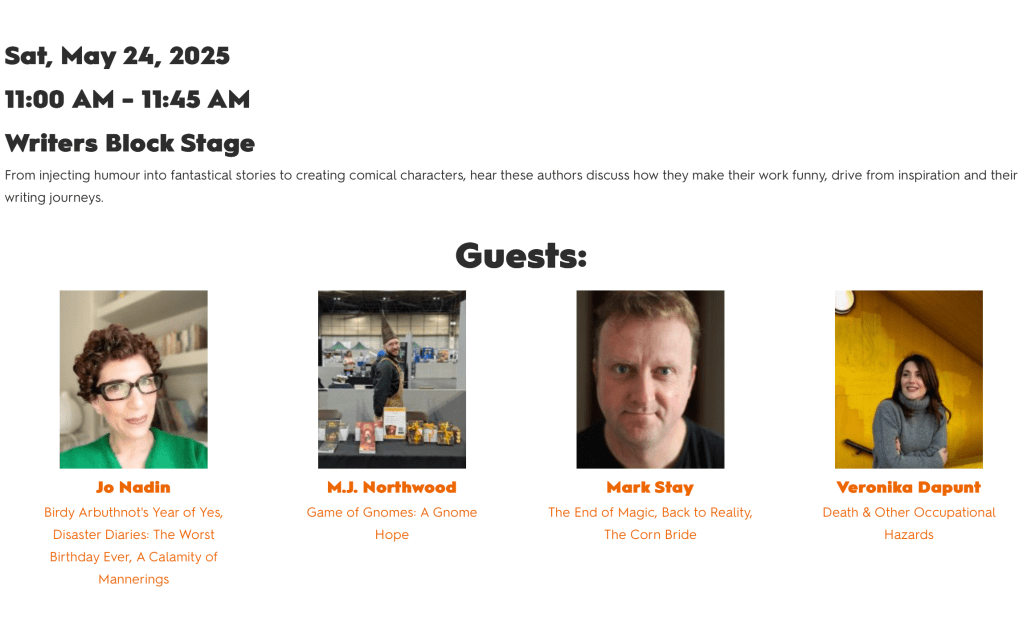
On the Saturday, I’ll be moderating a panel on writing comedy with these amazing authors: Joanna Nadin, MJ Northwood and Veronika Dapunt (click on the image for more details)…
If you’re one of the many thousands attending the MCM do please come along and say hello. I’ll be with all the fab authors in the WRITERS’ BLOCK where you’re bound to find a new favourite author.





 Mark Stay Writes