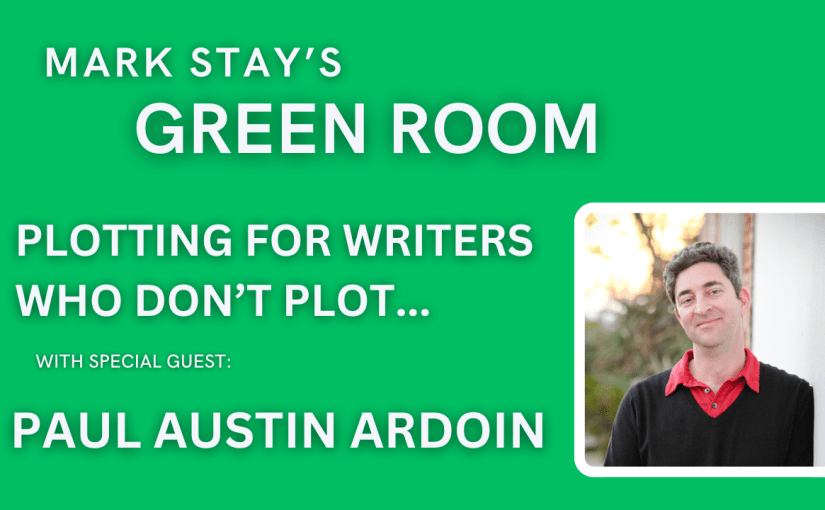
A bonus episode of the podcast with special guest Paul Austin Ardoin. Paul is the author of Fenway Stevenson Mysteries and he joined me and Green Room members to discuss his brilliant new nonfiction book, Outlining for Novelists who don’t Outline, which is packed with tips for panster writers who want more control over their story without losing their voice.
We discuss: If you can you pants a mystery Creating vivid characters Coping with disappearing sidekicks and much more!
This is the sort of stuff that we discuss in my online writing group The Green Room all the time and I’m planning on having more special guests in the future. You can join today! There’s more about the Green Room here.
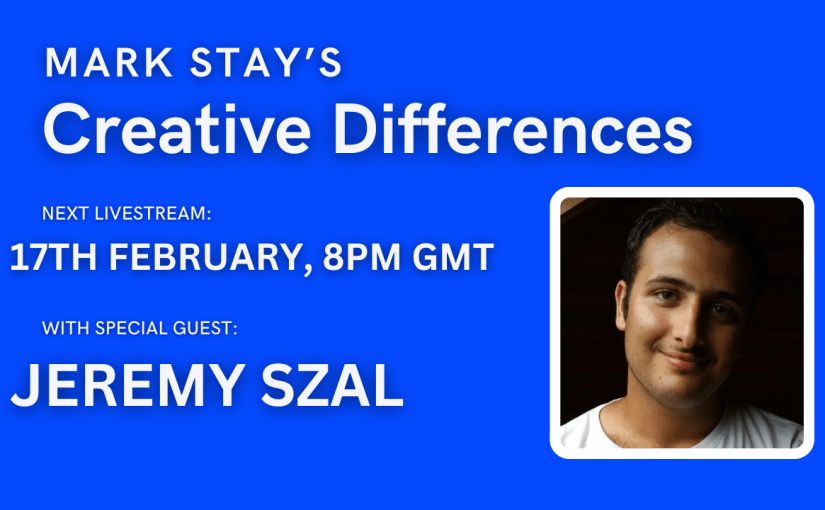
Join me and Jeremy Szal, who was born in the outback of Australia and raised by wild dingos (it says here!). He is the author of the Common trilogy, a dark space opera, and was a guest of honour at the 81st Worldcon in China. We’ll be discussing writing epic science fiction, forging a career as a writer in an uncertain world and much more!
Join in the conversation live on TUESDAY 17TH FEBRUARY, 8PM GMT
Twice a month, I run online sessions for writers called the Green Room. You can ask me questions about the craft of writing, your WIP, or the business of publishing. The sessions are fun and informal and chatty. You can send me questions in advance. They’re recorded live and saved on Kofi for exclusive access to Green Room supporters. Recent topics for the Q&A sessions include…
‘Show, don’t tell’
Writing for children
Dealing with feedback
Happy endings
Writing historical fiction around real events
And much, much more!
And once a month we have a 200 Word Workshop, where you can send me 200 words from your current project and I give it a critique.
I’m running this via Kofi, where you can join by clicking on the Green Room membership tier for £20 a month.
There’s no long term commitment. With Kofi, you can support for just a month, or for as long as you like.
My goal is to be able to give supporters advice that will make a real difference to their writing and career, because the way I see it: having worked in this industry as a salesperson, bookseller and author for over 30 years, I’ve made every mistake, so you don’t have to.
Twice a month, I run live surgeries on Zoom where you can ask me questions about the craft of writing, your WIP, or the business of publishing. Step backstage and let’s figure out practical solutions to your writing problems! The sessions will be recorded live and saved on Kofi for exclusive access to Green Room supporters.
In tonight’s session, we’ll be looking at sales agents for indie authors, writing historical fiction, working on more than project at a time and much more! Click on the image below to discover more about the Green Room…
A couple of months ago I started a little forum for Writers called The Green Room. We meet twice a month over Zoom: writers send me questions in advance on the craft and business of being a writer and it’s all relaxed and fun and chatty and there’s a great mix of writers: some just starting out, others are published and experienced and it’s all recorded exclusively for folks who support me over on Ko-Fi. Here’s a little taster from last week’s session with a great question on how to write believable and unpleasant antagonists…
I hope you found that that little taster helpful. The sessions are supposed to run for half an hour: they’ve all gone on for a good hour so far. I love chatting about this stuff with writers like you. If you’d like to try it out, pop over to my page on Ko-Fi and become a Green Room supporter. Untill then, happy writing!
How do you write a believable and unpleasant antagonist? I have tried looking at antagonists I like from other books, but I can’t put my finger on why some get under my skin and some don’t. Where do you begin?
Fantastic question! And I’m going to take my time with this one, because this is so important…
An antagonist is a person who actively opposes or is hostile to someone or something. This means your antagonist isn’t just a black hat villain who is evil for the sake of it. They have historical or psychological motivations for what they’re doing. And that’s a great place to start when creating a great antagonist.
Look at Ray Bradbury’s classic Fahrenheit 451, set in a world where books are banned and burned – the antagonist is Captain Beatty: he hates books for their contradictory facts and opinions and that they encourage dissent and unrest. But he’s also well-read, which makes him a hypocrite, but he has made a choice to destroy outlawed books that might encourage people to think. As far as Captain Beatty is concerned he’s providing a public service, and Montag — our hero who saves books — is a renegade who must be stopped.
Antagonists are often in a position of power: Captain Beatty, Uriah Heep in David Copperfield becomes secretary and business partner to Mr Wickfield, allowing him to deceive Mr Wickfield. Mob bosses, corrupt officials, powerful businessmen and women all make for great antagonists because of their position and the power they hold over others.
Antagonists are a dark shadow of the hero. Moriarty is a match for Sherlock Holmes’s wit and deduction, but he has chosen a life of crime. He is what Sherlock could become if he made the wrong choices. Same goes for Luke/Vader, Harry/Voldemort, Batman and the Joker etc.
Create the right Antagonist for your Protagonist
The antagonist’s role in the story is to force your protagonist to change. They will torment your hero so much that they have to rise up and overcome them or be defeated. If we think of our story as: thesis, antithesis and synthesis – the antagonist is the antithesis: they represent the opposite of what your hero believes to be true. That’s not to say that the antagonist is always wrong. A good baddie will have their own agenda that might even seem reasonable to others:
Shere Khan in the Jungle Book: turns out he was spot on about men hunting tigers to extinction!
Nurse Ratched in One Flew Over the Cuckoo’s Nest: a care provider who maybe lets power go to her head.
Javert in Les Miserables has a slavish devotion to the law and righteousness which drives him to pursue Jean Valjean tirelessly.
Each of these represent the antithesis to our hero: Mowgli wants the freedom of the jungle, but with none of the responsibility. He will learn through his encounters with Shere Khan that freedom is hard won.
McMurphy challenges institutional power in the form of Nurse Ratched, but discovers that institutions can be more powerful than the individual.
Jean Valjean epitomises how a man who has done something that society sees as wrong can be a good man, but Javert refuses to show any leniency.
With all of these, the stories would have been much shorter and less satisfying if the villains had been just a little bit reasonable… Imagine if Shere Khan had accompanied Mowgli to the human village instead of trying to kill him, what if Nurse Ratched had acknowledged her own tyranny and relaxed some of her rules, what od Javert said, ‘Y’know what, it’s a loaf of bread and those kids were starving. I’m going to look the other way this time…’
But each of these villains refused to bend and why? Because they have power.
Think about their POWER
If a villain is too easily overcome, then it will be unsatisfying for the reader. If they’re overpowered (and this happens a lot in SF&F) then you might find yourself reaching for some deus ex machina solution at the end.
NOT ALL VILLAINS ARE CREATED EQUALLY… and do you even need one?
So far we’ve discussed the traditional kind of antagonist: the dark shadow of your hero that must be overcome, but not every baddie needs to be Darth Vader. Here are some other examples…
A Force of Nature
Yes, it doesn’t even need to be a person. Your hero could be trapped in a storm, or tormented by a shark, Robinson Crusoe was surrounded by an unforgiving sea. The world around your hero could represent the antithesis of who they are.
A Rival/Opponent
Rather than an out and out evil bad guy, your antagonist could be more of an irritant. The kind of antagonist we’ll meet in real life: the annoying boss or co-worker, the strict parent
They’re simply someone whose goals are in direct conflict with the protagonist’s.
A Many-Headed Hydra
The antagonist doesn’t need to be just one person. In Mean Girls you have the alpha females
Most villains have henchmen who in some way embody an aspect of their ethos and as the hero overcomes them they will learn something essential about the villain that will help them overcome them.
The Protagonist Themselves
Ever been told you’re your own worst enemy? A character’s own failings and doubts can stop them from reaching their goal. Holden Caufield in The Catcher in the Rye, the narrator in Fight Club, Willy Loman in Death of a Salesman is delusional, insecure and volatile
Describing villains…
Uriah Heep, for example, in David Copperfield:
When we first meet him, he is described as a “cadaverous” man, “who had hardly any eyebrows, and no eyelashes, and eyes of a red-brown, so unsheltered and unshaded, that I remember wondering how he went to sleep. He was high-shouldered and bony; dressed in decent black, with a white wisp of a neckcloth; buttoned up to the throat; and had a long, lank, skeleton hand.”
‘As I came back, I saw Uriah Heep shutting up the office; and feeling friendly towards everybody, went in and spoke to him, and at parting, gave him my hand. But oh, what a clammy hand his was! As ghostly to the touch as to the sight! I rubbed mine afterwards, to warm it, and to rub his off.’
David Copperfield, by Charles Dickens
Annie Wilkes in Misery (she gets a long description, essentially one of only two characters in the book). Here’s an excerpt from p8 of my paperback edition…
Most of all she gave him a disturbing sense of solidity, as if she might not have any blood vessels or even internal organs; as if she might be only solid Annie Wilkes from side to side and top to bottom. He felt more and more convinced that her eyes, which appeared to move, were actually just painted on, and they moved no more than the eyes of portraits which appear to follow you to wherever you move in the room where they hang. It seemed to him that if he made the first two fingers of his hand into a V and attempted to poke them up her nostrils, they might go less than an eighth of an inch before encountering a solid (if slightly yielding) obstruction.
Misery by Stephen King
A lot of this initial description de-humanises Annie. It’s broad and derogatory, and as the novel goes on Paul Sheldon and the reader discover more and more about Annie and her motivations. I won’t give too much away, but it’s a masterclass in writing a psychopath.
And here’s how Holmes describes Moriarty in The Final Problem:
“His career has been an extraordinary one. He is a man of good birth and excellent education, endowed by nature with a phenomenal mathematical faculty. At the age of twenty-one he wrote a treatise upon the Binomial Theorem, which has had a European vogue. On the strength of it he won the Mathematical Chair at one of our smaller universities, and had, to all appearance, a most brilliant career before him. But the man had hereditary tendencies of the most diabolical kind. A criminal strain ran in his blood, which, instead of being modified, was increased and rendered infinitely more dangerous by his extraordinary mental powers. Dark rumours gathered round him in the university town, and eventually he was compelled to resign his chair and to come down to London, where he set up as an army coach. So much is known to the world, but what I am telling you now is what I have myself discovered.”
The Final Problem by Sir Arthur Conan Doyle
No mention of his physicality at all.
Here’s how Watson describes him in the same book:
He was extremely tall and thin, his forehead domed out in a white curve, and his two eyes were deeply sunken in his head. He was clean-shaven, pale, and ascetic-looking, retaining something of the professor in his features. His shoulders were rounded from much study, and his face protrudes forward, and was for ever slowly oscillating from side to side in a curiously reptilian fashion.
The Final Problem by Sir Arthur Conan Doyle
Hannibal Lecter, ch7 of Red Dragon: he’s mentioned 29 times before we meet him, and he never leaves his cell, doesn’t kill anyone for the duration of the narrative, and yet he is Will Graham’s antagonist.
Dr Hannibal Lecter lay on his cot asleep, his head propped on a pillow against the wall. Alexandre Dumas’ Le Grand Dictionnaire de Cuisine was open on his chest.
Graham had stared through the bars for about five seconds when Lecter opened his eyes and said, ‘That’s the same atrocious aftershave you wore in court.’
‘I keep getting it for Christmas.’
Dr Lecter’s eyes are maroon and they reflect the light redly in tiny points. Graham felt each hair bristle on his nape. He put his hand on the back of his neck.
‘Christmas, yes,’ Lecter said. ‘Did you get my card?’
‘I got it. Thank you.’
Dr Lecter’s Christmas card had been forwarded to Graham from the FBI crime laboratory in Washington. He took it into the backyard, burned it, and washed his hands before touching Molly.
Lecter rose and walked over to his table. He is a small, lithe man. Very neat.
Red Dragon by Thomas Harris
There’s more in the subsequent chapter, a drip-drip of little details that send a chill down your spine. It’s brilliant and Harris basically repeats it for The Silence of the Lambs…
The Green Room is a twice-monthly Zoom session with me and a bunch of wonderful writers where you can ask me questions about the craft of writing, your WIP, or the business of publishing. Step backstage and let’s figure out practical solutions to your writing problems!
It’s all run through my Ko-Fi page and costs just £20 a month.
Tonight is the first Green Room session for writers and it’s not too late to get involved.
I’ve already had great questions on editing a first draft, finding agents, writing for TV, collating research, writing series summaries and more! Even if you don’t have a question, do please come along as something might occur to you in the moment and those can be the best questions of all.
Twice a month, I’ll be running a 30-minute live session on Zoom where you can ask me questions about the craft of writing, your WIP, or the business of publishing. The sessions will be fun and informal and chatty. You can send me questions in advance. They’ll be recorded live and saved on Kofi for exclusive access to Green Room supporters.
There’s no long term commitment. With Kofi, you can support for just a month, or for as long as you like. Pop in, pop out: whatever works for you. My goal is to be able to give supporters advice that will make a real difference to their writing and career, because the way I see it: having worked in this industry as a salesperson, bookseller and author for over 30 years, I’ve made every mistake, so you don’t have to.
Here’s a clip from the first episode of the Creative Differences podcast where I explain what the Green Room is and how you can get involved…
Twice a month, I’ll be running a 30-minute live session on Zoom where you can ask me questions about the craft of writing, your WIP, or the business of publishing. The sessions will be fun and informal and chatty. You can send me questions in advance. They’ll be recorded live and saved on Kofi for exclusive access to Green Room supporters.
I’m running this via Kofi, where you can join by clicking on the Green Room membership tier for £20 a month…
There’s no long term commitment. With Kofi, you can support for just a month, or for as long as you like. Pop in, pop out: whatever works for you. My goal is to be able to give supporters advice that will make a real difference to their writing and career, because the way I see it: having worked in this industry as a salesperson, bookseller and author for over 30 years, I’ve made every mistake, so you don’t have to.