This month’s special guest Tracy Buchanan reveals how her dog inspires her creativity…
TRANSCRIPT:
MARK: What small thing has made a big difference to your creative process?
TRACY: Oh, having a dog in my office. A small thing: it’s walks. I know that sounds really… Going out for walks when I get stuck on something or trying to come up with ideas. And that’s what my dog — my dog assistant is snoring at the moment — comes in. So that’s that is a small thing for me, because if I’m sat there and I cannot figure out this plot hole, if I go out into nature, walk around… It untangles. So I’d always recommend that to anyone: going out for walks.
I had a great time talking to Tom Pepperdine about my writing process in great depth. This gets very nerdy, very quickly. This is an excellent podcast for writers, so do check out the backlist, too…
MARK: What small thing has made a big difference to your creative process?
NADINE: What I do now… Before I just used to write my first draft — and it sounds like a big thing, but it’s not, it’s a small thing — I write the first draft, and then after that, then do the rewrite, brief re-structure, whatever. That’s the second draft. But now I don’t. I write up to act two, and then once I finish act two in the first draft, that’s when I start doing the rewrite. Because now I’m doing the rewrite, I have a clearer idea of how… I’ve fixed everything now, so I know exactly how that last third is going to finish. And I started doing that. I think with… I think I did it with The Kill List, and I think it was just a timing issue I had. Like, a personal time finishing, I thought, I’m not going to get this done if I wait to finish it. I thought, let me just start rewriting it now. When I did that, I thought, this is a better way for me to work. So that’s what I do now.
MARK: And when you get to that two thirds point, you just plough on and get straight through to the end.
NADINE: Yeah, because I’m not thinking… When I’m writing that first draft, I’m already thinking, well, I already know I need to change this now. I need to change this character, put it in a different location, or I’m just going to get rid of that subplot. I just know these things aren’t going to work. And by the time I’ve done the second draft, I’ve already done that. And then I said, that last third is… I can’t say seamless, but it’s a lot smoother. I’m not fixing things.
MARK: Yeah, it’s so weird because I’ve just done that myself actually. You know, I’m talking about trilogies being hard. I got about I was 80,000 words on this, and the ending is there, and I’m kind of thinking, hmmm… And then I’m writing, I thought, ‘Oh, that’s what this is about!’ So I’ve realised, actually, what it’s about. So I’ve had to go back and sort of, you know, make changes. And now the ending just feels so much… Not, like you say, not easier, but I know where I’m going now. I know I’m going to do it. Yeah.
NADINE: You have a much clearer… There’s no debris in your path. That’s the best way.
MARK: Yeah, yeah, yeah, yeah, yeah. It’s a lot less cluttered, isn’t it?
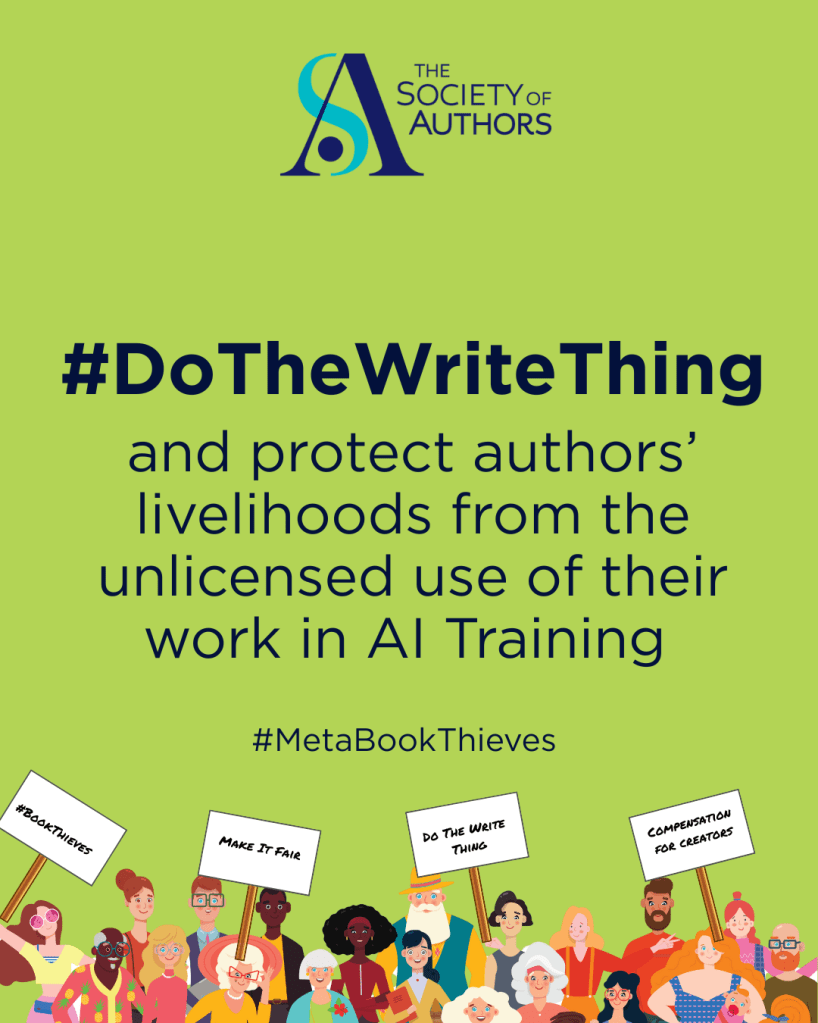
META (who owns Facebook) has used pirated versions of my books and those of pretty much every author I know to train its artificial intelligence software. We need the government to step in and ensure that META will #DoTheWriteThing
If you want to help, there’s a petition you can sign here…
MARK: What’s the thing that makes you think you’re ready to start writing on a project?
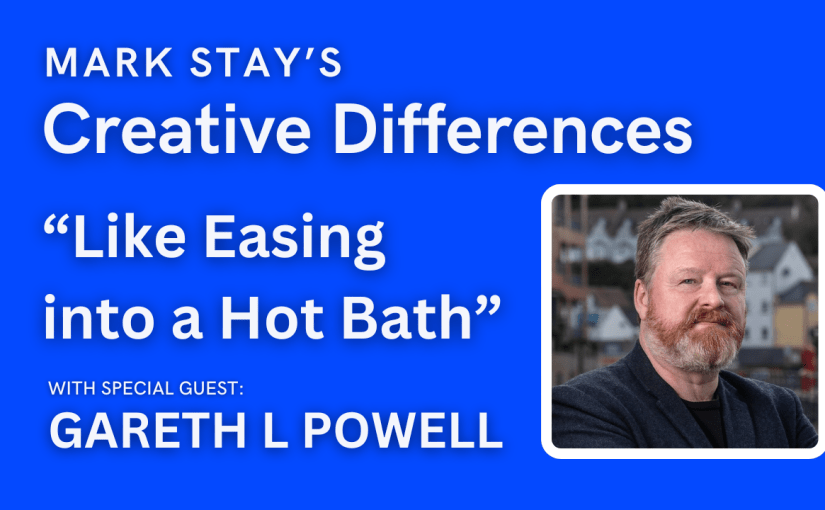
GARETH: As I was saying earlier, it is… sort of things gradually accrete, and sort of clump together and, it’s kind of… there isn’t a single kind of, oh, let’s go! But I kind of write my way into it. So I’ll start, you know, I’ll write the first line, I’ll write a paragraph and think hmm, okay. And then I’ll go back and I’ll rewrite the outline. The outline is usually about a page, just a very brief kind of high level overview of the plot. And I’ll rewrite that about ten times to fix it. And then I’ll start writing a first chapter, maybe that won’t be going anywhere, so I’ll start again. Or realise I picked the wrong character, and I just kind of write my way into the book so that by the time I’m about 5000 words in, starting to pick up steam, and I think: right. I know where we’re going now. So I might chop out the all the original stuff, but yeah, it’s kind of like easing yourself into a hot bath.
MARK: (Noting a listener comment): Elinor says this is the most British conversation ever. Tea and a hot bath. Yes. Brilliant.
This month’s special guest Nicola May has wise words for anyone worried about finishing their novel…
TRANSCRIPT
MARK: How do you know when you’re done?
NICOLA: Again, as a writer, do we ever know we’re done? It does annoy me, and I’m going to say this out loud: writers who procrastinate for bloody years over their manuscript, though. I do think get it down, get it to an editor, because what’s the point? Six years, going over this thing. What? It might not even be good enough. So that’s another bit of my advice. But, once I get to about 70,000 words — because my books are 75 to 80,000 words — I’m so happy to get to the end, thay I think, ‘Right, that should do. For now. The editor can look, then come back.’
MARK: And what do you do once you’ve finished that first draft? Do you sort of step away from it for a particular period of time, or are you straight back into editing mode?
NICOLA: Straight back into editing. To be honest, I’m a bit of a One-trick-Tina. My first draft is actually usually pretty good,
MARK: Right
NICOLA: Yeah.
MARK: Nice.
NICOLA: Don’t get me wrong. No, there’s been quite a few edits for ‘How Do I Tell You? — which I’ll hold up here. Here it is — That have made it much better by the editing team. So I’m not like, oh my God, there’s no edits at all. Of course there are.
MARK: Yeah.
NICOLA: It hasn’t had to be pulled apart.
MARK: So yeah. So a good sense of structure essentially is (important).
This month’s special guest Nicola May reveals a tip for naming your characters that will save you time in the long run…
TRANSCRIPT
MARK: So, let’s start with what small thing has made a big difference to your creative process?
NICOLA: I mean, again, I found this quite hard, but what I do do is… all my heroines have very short names; four letters or three letters. Ruby, Avy, Rosa. Victoria’s Vic. Because if you think how many times you type that in a manuscript, it saves you so much time. I mean, if you have something like Everard or, I don’t know, Christopher, you don’t want to be writing that… all those times. Although it’s good for word count.
MARK: I’m writing something at moment that has a character called Michael, and I’m four chapters in and already I’m thinking, I just want to call him Mike.
NICOLA: Yeah. You know, and I bet you you’ll have to go back because you will have so many wrong spellings of that as well.
MARK: Exactly. Yeah.
NICOLA: But it’s a little point, but it’s a good point. And also don’t choose a name that people can’t understand like Niamh, or things like that because there is nothing worse… As a reader, I hate it when I don’t know how to say the name.
MARK: You have to go to one of those those YouTube channels where they tell you how to pronounce it. Yeah, yeah,
NICOLA: Because I’ve got I’ve got a Joti in my book, would you say Joti or Jotti? And my audiobook narrator… I didn’t think actually to brief her on that.
MARK: I was going to mention this later. I went to the audiobook recording for The Corn Bride yesterday. And once I was in the room with them, they had a list. You know, it’s how you pronounce that? How are you pronouncing that? I. And I was like… (makes a non-commital noise). I don’t have strong opinions either way.
NICOLA: I never want to meet my narrator, because I’ve got one character who has an accent of someone who’s traveled many places abroad. So you don’t know where she’s from. And I put that on the brief. I’m like, oh my God, the poor woman.
I was thinking about Chappel Roan at the Grammies asking the record companies to pay their musicians a living wage and it got me thinking… if a publisher — one of the big five, say — started offering authors a monthly salary instead of an advance, would you take it?
A monthly salary, with a pension plan, health care (very important for our US cousins) paid holidays, maybe even expenses?
You could be on a fixed contract: 3 years or 5, but you have to deliver a book a year. Oh, and you have to write what the publisher wants (which, arguably, is happening more and more in traditional publishing), and you don’t retain copyright or get any royalties (which is kind of what happens in TV). Maybe you get a bonus for hitting sales targets? Would you do it?
Is anyone doing it already? I doubt it as the current system is very much weighed in the favour of the publishers… but if you’re an author, would you be tempted by a monthly salary with all the benefits and strings attached?
This month’s special guest Nicola May reveals the biggest mistakes (sorry… “learnings”!) of her writing career…
TRANSCRIPT
MARK: What’s the biggest mistake you’ve ever made in your writing career?
NICOLA: Now I like to call them learnings, Mark Stay, not mistakes.
MARK: Okay. Very good, very good. Yes, I like that. Yes. Good.
NICOLA: I’ve made many learnings. One of them, actually I went with W.H. Howes for the Corner Shop in Cockleberry Bay for my audiobook. There’s nothing wrong with W.H. Howes. I was jobbing at the time. I’d given up a big corporate job. I got offered 500 pounds advance. I was like, wow, I’ll take that. Thank you very much. Yeah, yeah, a big mistake because I now know how to create my own audiobooks. The other three, I’m making a very nice living, thank you very much. Because audiobooks really heightened in the last year. So again, I think the moral of this tale is if you’re just starting out and somebody does offer you something, don’t snap at the first thing because you know you’re good enough. But if somebody big like… or anyone offers you something, so take a step back and think, okay, maybe I should go and look at other avenues rather than jump at the first opportunity with anything, with an agent, with a publisher, because we all get so excited. But I think if someone thinks you’re good enough a lot of other people will. So that’s my little bit of advice on that one. My other mistake, and I shouldn’t really call it a learning, is not to go with one of the top five publishers and be traditionally published. It was something I always dreamt of. I thought, this will make me… I will be a world wide international superstar. I signed a three book deal for the Ferry books. Don’t get me wrong, I was… The advance was incredible, but the marketing wasn’t after, and I felt that I had… I was a million miles away from the people who I was dealing with at the publisher. And I think because I’m such a control freak, being an indie publisher, I didn’t like that lack of control. So it’s almost… I don’t think I actually marketed those books as well as I did in my other books, because I kind of lost a bit of heart, to be honest. So again… but it’s not for me… for somebody it would be the most amazing thing in the world to be with a trad pub, but it didn’t work for me.





 Mark Stay Writes