Twice a month, I run online sessions for writers called the Green Room. You can ask me questions about the craft of writing, your WIP, or the business of publishing. The sessions are fun and informal and chatty. You can send me questions in advance. They’re recorded live and saved on Kofi for exclusive access to Green Room supporters. Recent topics for the Q&A sessions include…
‘Show, don’t tell’
Writing for children
Dealing with feedback
Happy endings
Writing historical fiction around real events
And much, much more!
And once a month we have a 200 Word Workshop, where you can send me 200 words from your current project and I give it a critique.
I’m running this via Kofi, where you can join by clicking on the Green Room membership tier for £20 a month.
There’s no long term commitment. With Kofi, you can support for just a month, or for as long as you like.
My goal is to be able to give supporters advice that will make a real difference to their writing and career, because the way I see it: having worked in this industry as a salesperson, bookseller and author for over 30 years, I’ve made every mistake, so you don’t have to.
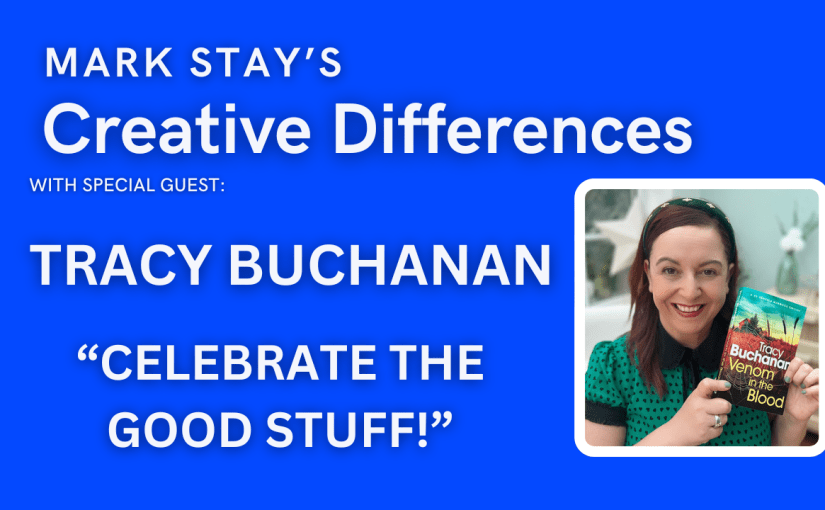
Tracy Buchanan is the bestselling author of the Dr Vanessa Marwood thrillers and she runs one of the best author groups on Facebook and is a brilliant advocate for authors.
We discuss: Which comes first: research or plot? If authors can still earn a living from writing Growing maggots for research purposes And much more!
Edit by Kai Newton Production assistance by Emily Stay Jingle by Dom Currie
My apologies for the quality of my mic for this episode. I had a dodgy connection and sound a wee bit toppy!
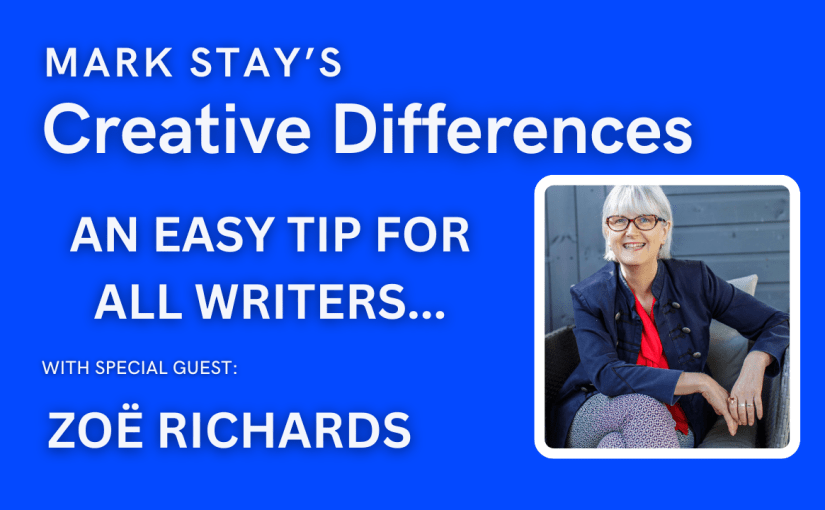
Mark: What small thing has made a big difference to your creative process?
Zoë: Just sitting down and writing? The only thing that ever stops me because I find I get more creative the more I write.
Mark: Yeah, yeah.
Zoë: It’s a bizarre thing, isn’t it? So if I sit there and don’t write, the writing doesn’t get done. And the creativity doesn’t happen either.
Mark: You can’t just sit down, not do anything, get up and walk away. It’s just embarrassing for all concerned, even if you’re completely on your own. So yeah, turn up sharp, tap some keys, see what comes out.
Zoë: I couldn’t think of anything to start today, and I actually wrote Need Something about Hunter and his gang days, and perhaps something about when his dad used to beat him up. And that’s all I’ve written into one of the chapters, but it immediately made me go, oh, in that chapter there, I need to do… And I just went off then and couldn’t stop writing.
Hello, folks. I’ve loved speaking to authors in the run-up to publication of The End of Dragons this summer, so I figured why not keep it going?
I’m going to be launching MARK STAY’S CREATIVE DIFFERENCES a monthly livestream where I talk to writer friends about those little things that make a big difference to their craft and careers in the hope that we can give readers some insight to the creative process, and writers and creative folk practical advice that they can actually use!
For the premiere episode, join me and my first special guest, author SC Gowland on Thursday 29th August 8pm BST live on Youtube (and Facebook, if it works) talking about the Law of Consequences anthology, on which he was a curator (and there’s a story by me): so we’ll cover fantasy fiction, short stories, self-publishing a book with 20 (count ‘em!) authors and, like I said, all sorts of useful, practical advice for creative folk, and readers who just want a peek behind the curtain to see how the sausage is made… (hold book up) Though that’s clearly a book and not a sausage. You get the idea…
Also, if you join us live you can ask questions and get in on the conversation.
Oh, and also, also… at the end of the episode, I’ll be revealing another exciting new thing which, if you’re a writer, I think you’ll be interested in…
For the latest updates on when and where all these monthly episodes go live, just come back to wherever you saw this. Until then, happy reading and writing and I hope to see you on Thursday 29th August, 8pm for the launch episode of Mark Stay’s Creative Differences!
Now I really fancy some sausages…
To join us on Thursday 29th August, click on the link below…
How much writing can you get done in a day before your brain starts to melt? I’ve picked up a few tips over the years that might help…
TRANSCRIPT:
Hello folks. We writers talk a lot about writing habits, writing every day or writing regularly. But let’s have a think about when to stop writing. Now, to be clear.
I don’t mean stopping altogether and jacking it in. I’m talking about how do you know when you’re done for the day? First drafts I could write all day and collapse in a heap. But I’ve discovered that my daily limit is about 2 hours. After that my poor little brain turns to soft fudge and it starts to leak out of my ears.
Either that or I’ve got an ear infection. Anyway, because my brain goes soft, the writing suffers. It’s just not as good as those first 2 hours. For edits, I find that it’s even more important to set myself limitations. Now I was really in the zone this morning, knocked out a little over a thousand words, which might not sound like much, but I’m editing and this was a whole new chunk that I was grafting on to the beginning of a chapter and it was my allotted task for that morning’s writing session.
I’ve left myself a note, you know, fix this by doing X, Y and Z… And I did it.
I was happy with it and I was so buoyed up that I just wanted to keep writing. But I stopped. Well, the truth is, I didn’t have much of a plan beyond my alotted task. I could have carried on, but I would have been blundering about with no idea what to do. And as I said, if this was a first draft I might have sat down and made some notes or maybe carried on writing blind. And that’s okay with the first draft, but when editing I like to stick to that plan. I’ve been through the book, I’ve made tons of notes, done my edit triage, figured out what needs fixing and I’m tackling those tasks one at a time. Have a look at some of my earlier videos on how I prepare for an edit in more detail. So for the next few days I’m focused on one particular character.
After that I’ll switch to the next problem on the list because when editing, the temptation is to try and fix everything at once and then you end up making a right old mess, and there’s a chance you can do more harm than good. So when editing, make a plan and stick to it. One fix at a time. The other thing I do at the end of a edit session is make a few notes for tomorrow’s session. So here… Just 50 words.
I’ve told myself I need to change the POV in the next chapter, and I’ve reminded myself of the changes I’ve made and what consequences they will have. Better to do that when it’s fresh rather than tomorrow morning where I might sit at my desk — and it’s 7:30 in the morning, don’t forget — and wonder just what the blimmin’ heck I’m supposed to do. On weeks like this, it’s also important to set limitations because I’m working on two projects simultaneously. Not ideal. But it happens.
One is the next Woodville books edit. The other is the second draft of a screenplay. They are sufficiently different for me to separate them in my mind, but also having alotted time and tasks really helps, as does having a bit of time between them. I’m lucky enough to work from home. So it’s those between times that I get bits of housework done, which also gets me off my bottom.
Very important for a writer. So that’s just what works for me. Have you discovered your writing session limits yet? Pop something in the comments below. Of course, you might be like Chet Cunningham.
I was reading about this legend the other day, from the publication of his first book in 1968 to his passing in 2017 at the age of 88, Chester Cunningham had something like 350 books published. Westerns, adventure novels, military thrillers. He also cowrote the “Penetrator” books under the pseudonym Lionel Derrick. This is what sent me down this rabbit hole. I saw the covers on the Pulp Librarian Twitter feed, and they are extraordinary. Chet comes from that pulp tradition where a writer was expected to knock out a thrilling adventure weeks, if not days.
I think at one point he was doing one Western per month. Why the hell not? And here’s the thing. Chet never stopped. Here’s a quote from the FAQs on his website when asked about Writer’s Block, he says, “I came from a newspaper background. When the editor assigns you a story, you write it now. No ifs, buts, or I-don’t-feel-like-writing-today. I usually write from eight to 10 hours a day when I’m a roll on a book. Researching is another thing.”
And then he was asked about Writer’s Block. Do you ever get Writer’s block? He said, “I never use the term. I don’t believe it exists. Ever heard of a Carpenter not going to work because he has Carpenters Block?
If a writer can’t write it’s because he doesn’t really want to, he isn’t ready to get it on paper. Or he’s just plain lazy. There’s no such thing as writer’s block only writer-dumb-dumb-dumb.” Well, Chet, we may disagree on that, but I salute you. Me.
I’m going to have a cup of tea. Until the next time, folks. Happy writing.
Want to make your prose more punchy? Try cutting a few of those filler and filter words. Note: these aren’t hard and fast rules. Of course you can use adjectives and adverbs whenever you like. But if you’re editing, it’s not a bad idea to trim as many as possible.
TRANSCRIPT:
Hello folks. Want to make your prose a little more punchy? When editing, look for those adjectives and adverbs that can really make your writing drag. All those filler and filter words. Find them and get rid of them. For example… Deep breath… “Thought”, “touched”, “saw”, “he saw”, “they saw”, “just”, “heard”, “he heard”, “they heard”, “she heard”… “Decided”, “knew”, “noticed”, “realised”, “watched”, “wondered”, “seemed”, “seems”. That’s one of mine. “Looked”. That’s another one of mine.
“He looked”, “she looked”. “Could”, “to be able to”, yeesh. “Noted”. “Rather”, “quite”, “somewhat”, “somehow”. Although I think these are OK in dialogue, if used sparingly. “Feel”. “Felt”. Now this… this one always starts alarm bells ringing. Don’t just tell the reader that Bob is feeling angry. Try and describe his rage in a way that is unique to Bob. Which is easier said than done, of course. But no one said this would be easy. “And then” — paired together. Cut one or the other. “Had”. If you have two hads in the sentence, one of them has to go. Hads: two hads together… “had had”, which does happen. See if there’s a better way of writing around that. You might have to completely rethink the sentence. “He looks”, “she looks”. “He turned to her and said”, “she turned”, “they turned”… All this turning can make the reader feel dizzy and you can have whole conversations with people turning around and it goes absolutely nowhere. “Supposed”. “Appeared to be”.
“Apparently”. All of these can be weak and they can make your characters feel passive. If you’re writing the first person, these filter words can be doubly harmful. So… “I turned and looked up and saw the elephant raise its foot to squish me” is, well, it’s fine. “The elephant raised its foot to squish me” is a lot more direct. Keep those physical movements to a minimum. All that turning, twisting, looking… Give the reader just enough to animate the action in their own head. You’re not choreographing a musical.
So when you’re editing, look out for these filter words. Do a “find and replace”. Most of the time you’re better off simply cutting them. Other times you might see an opportunity to replace them with something a little more dynamic. What I mean by that? Okay. Add a bit of movement or action or texture. Instead of the “look to”, “turn to”… have them raise their chin, look down their nose, scratch their ear, run their hands through their hair, drum their fingers nervously.
Action that underlines what the character is trying to say or might be thinking. I find it useful sometimes to act the scene out. We’re all writers, spending far too long sitting on our backsides, so a little exercise won’t do us any harm. Get up, move about, film it, film yourself. No one ever needs to see it but you. But seriously, most of the time just cut the buggers. You’re better off without them. Of course there are exceptions. Sometimes we need these words to add clarity to a sentence, but too often I find myself relying on them when I should be trying to be a bit more zippy with my prose.
But hey, that’s editing is all about. Hope you found that useful. Until next time. Happy writing.




 Mark Stay Writes