Gavin Smith is the author and co/author of 14 books, a couple of novellas and multiple short stories. His books include (but are not limited to) Veteran and its sequel War in Heaven, the Age of Scorpio Trilogy, the Bastard Legion Series and Spec Ops Z. As well as having written for Black Library, Gavin wrote the novelisation of the Sony Pictures Bloodshot movie and Marvel’s Original Sin series.
Within the games industry he has worked with Yoozoo, Ubisoft, DPS Games and CCP. In addition, he has optioned several film scripts.
And his new book ALIEN CULT is murder mystery noir set in the ALIENS universe and I can’t wait to discuss it with him!
Sorry folks, but the next livestream is now on Monday 3rd November, 8pm GMT. My apologies for any inconvenience!
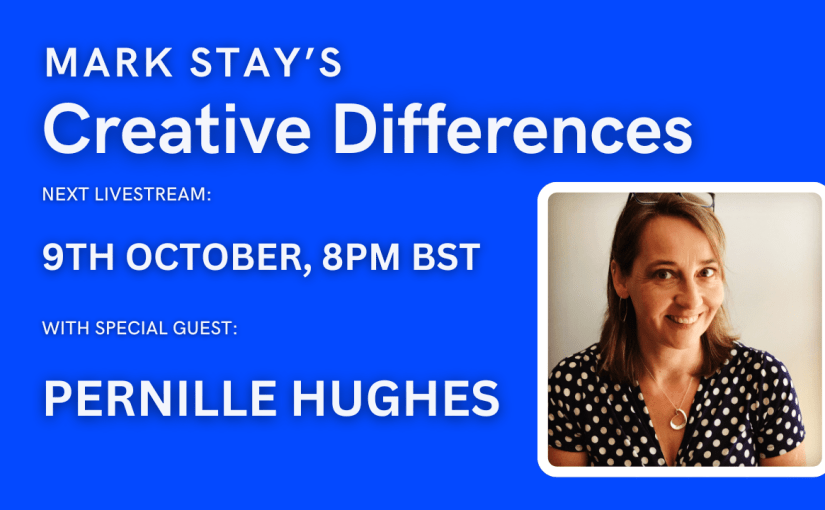
Pernille Hughes is the author of TEN YEARS, PROBABLY THE BEST KISS IN THE WORLD and PUNCH-DRUNK LOVE; novels brimming with warmth, wit and unforgettable characters. And now she’s back with her new novel A COPENHAGEN SNOWMANCE, which is here to herald in Christmas. Yes, I said the C-word! What of it?? Join the conversation LIVE on Monday 3rd November at 8PM GMT for what promises to be another cracking episode of the podcast that dares to shop early for Christmas.
Pernille Hughes is the author of TEN YEARS, PROBABLY THE BEST KISS IN THE WORLD and PUNCH-DRUNK LOVE; novels brimming with warmth, wit and unforgettable characters. And now she’s back with her new novel A COPENHAGEN SNOWMANCE, which is here to herald in Christmas. Yes, I said the C-word! What of it?? Join the conversation LIVE on Thursday 9th October at 8PM BST for what promises to be another cracking episode of the podcast that dares to shop early for Christmas.
GD Wright is the author of the bestselling AFTER THE STORM and INTO THE FIRE, and he’s genuinely one of the nicest guys in the business with an extraordinary tale to tell: he was a copper, then due to health issues had to retire aged 30, and if you know Gary at all you’ll know that he’s had a few challenges this year… but he’s come through and was an amazing guest on the livestream. He talks frankly his strange route to publication, creating a writing habit, how his work was optioned when he was self-published and much, much more…
MARK: What small thing has made a big difference to your creative process?
NICOLA: I think planning the middle, really. Because I used to plan the end and then, you know, your characters do their decisions, and then it would be like, hey, guess what? This 90,000 word novel is 130,000 words. And now I’m like; if I know the middle, it is much easier to stay on track. I think that’s probably the biggest change for me. I think in terms of, yeah, stopping me from going absolutely bananas. But also like a piece of information like… we talk about the German market: I was in a, a workshop with Imogen Cooper, and she said that if you translate a book into German, it adds almost a third onto the length of the book. When you consider translation costs, and paper costs, and ink costs and all the rest of it, it was like, whoa. Because up to that point I was like, it’s not that big a deal to cut some words, but actually, you realise in terms of making it appealing… So those two things together really focus me on not overwriting, not just enjoying myself forever and meandering off down wherever, and just keep me focused.
MARK: So yeah, yeah, I see that’s a very good point. The German editions of my books are quite chunky, but I just thought it was because they were a slightly smaller format. But that makes complete sense now. And when you when you talk about planning the middle… because for many people this is one of the most difficult parts, because the opening is all fun and games, the middle act is where you need to escalate and things have lots of consequences and sooner or later you have to tie these things up. How are you planning that middle?
NICOLA: So it’s that big shift. What’s the big change that is going to happen? That gear change. So when I’ve decided like what’s the big turning point, where everything sort of goes up a gear, once I know what that is, then it keeps me on track. And it means that my characters are never… You know, it’s like keeping the target in sight so they can’t veer off too much. You know, if you do what the characters want you to do, you will end up so far away from where you need to be. And editing for word count is probably one of the most painful versions of editing. When you’re trying to shave off 40,000 words and you’re going, ‘I can’t possibly!’ but you have to. Learning the hard way is also a very big motivator.
I had a wonderful time chatting to Nicola Whyte the debut writer of 10 Marchfield Square about how she was inspired by the nooks of London and Douglas Adams’s whodunnits. We also discuss planning the middle of a novel, “soft boiled crime”, designing author websites, and we get nostalgic about the Ottakars book chain and much, much more!
I chat with Sarah Pinborough, the bestselling and award-winning author of Behind Her Eyes about her new thriller We Live Here Now, spooky houses, her method of ‘triple writing’, going on tour and the lies we tell each other…
Join me with bestselling author Sarah Pinborough on the livestream that looks at the little things that make a big difference to the creative process.
Sarah Pinborough is an award-winning and New York Times, Sunday Times, and internationally bestselling author and screenwriter who is published in over 30 territories worldwide. Having published more than 25 novels across various genres, her recent books include Behind Her Eyes, now a smash-hit Netflix limited series; 13 Minutes that’s she’s developing with Carnival/NBC, The Death House that she’s adapted herself for Compelling Pictures, and her most recent book Insomnia which she adapted herself and is now streaming on Paramount+ And she’s hilarious, wise and has a lovely dog called Ted. Do please join us live as you’ll have the opportunity to ask Sarah questions on the night (and just before her big America tour!).
It’s going to be so much fun. Put that date in your diaries now…
MARK: What’s the best happy accident of your writing career?
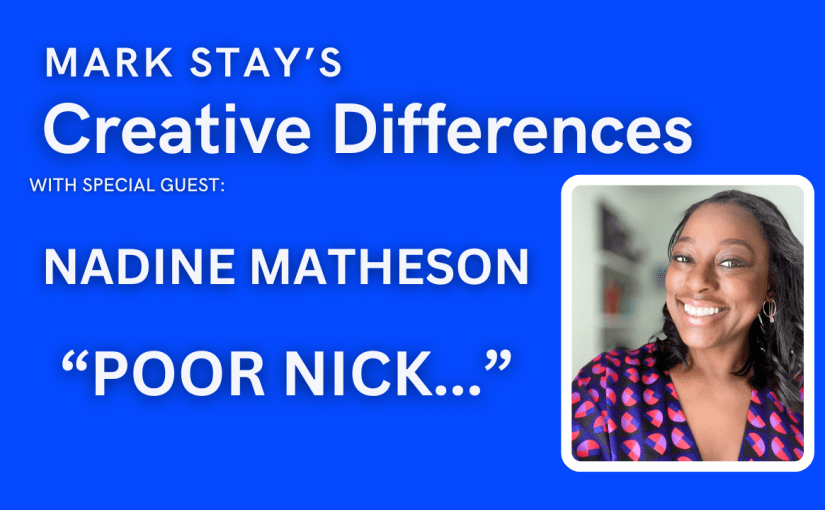
NADINE: I’d say that not reading the small print when I entered the city university competition, because, honestly, if I’d read the small print, then I would have read that: if you win the competition, you win a £2,000 bursary. And I know definitely back then, if I’d read that it was a bursary of the Creative Writing Masters, then I wouldn’t have entered because I’m thinking, I’m already working full time, you know, being a lawyer. But I was also teaching in the law school and I would do that in the evenings. So, I don’t want to spend any more time in a classroom. I give up my evenings as it is, you know, teaching in a classroom. Why would I want to go back? Why would I want to go back to school to learn how to write? So if I’d read the small print, I would not have entered. But because I did not read the small print, I entered and won the competition, did the Creative Writing MA, I and I wrote the Jigsaw Man, so… Is that a happy accident?
MARK: Absolutely, yes. It is. Absolutely. Fantastic. Yeah. Who reads the small print? Honestly, we all sign up to META and it says in there, you know, 17 pages down, we can steal everything you put up here. So yeah, anyway, enough of that.
MARK: What’s the thing that makes you think that you’re ready to start writing on a project?
NADINE: Because I’m a planner; once I’ve done the plan. If I haven’t done a plan and I’m like, well, yeah, it’s like… if there’s no outline, then I wouldn’t be comfortable writing. Because I know what would happen. I would just get to 20,000 words and then that would be it. I’ll just be… I don’t know what I’m doing with the story. But, and I say, it doesn’t need to be a, you know, a beat by beat by beat outline of the whole story. But it’s a general one. And once I’ve got that in place: okay, now I’m ready to start writing,
MARK: It kind of occurs to me, that’s the point in the story where you need to start making serious choices, story choices that have consequences. You know, the first 20,000 words you’re introducing people, you’re having fun, setting everything up. And then it’s like: we can start making serious decisions now. So it’s kind of scary, isn’t it? You don’t know where you’re going.
NADINE: I think that’s exactly it. I’ve mentioned this for my own podcast recently, I was writing this book, and I had a character called Nick. I didn’t have a plan for it. And, you know, the beginning’s, you know, all the set ups, that’s all the fun stuff. But then I got Nick into… Nick got released from prison, and then he went home. Now he’s sitting in his dad’s house, sitting in his dad’s kitchen. And to this day, he’s still there cause I’m like… I don’t know what to do with you now. I don’t know what. I don’t know what to do. So to this day, Nick is still sitting in his dad’s kitchen.




 Mark Stay Writes