Jon Wright and I are just starting out on a new writing project, TOP SECRET PROJECT X. I know, catchy! This is immediately coming off the back of over a year’s solid work writing a script that we hope to get into production this year, and we wanted to have something ready to follow it up with (always helps to think ahead). So we’ve gone from hurtling at a hundred miles an hour, steering skilfully round familiar bends, to suddenly pushing a clapped-out old Vauxhall Viva uphill to the nearest garage.
Starting a new thing can be very daunting indeed.
It’s taken us about six months to get around to the actual writing bit. Time is great aid to fomenting ideas, and it’s a luxury a screenwriter doesn’t often get, but I would recommend using it whenever you can. Take any intriguing idea you have, jot it down, nurture it with seedling ideas and before you know it, new ideas will be presenting themselves to you at three in the morning, demanding that they be implemented immediately. Here’s one I made earlier…
Late night scribbles can produce surprising results…
This one started with lots of talking — initially with a conversation outside a pub — then continued with more chatting in places where tea is served, and then long phone conversations about situations and characters, and then we progressed to tentative emails. With each of these gently flirtatious stages we’ve been collating nuggets about characters and situations and themes, and now we’re at the stage where we’re putting together the actual building blocks of a story.
The nitty-gritty starts with character work. On our previous project we were adapting someone else’s script and didn’t feel that we had a good enough grip on the characters, so we wrote monologues for each of them, bouncing drafts back and forth between the two us, adding more interesting details and texture until we really knew who these people were. That was when we finally felt that we had taken ownership of them and the script, and our writing after that became a lot more instinctive: the sports car swerving round tight bends.
So, this is where we’ve decided to start with TOP SECRET PROJECT X: character monologues, like pieces to camera, confessional and candid and revealing, and it’s a great way to get a story that’s driven by characters and not set pieces. There are lots of blind alleys, things we’ll get wrong, but it’s worth it for the things that shine and excite and inspire. We’re off to a great start, but there’s still a very long way to go, that clapped-out Vauxhall Viva is still very heavy and the mountain is very steep. In the meantime, here’s a bit of Paul Weller to chivvy us along…
The painting above is The Wanderer Above the Sea of Fog, (Der Wanderer über dem Nebelmeer um) 1818 ~ by Caspar David Friedrich, and is how all writers should visualise themselves when embarking on a new project, and not hunched over a laptop wondering if they can have another chocolate Hobnob yet.
On our week of release, I was over the moon to be told that ROBOT OVERLORDS, the film I co-wrote with director Jon Wright, leapt to #3 in the UK Blu Ray chart, and #7 in the DVD chart. This news came just over 5 years after getting an email from Jon asking me if I’d be interested in working on the project. So now seems as good a time as any reflect to reflect on the things I’ve learned from writing my first movie…
COLLABORATION IS EVERYTHING
I expected a good level of collaboration with Jon and the actors, which was fantastic, but some of the most surprising and rewarding stuff was getting emails from the production design team asking for names for castles, banks, names of towns on maps, the date of birth for our hero for a sheet of paper, all of which are barely seen on screen. This was great fun as you’re made to delve a little deeper into the world you’ve helped create, prompted by a team of people whose sole purpose is to make it look as believable as possible, and who think of all those details that add texture and depth to the environment.
GET ON SET
To be honest, most days on set a writer feels like a fifth wheel: that paper script of yours no longer exists and the cast and crew are too busy trying to make it into a movie to accommodate you. But you’re on a movie set! For a film nerd like me this was heaven, especially on the day we shot at Pinewood, where I strolled around like I owned the place.
I was on set about eight days out of an eight week shoot (they didn’t have the budget to have the writer hanging around, plus I had a novelisation to write!). Jon and I had discussed protocol for dealing with any script changes on set/location, and agreed that he would take care of the day-to-day minor tweaks, but that we would collaborate on anything major. In the end, there was only one occasion where we had to make a major change and I happened to be on set that day. I was despatched to a trailer (I had my own trailer! For a bit…) where I worked on the revisions. I felt very important for at least forty-five minutes.
And the catering. Don’t forget to make the most of craft services. I put on quite a bit of weight.
PEOPLE THINK YOU’LL BE FAMOUS
“You’re going to be famous,” friends and relatives would say. I’d then ask them to name three screenwriters (that weren’t also directors) and most of them were stumped.
Screenwriters just don’t have the same profile as authors. Film is a director’s medium. And authors can’t be fired from their own book, whereas screenwriters get fired all the time, even from projects they originated! This time I managed to stay the course.
DIRECTORS AND PRODUCERS ARE THE HARDEST WORKING PEOPLE IN SHOWBIZ
There’s an alternate universe where our producer Piers Tempest didn’t option the film and Jon and I are musing “That Robot Overlords idea could be a goer, y’know.” Without Piers’ tireless work this film would never have been made. And Jon spent pretty much every waking hour either writing, sketching, pitching, listening, re-writing, answering roughly twenty thousand questions a day before, during and after the shoot. Over a period of about four years. That’s hardcore stuff and I don’t think he put a foot wrong.
ACTORS ARE AWESOME
I had a week of rehearsal with Callan, Ella, James and Milo, working to tailor the dialogue to their strengths. It was an absolute joy to see them take ownership of their characters, and the backstory stuff we worked on formed the basis of the first part of the novelisation.
And then the likes of Gillian Anderson, Geraldine James, Roy Hudd, Tamer Hassan and Sir Ben Kingsley start saying words that you wrote. That’s a series of pinch-yourself moments right there.
I have so many favourite lines in the film, but the one that makes me giggle every time is just one word. “Fecund.” And Kingsley delivers it with exactly the kind of filthy relish we were hoping for.
VFX IS ALL ABOUT TIME
You can do it well, cheap or fast, but not all three. Visual effects is a much-misunderstood industry, not least by me at the beginning of this project. The team at Nvizible pulled off nothing short of miracle bringing our metallic invaders to life on a budget that would barely pay for the Incredible Hulk’s pants on certain other movies. And they did it with meticulous attention to detail in a craft that’s a curious mix of hard science, pure art, teamwork, and all done with a rigorous pride in finessing stuff that might only register subconsciously with the viewer, but makes all the difference. They also have a terrific understanding of story and character. So much so, that I’ve even written a script with one of them.
PREVIEW SCREENINGS ARE BOTH TERRIFYING AND EUPHORIC AND ABSOLUTELY NO INDICATION OF THE FILM’S SUCCESS
We ran the gamut from children running screaming from the room (from one scene in particular, which became known as “the torture scene” by the producers) to others declaring it to be the best film they had ever witnessed.
We had the most amazing preview screening at the BFI Southbank: over 300 kids whooping and cheering and bursting into applause at the end, but we still didn’t manage to get the kind of nationwide distribution we wanted. Why? Myriad reasons, but it largely comes down to money. Marketing to 8-14 year olds is very, very expensive business (probably in the region of two million quid) and there wasn’t a major distributor in the UK willing to take the risk on an original idea. A shame, but that’s the reality of the British Film Industry at the moment.
REVIEWS ARE HILARIOUS (AND NEVER READ THE COMMENTS)
I read all the reviews and you’re soon able to discern if it’s going to be a good or a bad one in the first paragraph. There’s nothing more wonderful than when a reviewer latches on to what you were aiming for and sings your praises, there’s nothing more sobering than a critical review that nails a problem that should have ironed out before production, or might not even be the production’s fault at all, simply a compromise made due to limitations of time and money. And there’s nothing more hilarious than the cretinous remarks by the Simpsons Comic Book Guys who troll the comments pages of Youtube and IMDb and have yet to learn that not all films are made for males aged between 20-35.
The hardest bit has been keeping my mum away from the bad reviews, because she will hunt down and kill the reviewers.
FILM PIRACY IS RAMPANT AND MOST PEOPLE THINK THERE’S NOTHING WRONG WITH DOING IT
Somewhere along the line, someone managed to pirate a rather poor quality publicity screener of the film, and it was suddenly all over the torrent sites. We should have been flattered that it topped the torrent charts for some time, but the crummy quality of the pirated copy simply does no justice to the film.
What was remarkable though, were the number of people who would talk online about downloading/streaming the film from torrent sites and then tag our Twitter and Facebook accounts in their conversation! When you politely pointed out that what they were doing was illegal they became very apologetic and promised never to do it again, but there’s clearly a vast swathe of the population who enjoy their movies highly compressed with tons of digital noise and diabolical sound quality. Each to their own.
PEOPLE THINK YOU’RE RICH
I’m not. I still have a day job to pay the bills. And based on what I was paid for this gig, I will need the day job for some time. Screenwriting is not a get rich quick scheme. It might not even be a get rich slow scheme. Ask me again in thirty years.
WRITE THE NOVELISATION IF YOU CAN!
When Piers first suggested a novelisation of the film I raised my hand like the swottiest kid in class, “I’ll do it, let me, let me! And I know just the people who can publish it!” It’s been a privilege working with the Gollancz team to write a book that I hope stands alongside the great movie tie-ins I read when I was a kid. And you never know, if enough people like it I might get to write another one.
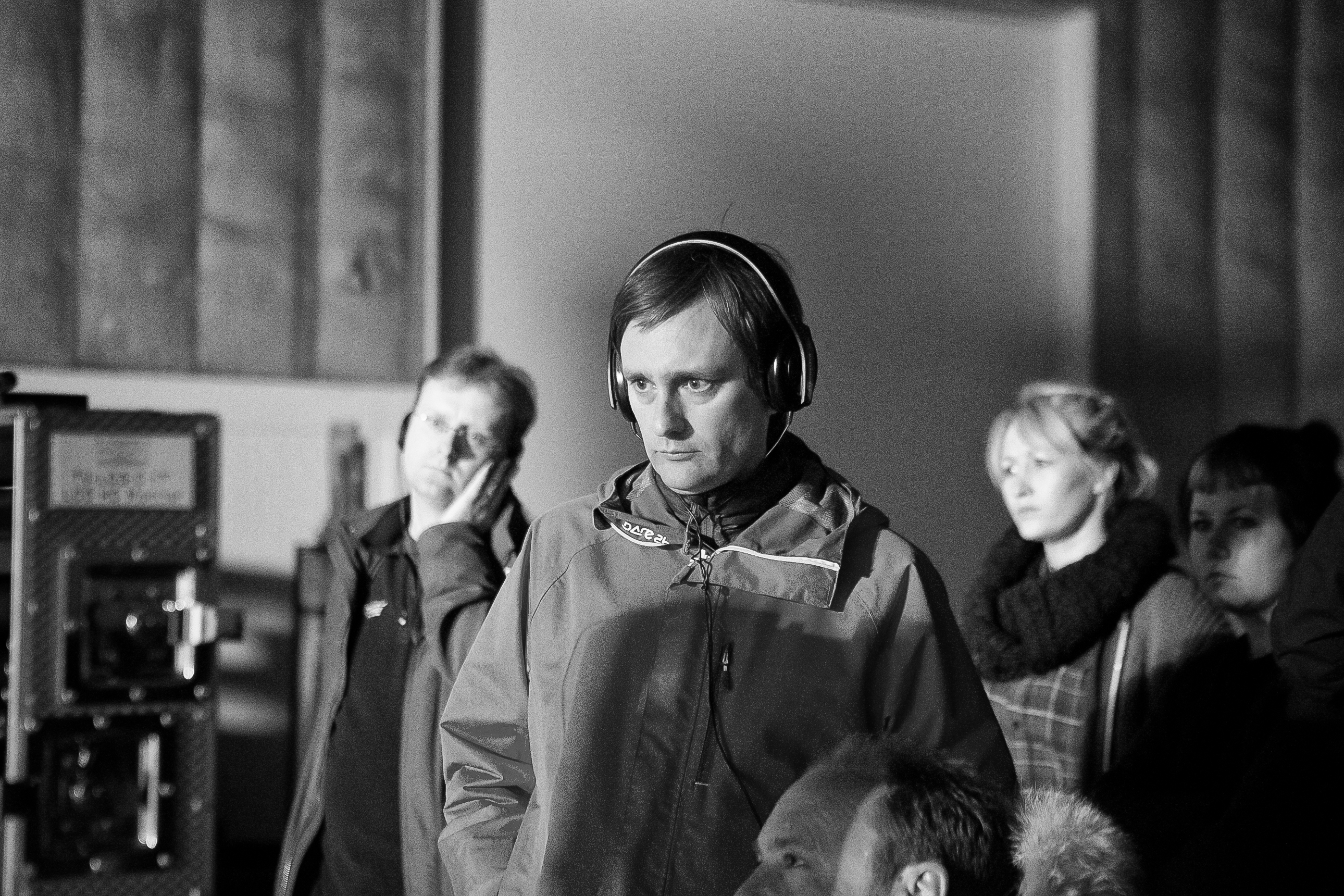
Oh, and always wear headphones, and always, always lurk near the director… Photo by http://www.mpsv.co.uk
I found myself with a free afternoon yesterday, not something that happens often these days as any spare time I have tends to be dedicated to writing, but I’m in a lull on one project and stuck on another, and so I found myself plugging my guitar into a pedal board and amp, and I started thrashing out a few chords.
Inspired by its inclusion on the GUARDIANS OF THE GALAXY soundtrack, I thought I’d have a go at learning David Bowie’s splendid MOONAGE DAYDREAM and was surprised by how simple it was: lots of nice major/minor chords, a very easy riff and a straightforward melody.
And it got me thinking about a half-baked music analogy I have about creativity. When rock bands start out they begin with the simple stuff: twelve-bar blues, major chords dropping to minors, and a cool hook. Stuff that’s basic, but highly effective, hitting people right in the feels…
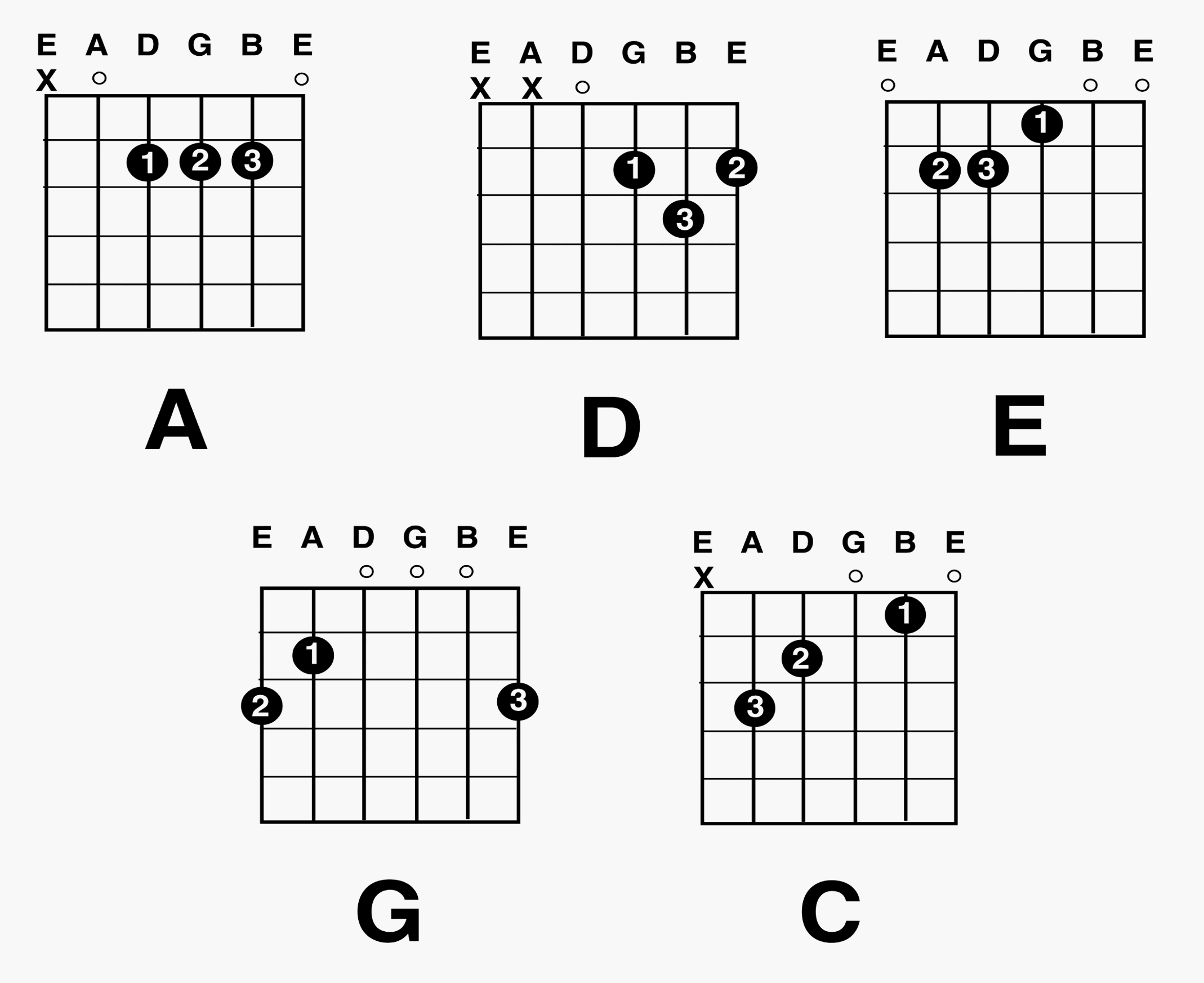
Major chords. Easy peasy, lemon squeezy and making people feel totes emosh since the dawn of time.
But as an artist progresses in their career, they understandably want to try something more complex and challenging, and, if you’re a guitarist, this means that sooner or later your favourite band will start using complex jazz chords…
Jazz chords. Evil bastards. Not to be trusted.
Don’t get me wrong; I enjoy jazz, but in quite small doses. It just doesn’t engage me emotionally in the way that a big, stupid rock song does. Just as I prefer Bowie’s early stuff, I suspect that it’s songs like STARMAN and LIFE ON MARS that are paying the mortgage at chez Bowie, rather than anything he’s recorded in the last twenty years. It’s also why the musically straightforward 1970s-era Pink Floyd continue to sell more than the jazz odyssey stylings of their early Syd Barrett stuff or, say, Captain Beefheart…
Of course, this theory is full of holes: if anything, the Beatles’ songs became more straightforward as they progressed, Kate Bush’s stuff was always complex musically (though her early albums are arguably more tuneful), and it probably doesn’t apply to classical or opera, though Beethoven’s Fifth (Duh-Duh-Duh-Duuum!) is as rock n roll as classical gets.
But you get the idea: the simple stuff works. It will always have a greater reach, audience-wise, than the introverted, “clever” stuff.
And here comes the big, clanging, G-major analogy that I’ll be trying to apply to my writing: I won’t be putting too many jazz chords into my stories. I might think I’m being clever by killing the hero on page 35, or starting in the middle of my story and working backwards via flashforwards, but some poor producer has to pitch that idea to raise money, and nine out of ten of them will always go for the simple sell.
That’s not to dismiss “simple” as “easy”: keeping a story truthful, engaging and emotional is hard enough as it is. So why make life more difficult for yourself?
And so my creative aim in life is to hit the same simple and moving peak as Bowie who has Mick Ronson open a song with a big, fat D-major chord as he cries, “I’m an alligator!” There’s no greater achievement in art…
I’ve had a pretty incredible 2013. I also have a row of bruises on my arms where I’ve been constantly pinching myself, for 2013 was the year of things-that-do-not-happen…
The way it usually works is you get your first job on a low-budget horror, or maybe on one of the BBC TV shows like Doctors, and you struggle for years before getting a break. Or, if it is a ambitious movie, you – the inexperienced writer – are eventually fired by nervous producers and replaced by someone with a better CV.
None of these happened. Well, I’ve certainly done the struggling bit. I’ve been writing for years and failing quietly. But with each dead end, every trip to development hell, and with every new draft, my writing improved and I made new friends in the film community. I have that low-budget horror movie on my CV, it just never got made (yet).
Then, once the film went into production, my day job employers at Orion Publishing were gracious enough to allow me to take a six month leave of absence to concentrate on working on the film. Again, that never happens! Employers might understandably be wary of extracurricular activities, some might even back you into a corner and ask you choose between the security of a regular paycheque, or the risky world of a the freelance writer. Not these guys. They were incredibly supportive, and have kept the door open for my return. I could not have asked for more.
Pictured on set: one jammy bastard…
Those six months allowed me to be on set during production, to be readily available for rewrites, to work solidly on [redacted], and that script about [redacted], and to really get my teeth into [redacted]. All top-secret eggs, laid in 2013 and hopefully all hatching in 2014.
I also got to live the freelance writer life for six months. Writing in solid chunks 9-to-5, instead of sporadically on the train/lunch breaks/nights/weekends. I did not waste a second, and this has been the most productive year of my writing life.
So, tomorrow, I return to the day job. Some friends have asked if I’m dreading it. Not at all. It’s a pretty cool job, it’s not working in a salt mine or anything, and I work with some fantastic people that I’ve missed very much. I will go to work tomorrow with a skip in my step.
But I’ve had a taste of another life these past six months, and I liked it. It’s a world where the work and money is precarious, and there’s no more failing quietly once the general public get their teeth into what you’ve written, but it’s the thing I love to do most, and in 2014 I’ll be working harder than ever to make it a reality again.
Thanks to everyone for their good wishes and support and I hope you have a fantastic 2014.
It was the 90s, and poster budgets were smaller then…
“Mum! Mum! You have to see this!”
Have you ever watched a film that was so uncannily like your own life that you were convinced that the film-makers were monitoring and recording your every move? For me, LIFE IS SWEET was that movie.
I’m not talking about the events in the story, but all the way through there were little character moments that chimed so precisely with the world I lived in (still living at home with mum, dad and sister, in a house too small for us all) that once I finished watching it, I rewound the tape, dragged my mum and sister into the room and made them watch it too.
They did so, with wide eyes and open mouths. One scene in particular had them screaming with recognition…
We were used to seeing a sort-of hyped-up reflection of reality in soaps on TV, but they were always done in such a rush, with such a sense of melodrama, that it was hard to take them seriously. But Life Is Sweet is a Mike Leigh movie. The actors spend weeks, if not months, working on their characters, rehearsing and refining them through improvisation. It’s a fairly unique method of film making, but gives the dialogue a naturalistic rhythm that would look impenetrable on the page.
To say that this film was a major influence on my early writing, especially my first play, would be a massive understatement. It gave me licence to write characters that sounded like people I knew.
Leigh gets a lot of flack for being patronising to his audience, characters and even the working classes*, but in Life Is Sweet, and the better-known SECRETS AND LIES, I saw truthful representations of ordinary people I recognised, and the trials they faced. Not epic struggles against monsters or aliens, but just people coming to terms with life in an ordinary suburban world. I’m learning that story is all about characters discovering who they are, reconciling the conflicting parts of their own selves. If you can pull that off, whatever the setting, you’ll have the ingredients of a great drama. And Leigh’s films have this in spades.
*Though I only ever see this criticism from middle class journalists, so…
So, yesterday someone asked me for screenwriting advice. Never mind that I have no movie credits to my name (yet), but the news that I’ve co-written a script that’s going into production was enough to send a 22 year-old I’d never met before, pelting down three floors of our office building to seek out my sage wisdom.
“Have your inciting incident in the first ten pages, you must.”
I was flattered to say of the least, and my ego puffed-up to full as I prepared to dispense pearls of wisdom to this young neophyte. But, as I opened my mouth, I realised that I was one microsecond away from becoming a pompous Robert McKee type, and managed to stop myself.
The truth is I don’t have a bloody clue. I managed to piece together a chronology of how I managed to get where I am today, but anyone can do that, and everyone’s story will be different, so what use that is, I have no idea.
The only vaguely useful advice I could give was, “Er… Write, keep writing, and eventually you get better at it, and one day people start to take notice of it, and maybe you’ll get some work.”
I also urged her to meet and befriend other writers. Not only are they fun, if slightly mentally unhinged, but we all have the same doubts and fears and share them on Twitter when we know full well we should be working to a deadline.
Then I started reeling off lists of podcasts I listen to (and I’ve shared them below), because this has been a big part of my education in writing in the last few years, and these guys all know a lot more than I. And that was it, really. I was all out of advice.
I’m collaborating on a new script with a new writer. It’s his first, my umpteenth. And the thing I must not do is start telling him how to write. I have more experience, yes, but to tell him how to write is tantamount to telling him how to think, and that’s how cults and religions and very bad things start. Why do you think they call them script gurus?
MY FAVOURITE PODCASTS:
You can get all of these on iTunes for free, but it’s worth having a look at their related blogs, and do follow them on Twitter too.
What sets these guys apart from the Syd Fields and Robert McKees of this world, is they’re actually working as writers in the film industry, so they can talk with authority about how the industry works. This one covers everything from writing techniques, to agents, managers, lawyers, the WGA, writing software, and even fonts (John August also develops apps). It’s been running for a couple of years now, and it’s worth dipping into the backlist, though you can jump in at any time. This is a very American podcast, but if you’re thinking of working in the States, this is very useful.
Scriptwriting in the UK with Danny Stack and Tim Clague:
Danny has one of the best UK scriptwriting blogs out there, and, in this monthly podcast, he and Tim Clague talk about writing in the UK.
Danny is clearly smart, professional and knows his stuff. Tim now seems to mostly write for games, and never fails to mention that he once won a Bafta for a short film he made years ago (and, to be fair, neither will I when the day comes). Not as zippy or slick as the US podcasts, but invaluable for insights into the UK film and TV industry.
Jeff gets an amazing roster of writers talking at great length about how they started, their careers and their latest film. This is American too, but he gets loads of British writers on the show. These are often recorded after a screening, and the audience get to ask questions.
He previously presented the Creative Screenwriting podcast, which no longer seems to be on iTunes, but I’m sure you can find it if you go digging online. They were terrific, essentially the same format, but presented in association with the magazine Creative Screenwriting.
Not a podcast about writing, but these guys love popcorn movies. They watch them on Netflix (which can skew what kinds of movies are available) then get together over Skype to dissect them. They’re really good at pointing out tropes and plot holes, which is invaluable for a writer. I’ve lost interest recently, as they don’t seem to be covering movies I particularly like, but the earlier episodes on films like Superman and Wrath of Khan are outstanding.
Probably the best film show on radio. It goes through phases of being overly self-referential, but Kermode really knows his stuff (even if he never shuts up about bloody 3D), and Mayo keeps him in line. Hello to Jason Isaacs.
I bloody love Empire, and this podcast is huge fun. Their reviews tend to be more forgiving than, say, Kermode’s, and the interviews are always good. The hour long specials are wonderful. The Terence Stamp one is a gem. And Helen O’Hara should have her own show.
*Okay, so I’m not exactly Jabba the Hutt, but I have a bit of a tum, and boy, do I love to eat.
First of all, apologies for two Bond posts in a row (but it’s all Bond fever round these parts, y’know), and secondly if you haven’t seen Skyfall, then read no further. This one’s riddled with spoilers…
All good? Let’s go…
Skyfall is getting the kind of notices that genre movies dream of; fans and critics alike seem to be united on praising this as one of the best Bonds ever. And it deserves it, with some great action, a fun villain and a light smattering of Komodo dragons.
But what really sets this Bond apart is that Sam Mendes and the writers have taken advantage of a fairly unique situation that gives them the chance to tell a story with real emotional heft, the likes of which Bond fans haven’t seen since On Her Majesty’s Secret Service.
Just checking one more time – spoilers ahoy – anyone here who hasn’t seen the film should leave now. We’ll be here waiting for you when you get back…
Okay, as we all know, Judi Dench’s M dies at the end of the film. I guess she announced to the producers that she was retiring from the role and that she wanted to go out with a bang. So, for once in a Bond movie, we get to see the death of someone who really matters to us and to Bond. She’s been in the role since 1995, she’s done seven movies – as many as Connery and Moore – and she’s a national treasure. Everybody loves her. How often does a Bond writer get a chance like that?
So it’s great that Purvis, Wade, Logan and Mendes made the most of it and caused friends of mine, who aren’t big Bond fans, to shed a tear at the end.
But here’s the rub; some poor sod has to follow that. Okay, it’s probably going to be Logan. A fine writer. But at the end of Skyfall, we’ve hit a reset button. We have a new M, Moneypenny, and the set of M’s office now looks like the wood-panelled room of the Roger Moore era. You can’t help but feel that they’ve painted themselves into a corner and been too clever for the franchise.
I recently caught the beginning of The Man With The Golden Gun on TV and cringed at how it had the look and feel of an ATV series like The Persuaders: episodic, flat lighting and odd pacing. I don’t think for a second that Craig’s next films will end up like that, but by their nature Bond films are episodic and do seem to have a boom and bust cycle to them. So how long before Craig is driving an invisible car into a low Earth orbit space station to the tune of a penny whistle?
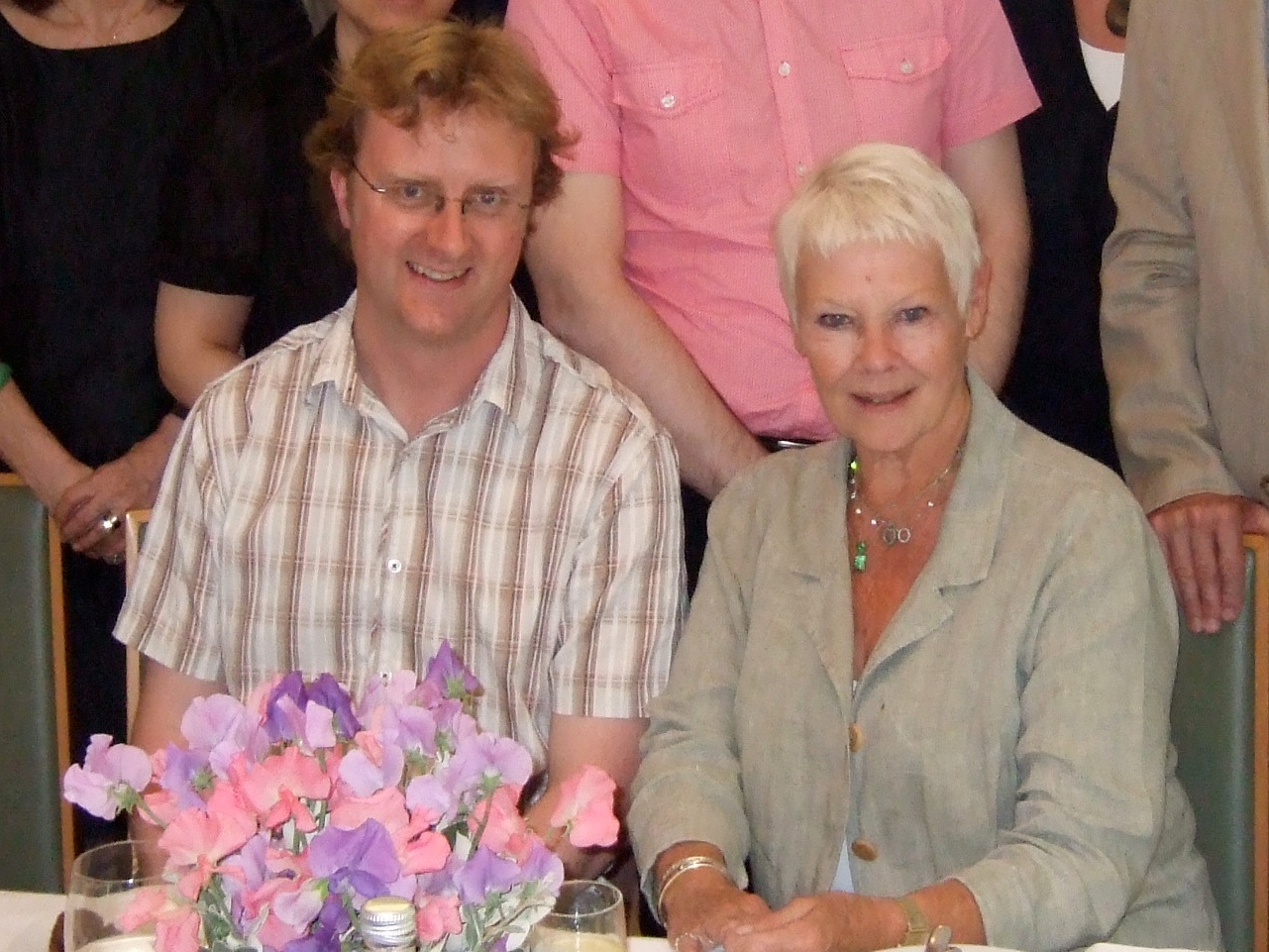
I once met Judi Dench. She really is lovely. Here she is giving me orders to kill the photographer.
PS. Oh and Albert Finney at the end… He was great, but do you not think that role was written with Connery in mind? 50th anniversary and all that…
I’m on hols in sunny Spain, relaxing at my in-laws’ place halfway up a mountain in the middle of nowhere, the perfect place to work on script revisions between important sessions of poolside vegging…
It’s essential to have somewhere quiet to work…
I’m currently working on a project with director Jon Wright. We’re on a deadline to deliver our latest draft by the end of the month and we’re swapping revisions while I’m out here. This is nothing unusual; this script has been written in locations as varied as the Royal Festival Hall, the Sundance Festival, a friend’s flat in Whitstable, and assorted trains from Waterloo. We’ll write together, one of us pacing as the other types, or solo, swapping rewrites over email.
More recently, as the script nears the final furlong, the rewrites have become more focused. I’ll often open Jon’s latest Final Draft file to find it in 150% mega-large print as he scrutinizes the script line-by-line, and this perfectly illustrates the advantage of co-writing with a director. Jon is the guy who has to make this work. He’s the one who’ll be standing there on location with the day’s pages, surrounded by an eager cast and crew, each with a million questions for him, and if he has a script that doesn’t work then he’s stuck, and that’s no fun when the clock’s ticking and each second represents a fistful of dollars.
So he will take some of my more fanciful stuff and give it a reality-check, turning something that looks cool on the page into something that can actually be shot. The running gag while writing this has been me turning in an awesome action sequence and then reassuring Jon that it’ll be a doddle to film. He somehow resists the urge to thump me and we then work together on knocking it into shape, breaking it down into set-ups, and trimming the dialogue down as far as it will go.
I love co-writing. Movie-making is a collaborative process and any screenwriter who wails about actors and directors changing their script should perhaps consider writing novels instead. But more than anything I would recommend writing with an experienced director; it’s an incredible learning curve, rooted in the realities of day-to-day film-making. If you get the chance take it!
PS. Bear in mind that Jon has been writing this during the post-production and release of his latest film GRABBERS. It has a wicked script by the mighty Kevin Lehane and is on release in Ireland on Aug 10th, at Frightfest later this month and in the UK later this year.
Please be warned: there are spoilers below. If you haven’t seen The Dark Knight Rises yet, then please come back when you have…
Winding up a trilogy is hard. You only have to look at the tombstones in the vast Graveyard of Part Threes to see how the mighty have fallen: The Godfather, The Matrix, Pirates of the Caribbean, Alien, and The Care Bears have all fallen at the final hurdle.
Even the greatest trilogies have limp, if not actually bad, final acts: Return of the Jedi, Back to the future 3, and Spider-Man all have okay conclusions, but they’re not quite as good as previous episodes (though BTTF2 was a bit of a shambles in my humble opinion).
And the number of the truly outstanding conclusions is very small indeed: Toy Story and Lord of the rings are the most recent ones I can think of, and now I think we can add Dark Knight Rises to their number.
Why do so few of these work? There’s a strong argument that the second act of any story will always be the most interesting. It’s where your hero has everything thrown at them, you’re not bogged-down introducing the audience to your characters and their world, and you can have fun and ramp up the conflict all the way up to 11, knowing full well you can end on a whopping cliffhanger for part three.
But I don’t necessarily buy that for all movies. Very few film makers know that they’ll be seeing a trilogy through to the end. Peter Jackson is perhaps a notable exception, but most directors and writers need to prove themselves with part one before they can even begin to think about parts two and three*. Certainly the makers of the Matrix seem to have been caught on the back foot with this, and Alien3 killed off the survivors of Aliens in a mean-spirited way, suggesting that that the only way forward was to ignore the past. Return of the Jedi took characters that had been made complex and exciting in The Empire Strikes Back and did virtually nothing with them, essentially remaking the first Star Wars with a bigger effects budget.
So why did The Dark Knight Rises succeed where others have failed?
Christopher Nolan has stated in interviews that when he was making Batman Begins he had no idea that there would be any sequels, he concentrated on making the first movie as good as he could. So there was no LOTR-style master plan.
When I’m working on the third act of a screenplay I’ll almost always find that the solution to any story problem is not in what I’m writing now, but in something I wrote back in act one or two. Sometimes it’s something seemingly inconsequential that suddenly has a new resonance and it can mean that you end up looking at your story in a completely new way. It’s one of those golden rules of screenwriting, and the Nolan brothers and David S. Goyer have executed it beautifully; finding the themes that worked so well in the previous movies – part one’s fear and part two’s chaos – creating a new kind of anarchy for part three and stacking the odds against Bruce Wayne/Batman in a way that trumped the previous films without actually repeating the same beats. On top of this come new themes of loyalty and sacrifice that constantly remind you that you’re watching the finale, and that anyone can die.
As anyone who caught the end of The Amazing Spider-Man will know, a story is often about the protagonist asking ‘Who am I?’ To say that Bruce Wayne has suffered an identity crisis in this trilogy is something of an understatement, but here he faces a mirror image of himself: an orphan who clambered up from darkness with hatred in her heart, and a inversion of himself, a masked man who shows his henchmen no loyalty whatsoever and demands the ultimate sacrifice from so many of them. So Bruce must put aside his anger and hatred, recover from his grief, and offer himself in sacrifice to Gotham.
And when Batman tells John Blake that ‘You’ve got to wear a mask to protect those you care about’ we now have a hero who knows what he has become, where his place is in the world, and what he must give in order to save the day. Bruce Wayne’s story has come to a definite conclusion.
In the past, Batman has often been less interesting than his villains, but not this time.
TDKR is not a flawless film; it takes its time, but it never bores and the payoff is well worth the wait. To paraphrase George Lucas; ending a trilogy is fun because you get to tie up all the loose ends, but ending a trilogy is hard because you have to tie up all the loose ends.
*And if you think the graveyard of part threes is big, just have a look at the Cemetery of Trilogies That Never Got Past Part One… Flash Gordon’s “?” ending, anyone…?






 Mark Stay Writes