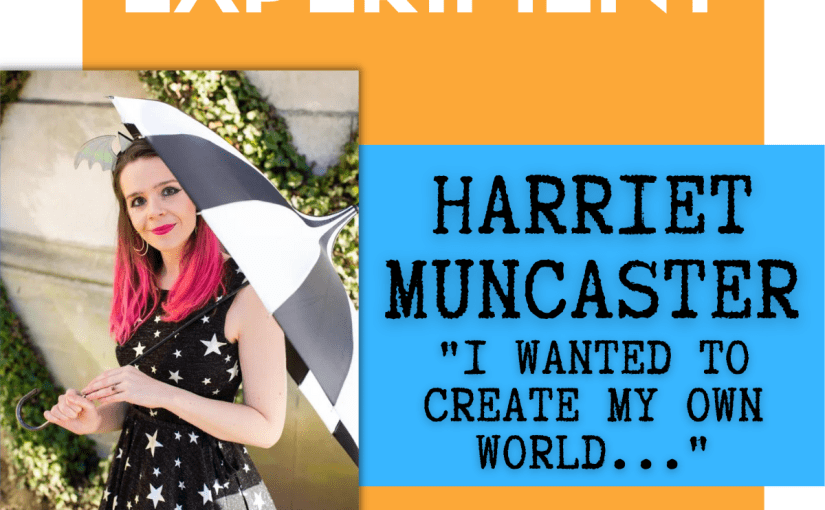
Harriet Muncaster on the Bestseller Experiment: Creating Worlds

I saw a blog by a writer recently declaring that we should all aim for perfection. Their point being that once the book is out there, then you don’t have an opportunity to change it (which isn’t strictly true) and that we should all aim to make any book we write the best it possibly can be.

I agree that I want anything I write to be the best that I can do, but perfection…? Not sure it exists. And it can be the enemy of creativity, especially when you’re starting out. The idea of creating something as polished and perfect as your favourite author’s latest tome is intimidating at best, crippling at worst. Over time I’ve discovered that creating is a process of failing a little less each time. With each draft, each book, each script I’ve learned something that helped make the next one a little better. But it’s never perfect.

There’s a moment in this week’s interview with the brilliant Harriet Muncaster where she says she held off from starting a project because she wanted it to be perfect. Which meant for a long time she didn’t do anything at all. Then she eventually realised that, ‘If you don’t start something, then it never really develops.’ So if you’ve been putting off that novel, script, artwork, whatever, because you were worried that it wouldn’t be perfect then today’s the day to start it. It won’t be perfect. Nothing ever is. But as you work on it you will discover that it just might be better than you ever imagined.

Also in this week’s episode me and Mr D discuss being child-like and end up being very childish. And in the extended version I finally talk about my role in the Nautilus TV series and what’s happened at Disney+. You can listen to that by becoming a Chart Topper supporter here.

“Thag no like change.” From cave paintings to 3D

Thoroughly enjoyed The Artist the other night. A really charming film that’s basically Singin’ in the rain without the – er – Singin’. In other words it’s that old story about one form replacing another. Change creating upheaval in an artist’s life.

There’s a lot of that about at the moment. Music download sales finally overtook physical recently, and in my day job everyone’s fretting about the decline of physical book sales as eBooks rapidly become the predominant form. And just the other day I shared a cab with a screenwriter and director; the former romanticising celluloid’s organic qualities, while the director preferred the flexibility offered by high-quality digital.

Tonight I watched Werner Herzog’s Cave of forgotten dreams, the latest of his excellent documentaries. This one featured prehistoric paintings from the Chauvet caves in the south of France. Some of the paintings are over 35,000 years old and represent humanity’s first artistic endeavours. Herzog looks at one likeness of a bison, painted with eight legs blurred in a depiction of what he calls ‘proto-cinema’, and imagines how it must have looked with a fire burning and the flames throwing shadows on the cave walls. It’s an almost hallucinogenic moment in a really engaging film.

And this is is where the storytelling urge began. Our ancestors seeing something that moved them and wanting to capture it and share it with their contemporaries (except Neanderthals, they apparently showed no artistic flair whatsoever… which is why they’re now all PE teachers). And that urge is still with us now, whatever the form.

When The Artist was first released, I read many reviews wryly suggesting that Hollywood would no doubt be lining up a whole slew of copycat silent movies, cashing in on the phenomenon. But, as far as I can tell, that hasn’t happened. Maybe they figured out that moviegoers went to see The Artist because of the great story and the engaging characters, or maybe it’s because Hollywood is still so mesmerised by 3D it can’t be arsed to go back to silent movies.

But it’s never the form that endures. Oh sure, 3D, Kindle, HD and iTunes will excite people for a while, but the reason they keep coming back are the stories; that little flutter in the heart when we’re moved by something. Vinyl, celluloid and hardbacks will probably always be with us, even if they become sidelined and niché, and when the apocalypse comes we can go full circle back to cave paintings. Only this time it’ll be mushroom clouds or hordes of zombies we’ll be painting. That’ll give Herzog’s descendants something to talke about 35,000 years from now.