Strange doesn’t even begin to describe it. To be the first to get news on this exciting new book series, sign-up to Mark Stay’s newsletter here.
Author: MarkStayWrites
Author, screenwriter, and award-winning podcaster.
Oliver Stone, Chocolate Hobnobs and Japanese Knotweed
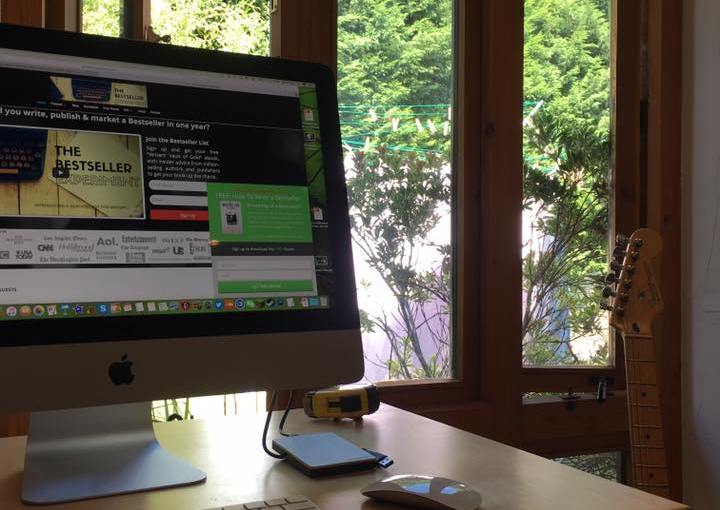
After months of wrangling with estate agents, solicitors, Japanese Knotweed and a very stubborn tree, my family and I have finally moved home. We’ve left the suburbs behind and headed out to the country where I won’t be watching afternoon repeats or the food I eat, but instead working on making a new life here, and writing as much as possible in my mighty man cave (with a lovely view of the washing line)…

The latest news on the Bestseller Experiment is that we’ve finished our latest draft and have sent it to our editor. This is the first time that a fresh pair of eyes will read our work, and it’s always a slightly terrifying prospect, but we’ve worked our nuts off on this book, and when working on the final chapters over the weekend I actually found myself blubbing. That’s never happened to me before, so I reckon we might be onto something (mind you, I’ve been wrong in the past).
A big change to my routine is my commute. I used to get thirty minutes or so on the train each morning to write, then I would write in my lunch break, then again on the train home. Two hours a day of good writing, albeit mostly in a tin can full of stressed commuters, which could leave me wiped out on a hot day. My new commute takes up over three hours of my day, but it’s far less stressful, fully air-conditioned, and ten times as productive. I’m loving it already and wished I’d done this years ago.
Oh, and I’m in a film! Film lover, film reviewer and now filmmaker Stuart Bannerman has a made a documentary called Experiencing Comic Cons. I love going to cons and Stuart spoke to me while at MCM last year. Blink and you’ll miss me, but Oliver Stone is in the film, too, and I think that means me and Ollie are best friends or something (he’s yet to answer my calls, but it’s just a matter of time before I wear him down). It’s a passion project for Stuart and if you love cons, or even if you’ve never been and want to know what all the fuss is about, then I urge you to check it out (also, he very kindly brought me a packet of chocolate Hobnobs while I was signing books, which makes him one of my favourite people in the world).
Back to work now. Mr. Desvaux and I now have been tasked by our editor to come up with a synopsis and blurbs for our book… Wish us luck!
A version of this first appeared in my monthly newsletter. To subscribe, click here
I haven’t written for three days!
If you follow the Bestseller Experiment podcast you might have noticed that we recently finished our first draft. This is always a cause for celebration, even if the draft is a big old mess (which it is) and will need a ton of work (which it will). Simply finishing something is an achievement.
I celebrated by getting a summer cold, and diving straight into rewrites of a TV pilot script. This was huge fun, as this was the script that had been give such a kicking a while ago, but I had spent the time since working on solutions that I couldn’t wait to try out.
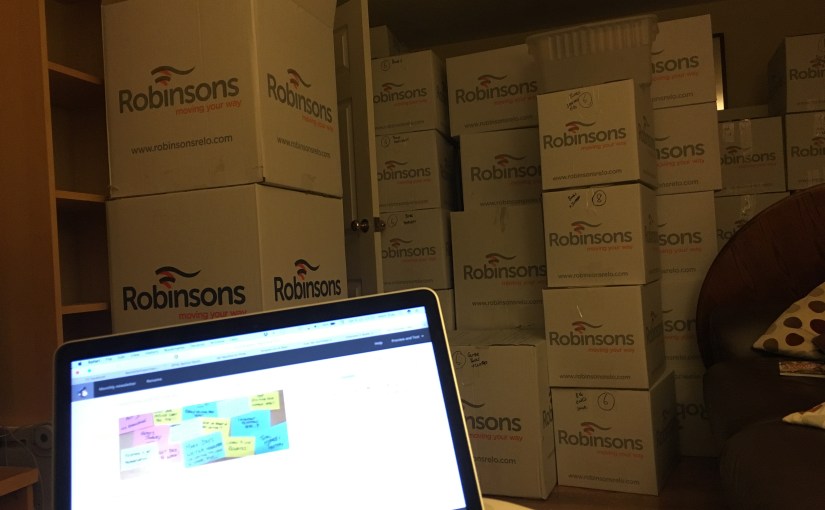
The other reason for the hurry is that I’m moving house. The Stay family is leaving the suburbs and heading to the country… Well, maybe not the country, but it’s next to a farm, and for a boy born in the city that counts as the countryside. All this means lots of packing (so many books!), and a break in my usual routine, which means I haven’t written anything other than emails to utility companies in three days.
I’m a ‘write every day’ guy. If I don’t write anything during the working day, I get twitchy. So much so, that I just snuck out of bed in the middle of the night to sit among the boxes and compose this blog…

… and that feels good, even though it’s not the full dose of happiness that I get from a bit of creative writing. But I am reassured by the response we got from Sarah Pinborough on the podcast when we asked her if she wrote every day. ‘No,’ she said. ‘That’s bollocks.’ She went on to clarify that even though she might not actually be writing her latest work in progress, she’s always thinking about it. Well, I’ve been doing lots of thinking, and I’m allowing myself to call that work, even if it’s just for a few days.
The other thought that keeps me going is that when we move I will finally have a writing room. I hate to use the phrase ‘man-cave’, due to all the icky connotations, but it will almost certainly be the very definition of male writer mid-life crisis decor: film posters, books, Lego, and I might even succumb to the lure of vinyl LPs again… Lordy, what have I become…?
In the meantime, keep writing, my friends. I love hearing about your work and news (my friend Graeme Williams just had some amazing news!) and it’ll keep me going till I see you on the other side once I’ve unpacked…
This post was seen first by subscribers to my newsletter. Sign-up now and grab one of two free eBooks…
Bespoke children’s book written by Piers Torday – starring your child!
Wonderful idea from a terrific author…

ITEM: A book written to order about your children in the adventure of their choice.
DETAILS: Piers will interview your child/children and write a bespoke story starring them as the main characters in the fictional world of their choosing.
BIO: Piers Torday is the bestselling author of The Last Wild Trilogy (Guardian Children’s Fiction Prize) and There May Be A Castle.
WHO CAN BID: The greater the bid, the longer the story, £1 per word. Minimum bid is £500. Interviews outside London and the UK will be conducted via Skype. The finished story will be published on my website and the successful bidder will also receive a signed and bound copy. I reserve the right to publish it in magazines, online etc, to secure further funds for the appeal. If the successful bid is over £10,000, I will attempt to secure publication, with all profits going to the British Red…
View original post 62 more words

Ever felt worthless as a writer? You’re not alone.
Up till Tuesday night this week, I was invincible.
I had spent the weekend polishing a TV spec script that was going to be my calling card. It was, without a doubt, the best thing I had ever written. I had spent maybe a year and bit slowly bringing it to life, researching the historical background, building the characters and the world, and it had already been through two beta-readers, who had given me excellent notes and were very positive, and it was ready to go out.
But I wanted one more opinion before I did that, just to be sure, and so I sent it to another writer friend for his opinion.
His notes were like a punch to the gut.
He found problems with the protagonist, the tone, the antagonists, and the ending.
And the worst thing is, he was right.
This is where my old friend self-doubt made an appearance. How could I have been so blind to the script’s flaws? Worse still, how could I have been so supremely confident that it was ready, when it clearly wasn’t even close? I’ve been doing this for long enough that I should know this, surely? I really did not know if I had the judgement to continue with writing. If I couldn’t see my own flaws, then how could I even possibly think about a career as a writer? I was useless. Hopeless. Worthless.
The notes arrived via email late at night, and I barely slept after that, constantly turning dead-end rewrite ideas over in my head.
By the morning, however, almost all of that doubt had gone. I had formulated some ideas for a rewrite and this time it was going to be awesome.
I’m hoping that this sequence of events is familiar to other writers.
I’ve gone through various incarnations of it ever since I started writing at school. I spoke about this on the podcast recently, noting that coping with tough feedback can be a bit like going through the stages of grief. Not to denigrate the overwhelming intensity of losing a loved one, but we writers can be melodramatic, and it cannot be denied that the similarities are pretty remarkable:
First comes denial: They’re wrong! How dare they misinterpret my genius!
Then anger: Fuck ’em! Look at these shitty notes: he contradicts himself three times, so why should I listen to him?
Bargaining: Maybe I should email them, pointing out the stuff they missed, which will help them see just how brilliant the story really is?
Depression: I’m utterly worthless, a total fraud and I should never put pen to paper ever again.
Acceptance: Ah, y’know what? Maybe they had a point? Let’s get to work.
Earlier that evening I had been messaging a writer friend who was going through the same thing, and I think that’s possibly what exacerbated things this time for me. I was telling my friend to keep his chin-up, you’ll get through this, you’ve been published, people love your books, you’re awesome… And all the while I was thinking how lucky I was to have put those days behind me.
What a doofus I was.
It never goes away.
I think good writers are able to hold conflicting thoughts in their heads. It’s the only way you can have characters with opposing views convincingly have at each other on the page. The trouble with this skill is you can be all too empathetic when people criticise your work. My inclination is to immediately agree with them; yeah, you’re right, it’s crap isn’t it?
I looked back at the notes that my friend had sent me. There was so much positive stuff in there. He loved the pace, the characters (mostly), the period, the maguffin, he said it was huge fun, unusual and really visual. Why was I only seeing this now? My eyes had somehow glazed over this and chose to focus on the shit.
I’m not posting this for ‘Aw, hun’ hugs, I just want other writers to know that if you’re going through this rollercoaster, you’re not alone.
And once you start to recognise the stages, it becomes easier to manage them, move through them more rapidly, find yourself working on solutions, and thanking your lucky stars that someone cared enough to help you make your work better.
So here I go with another rewrite. And this time, it really will be the dog’s bollocks.
Hope this wasn’t too depressing. Normal service will resume shortly. But if you think you know a writer/creative who might benefit from this post, then please do share… or give them a hug… or tea and biscuits usually does the job!

Looking Back At The Bestseller Experiment Episode 2 – Sam Eades & Juliet Ewers
At the time of writing, we’re up to episode 36 of the Bestseller Experiment podcast and, as we get close to finishing the first draft of our book, I thought it would be interesting to go back and listen to those early episodes, and give you, dear reader, a little peek behind the curtain.
We still didn’t have any big names lined-up, and this was another one we recorded at the end of August, long before our launch. But, I’d heard precious few editors interviewed in writers’ podcasts and we thought we could offer some value with two of the best, and little did we know what a cracking episode it would be. Have a listen here.
Sam and Juliet came properly prepared with copious notes and, as we recorded it at the tail end of a colleague’s farewell drinks in the office, they were both very relaxed thanks to the power of beer.
My favourite bit comes 23m 30s in, where I flippantly announce the end of the podcast. We had to make it clear to listeners that we weren’t cynically trying to custom-build a bestseller. I’d been tipped off that a book called The Bestseller Code was coming soon, and already it was getting a bad buzz in the industry. We wanted to avoid comparisons with any kind of bestseller-by-numbers approach. It’s a criticism that we still get, and understandably, considering what we decided to call the show, but I didn’t want this to be a nuts and bolts, insert tab A into slot B operation. If my name is going on the cover of a book, it’s going to be as good as I can make it.
A few thoughts listening back…
- The sound at Hachette still had too much reverb.
- We still had no clue what we were going to write
- I say ‘prevaricating’ when I mean ‘procrastinating’… It’s lucky I don’t intend to make a career out of this words malarkey, eh?
- I do a very weird pause at the 39:37 mark. I simply ran out of things to say.
- I still haven’t spoken to Juliet about her time working in recording studios, and I see her every day…
- We still haven’t got Ian Rankin on the podcast (but we’re working on it).
- There are no twins or unreliable narrators in our novel, but there is some sex. It’s excruciating.
- We have the first mention of Into The Woods by John Yorke!
- I keep banging on about ‘voice’… Something I still bring up with annoying regularity.
- Our biggest takeaway: we were NOT going to write GONE GIRL.
- Juliet mentions using everyday language to help make a book more accessible to readers. Not quite the same as Mr. D’s Grade 3 obsession, but duly noted.
- That fear of it all falling apart was still very real…
- Question of the week was another fake one!
Our most important lesson from this episode was Juliet’s declaration that if you don’t love what you’re writing, then why would anyone else? And writing what you read was another important note for us. As Mr. D reads a lot of narrative non-fiction, and I read a lot of science fiction and fantasy, I thought it would be impossible to find something that we were both fans of, but it turns out I needn’t have worried. We certainly weren’t up for giving Sam her sweeping romance novel, but her idea of happiness as a theme definitely resonated with us, and influenced what we finally decided to write. I’m also really interested in making an emotional connection through writing. I can do excitement and comedy, but I’ve yet to make anybody cry, and that’s my high bar for writing now. I get weepy when I watch movies and read books, so can I dig deep and do that with my own writing?
Still haven’t read Gone Girl.
There’s a transcript of the interview in our free ebook. Get your copy here.

Sign-up to my newsletter and get a free eBook!
For regular writing tips, news and other stuff to help a writer get through the day, sign-up to my monthly newsletter, and grab a FREE eBook while you’re at it!
You can choose from my Robot Overlords Shoot Diaries and The Mediator Prototype, a Robot Overlords short story. Both come in either ePub or PDF formats.
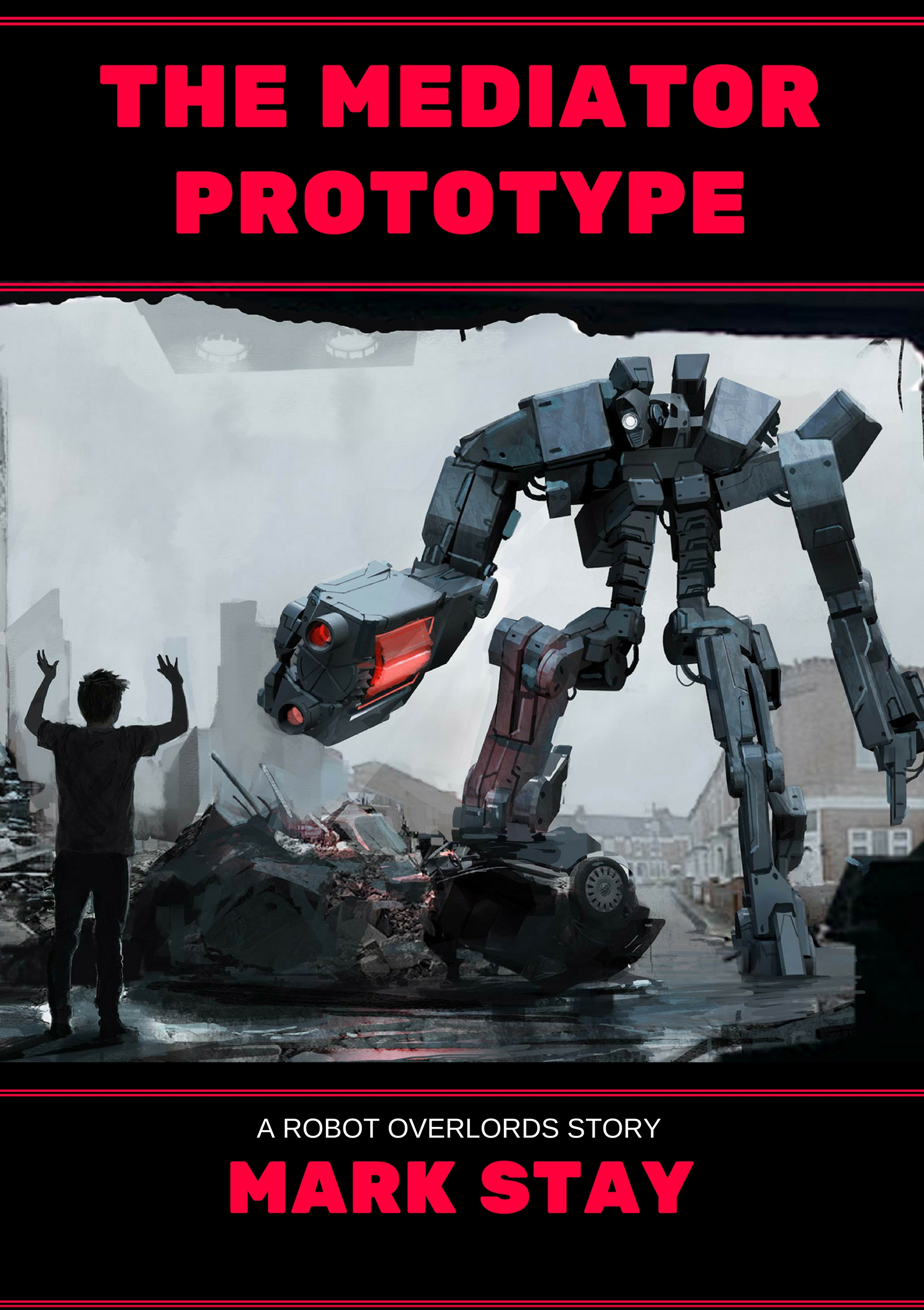

Robot Artwork by Paul Catling. Photo of Mark Stay by http://www.mpsv.co.uk Both used with kind permission. All rights reserved.

Looking back At The Bestseller Experiment Episode 1 – Who Buys Bestsellers?
At the time of writing, we’re up to episode 35 of the Bestseller Experiment podcast and, as we get close to finishing the first draft of our book, I thought it would be interesting to go back and listen to those early episodes, and give you, dear reader, a little peek behind the curtain.
We kicked off with Vics Tranter, who’s terrific on consumer insight stuff and has sadly since left Orion. Her advice was invaluable, especially pointing out that many of the pioneer readers of fiction are women in their thirties and forties, and how important they could be in spreading that elusive word of mouth. It became clear that Mr. D and I would need to write something that would appeal primarily to women. We did briefly dally with the idea that we might write a Gone Girl-style thriller, but over the next few episodes it became less and less appealing as we realised that neither of us really had a passion for those kinds of books, although we do talk about writing outside out our comfort zones. Have a listen…
A few thoughts listening back…
- We say that we’ll keep referring back to this interview throughout the series and we have!
- We ask our guests top tips for wannabe writers and then ask what they’re reading… That didn’t last, did it?
- We still haven’t got Daniel Cole on the show.
- I think Mr. D and I have a pretty good rapport from the start, and we slip into our natural cynic/optimist roles effortlessly.
- Regular listeners will recognise some of Mr. D’s common themes making their first appearance, not least about keeping the language simple, and we still go back and forth about this… We’ll need an editor to make the final arbitration, I think.
- What’s our hook? Not saying yet, but it came out of conversations we had in the following weeks.
- This episode also witnessed the birth of the Writers’ Vault of Gold, which at the time of writing is currently nearing 100k words. I’m not just saying this, I really do go back and dip into this constantly. It’s an amazing roster of authors, editors and other professionals and it’s full of great writing advice and it’s currently free. FREE! One day it won’t be. Get your copy here.
- Scrivener – I really, really did need converting from Pages to Scrivener. I struggled with it to start with, though that probably had more to do with my stubborn refusal to change that the software itself. Interesting that we were eulogising about it so soon as, at this point, I don’t think we had secured their sponsorship.
- Ah, the Question of the week – or the Question Mark as no one is now calling it. Time to fess up: this first one was completely made up. There is no Andrew in Surrey… well there might be, but he didn’t send us a question. Andrew is my middle name.
- Sound quality. There’s quite a bit of reverb from my end, which is a sound editor’s worst nightmare, and for the first few episodes I had my headphone volume quite loud, so it would leak to the microphone. This would drive poor Mr D. mad as he worked on the edit.
- Secret guest… Yes, we really hadn’t booked them yet… and the GollanczFest that would feature many of our first big names was still just a distant speck on the horizon.
We recorded this on 23rd August 2016, waaaay before our actual launch in October. Mr. D and I had been talking about this idea for some time, and the plan was to get a few episodes in the bag before we launched as we had heard that launching with multiple episodes might send us up the iTunes podcast chart. And, it was also to see if it would actually work as a format. Here’s my diary extract for that day…
First interview for the Bestseller Experiment podcast tonight with Vics Tranter at Orion. A couple of technical glitches aside, it went well and there’s a definitely a lot of potential in the project. Could be a ton of work, but might also be very rewarding.
A ton of work… if only I knew. But it has been rewarding, too. Not fiscally, oh no, but hearing from writers on their own progress, and hearing how they’ve been inspired by the show has brought sunshine and happiness to my dark, cynical heart and long may it continue.
Oh, and I still haven’t read Gone Girl.


I’ll be covering episode two soon, so please subscribe to make sure you don’t miss out!

The Madcap’s Last Laugh, Syd Barrett tribute concert – May 10th, 2007
I’ve been trawling through my diary from ten years ago, chronicling my trials as a writer, but every now and then I find something very special that has nothing to do with my scribblings. Ten years ago today I was lucky enough to go to a gig with my nephew Chris which exceeded all expectations…
Last night Chris and I drove to the Barbican to attend The Madcap’s Last Laugh, a tribute concert to Syd Barrett. I had been looking forward to this since it was first announced. All sorts of rumours had been flying around about who might show up, but when names like Robyn Hitchcock, Chrissie Hynde and Martha Wainwright were officially announced I realised that it would be a sincere tribute from people genuinely influenced by Syd. I had wondered if anyone from Pink Floyd might show up. Guy (Pratt) told me that David Gilmour had been approached and had politely declined. I guess he felt that he had made his tribute already with his very moving rendition of Dark Globe on his last tour. David saying no effectively ruled out Nick and Rick, too, and as for Roger… I knew that he was in the country on tour, but who knows if he had the time?
Anyway, the traffic was terrible and we were fifteen minutes late but, thankfully, the show was late starting and we were in our excellent seats (second row, just right of centre!) in plenty of time for the start. The show was wonderful in a very English and slightly shambolic way. Everyone was just a little under-rehearsed, singers had scraps of paper with the lyrics, roadies wrestled with mic stands to ready them for the next artistes, all of varying heights. The line-up was great. Captain Sensible (looking alarmingly like Paul O’Grady), Nick Laird-Clowes, Damon Albarn, The Bees, and then, to finish the first half, on strode Roger Waters.
Well, Chris and I jumped to our feet as did the rest of the audience. He looked very nervous – he was shaking like a leaf even when he was playing – and he played Flickering Flame on an acoustic guitar accompanied by Jon Carin on keyboards.
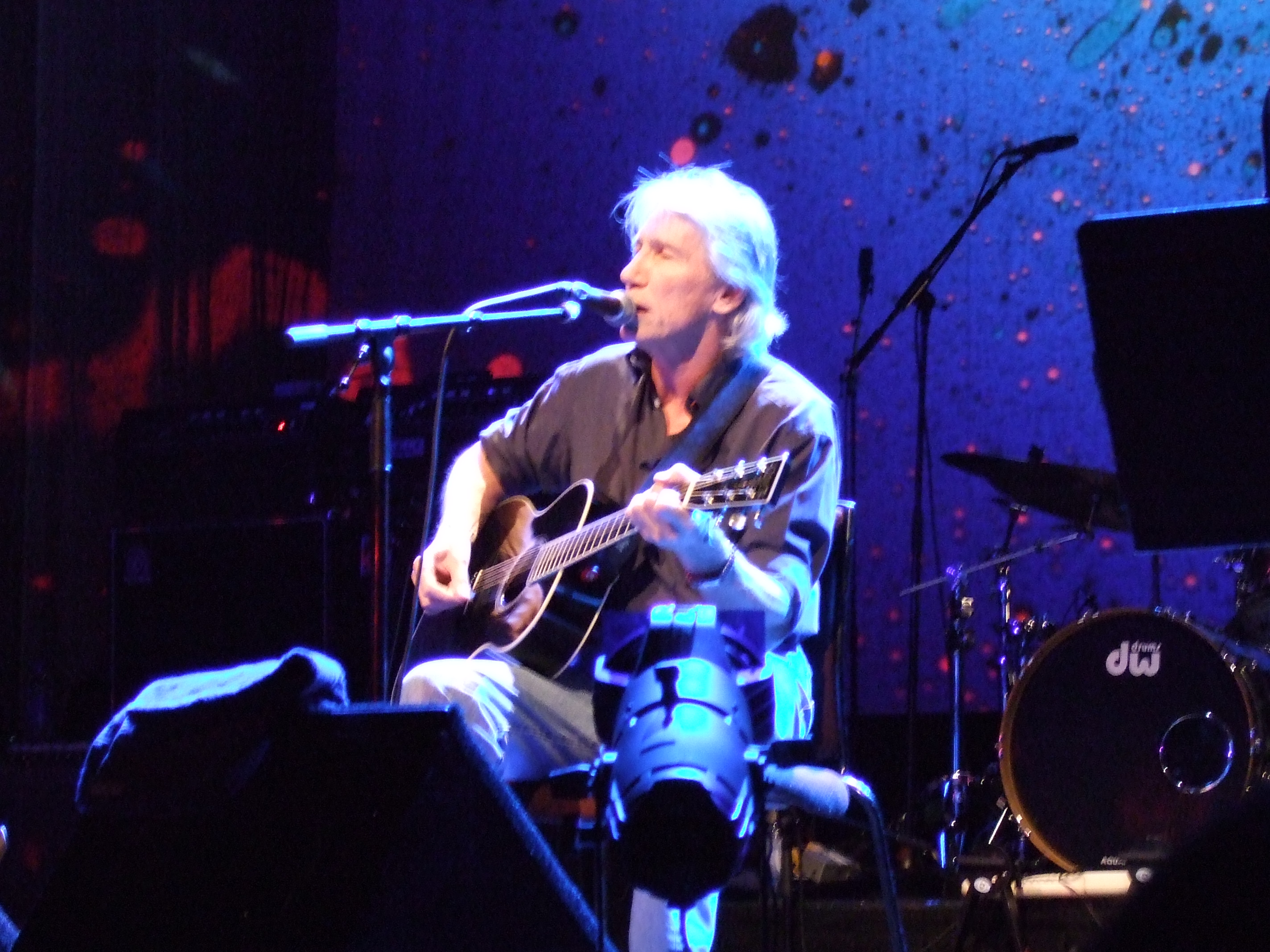
What a great first half. I even saw Storm Thorgerson queueing for the loo in the break.
The second half was even better. Vashti Bunyan, more Damon Albarn and Captain Sensible, Robyn Hitchcock, John Paul Jones, and Chrissie Hynde. Then Joe Boyd came on and told us he couldn’t think of a better way to round off the evening than to ask David, Nick and Rick onto the stage… Well, we were blown away. I had totally convinced myself that this was not going to happen and here we were. There were shouts of ‘Roger Waters!’ from the crowd, to which David replied, ‘Yes, he was here, too…’ So where was he now? Never mind… They played Arnold Layne – it wasn’t the greatest rendition, there were problems with Rick’s keyboard and mic, but it was just terrific to see them playing again.

And that was it. There were cries for more, not least from me, and they did join everyone else for the final Singalonga Bike. An amazing evening and Chris and I left on a real high.
I later learned from Guy that David had called him at 2pm that day asking what he was up to that night. Guy had a Bryan Ferry gig in Cambridge and couldn’t attend. He was gutted. He also explained Roger’s no-show with the band: apparently he had to get back to his hotel to meet his girlfriend. I hate to think that I missed my one opportunity to see the classic Floyd line-up because Rog’ fancied a quickie with his bit of stuff*…
Anyway, it was a great evening, a worthy tribute to Syd and I got some good photos. I had hoped to meet Matt Johns from the Brain Damage website, but I couldn’t get a signal on my phone in the Barbican. Turns out he was sitting about four seats down from us.
*I realise I’m being very uncharitable here!
For a full setlist, the wonderful Brain Damage site has it all here.
All photos by Mark Stay
Enjoyed this? Then please…


My First BA Conference (and jeweller’s robbery!) – My Writing Diary Ten Years On – May 1st & 2nd 2007
The Booksellers’ Association conference is an annual gathering of the great, the good, and (in my case) the liggers of bookselling and publishing. Orion was paying for one of our customers to attend the gala dinner and I went along to be their handler for the evening. This is when the BA hands out their awards, the Nibbies, and there’s sometimes a quiz, plenty of food and drink, and jewellery shop robbery… Maybe that last one isn’t as common? Maybe they laid that on just for me…?
Tuesday 1st May, 2007
Harrogate: The Booksellers’ Association conference. Only here for the gala dinner this year. Journey up was fine. Knaresborough looks like a great place to explore: steep and cliffy. Harrogate is a perfect little town and Betty’s Tea Room smells glorious. My agent got back to me on Dead Man’s Finger*. I don’t need to make a decision till next week… Hopefully I’ll get to meet with Jon (Wright) tomorrow to discuss God Of Scarecrows**. We’re planning to meet at King’s Cross tomorrow afternoon.
Off to the gala dinner. It’s too hot to be dressed as a penguin.
Wednesday 2nd May, 2007
9:50am. On the train to Leeds… Amazing! Just seen the end of a robbery in jewellery shop in Harrogate! I was happily strolling to the train station when, from around the corner, I heard a woman scream, followed by a series of bangs (three, I think), then a red car came screeching around the corner. Its windscreen was bashed, presumably as a result of the banging I heard. Not gunshots, but someone trying to smash the car’s windscreen. I couldn’t see through the cracked glass to identify the drivers. The car sped away at high speed, but before it had even reached the junction at the end of the road, there were three or four people already on the phone to the police yelling its registration number into the receiver. There were at least a dozen other witnesses to the crime, so I figured I wouldn’t be needed. In the two minutes it took me to reach the station the air was full of the noise of sirens and police cars and vans were in hot pursuit. I guess it won’t take them too long to find a red car with a smashed windscreen.
The incident proved what I’ve always feared: I would be a rubbish witness in court. The car was red, a C reg, and I can’t even remember the name of the jewellers’, although I’m pretty sure it was in Prince’s Street.
Anyway… last night was okay enough. Mark Billingham was MC and managed to inject life into some old gags and there was a fairly funny turn from Al Murray, the pub landlord.
Richard Littlejohn proved himself to be the twat I’ve always imagined him to be: he declared Alastair Campbell to be a mate and then proceeded not only to slag him off, but also suggested that Campbell was responsible for the death of weapons inspector Dr. Kelly. This prompted Mark Billingham to splutter, ‘Fuck, if he’s your friend, what do you say about your enemies?’
Littlejohn’s response was, ‘You should hear what he says about me!’
You should hear what we all say about you Littlejohn, you hate-mongering little fuck.
Home, 11pm. Had a good meeting with Jon this afternoon. He had some good ideas for The God Of Scarecrows. I will have to change the ending. We also discussed an idea. More of a framework for a short film that can exploit extremes of sound. Thinking cap on…
Tired now. I’ve spent too long today in trains and taxis.
The car was a Rover! And it was red, and a C reg, so maybe I’m not so bad an eyewitness after all? There’s more here… No idea if they ever caught them, but if you’re looking for an eyewitness with a ready-written statement, I’m your man!
*I have zero recollection of what this is.
**A short film idea that I still bloody love, and might fold into a book project I’m tinkering with…
 Mark Stay Writes