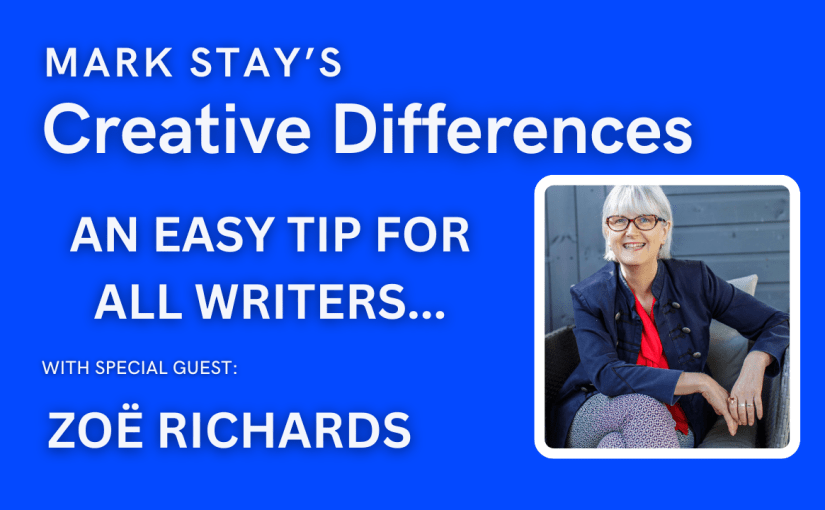
This month’s special guest Zoë Richards reveals what she needs to know before she can start a writing project…
TRANSCRIPT
MARK: What’s the thing that makes you think you’re ready to start writing on a project?
ZOË: The thing that makes me say, just go for it: I’ve got to know what the ending’s going to be. Once I know where this is going. And I think, again, that goes back to reports that I used to write. So what do I want out of this report? I want the execs to give me 3 million pounds for autism services. I have to say, spoiler alert, I never got 3 million pounds for autism services for children. It never, never happened. Great report, Zoë, the best we’ve ever seen. No, we haven’t got any money for you. Yeah, that didn’t work. However, the process worked of knowing that’s my ultimate aim, that I need them to know that that’s what we need, what’s going to get me there. And so it’s the same thing when I’m ready to write. Once I know where I’m going,
Mark: What small thing has made a big difference to your creative process?
Zoë: Just sitting down and writing? The only thing that ever stops me because I find I get more creative the more I write.
Mark: Yeah, yeah.
Zoë: It’s a bizarre thing, isn’t it? So if I sit there and don’t write, the writing doesn’t get done. And the creativity doesn’t happen either.
Mark: You can’t just sit down, not do anything, get up and walk away. It’s just embarrassing for all concerned, even if you’re completely on your own. So yeah, turn up sharp, tap some keys, see what comes out.
Zoë: I couldn’t think of anything to start today, and I actually wrote Need Something about Hunter and his gang days, and perhaps something about when his dad used to beat him up. And that’s all I’ve written into one of the chapters, but it immediately made me go, oh, in that chapter there, I need to do… And I just went off then and couldn’t stop writing.
A couple of months ago I started a little forum for Writers called The Green Room. We meet twice a month over Zoom: writers send me questions in advance on the craft and business of being a writer and it’s all relaxed and fun and chatty and there’s a great mix of writers: some just starting out, others are published and experienced and it’s all recorded exclusively for folks who support me over on Ko-Fi. Here’s a little taster from last week’s session with a great question on how to write believable and unpleasant antagonists…
I hope you found that that little taster helpful. The sessions are supposed to run for half an hour: they’ve all gone on for a good hour so far. I love chatting about this stuff with writers like you. If you’d like to try it out, pop over to my page on Ko-Fi and become a Green Room supporter. Untill then, happy writing!
How do you write a believable and unpleasant antagonist? I have tried looking at antagonists I like from other books, but I can’t put my finger on why some get under my skin and some don’t. Where do you begin?
Fantastic question! And I’m going to take my time with this one, because this is so important…
An antagonist is a person who actively opposes or is hostile to someone or something. This means your antagonist isn’t just a black hat villain who is evil for the sake of it. They have historical or psychological motivations for what they’re doing. And that’s a great place to start when creating a great antagonist.
Look at Ray Bradbury’s classic Fahrenheit 451, set in a world where books are banned and burned – the antagonist is Captain Beatty: he hates books for their contradictory facts and opinions and that they encourage dissent and unrest. But he’s also well-read, which makes him a hypocrite, but he has made a choice to destroy outlawed books that might encourage people to think. As far as Captain Beatty is concerned he’s providing a public service, and Montag — our hero who saves books — is a renegade who must be stopped.
Antagonists are often in a position of power: Captain Beatty, Uriah Heep in David Copperfield becomes secretary and business partner to Mr Wickfield, allowing him to deceive Mr Wickfield. Mob bosses, corrupt officials, powerful businessmen and women all make for great antagonists because of their position and the power they hold over others.
Antagonists are a dark shadow of the hero. Moriarty is a match for Sherlock Holmes’s wit and deduction, but he has chosen a life of crime. He is what Sherlock could become if he made the wrong choices. Same goes for Luke/Vader, Harry/Voldemort, Batman and the Joker etc.
Create the right Antagonist for your Protagonist
The antagonist’s role in the story is to force your protagonist to change. They will torment your hero so much that they have to rise up and overcome them or be defeated. If we think of our story as: thesis, antithesis and synthesis – the antagonist is the antithesis: they represent the opposite of what your hero believes to be true. That’s not to say that the antagonist is always wrong. A good baddie will have their own agenda that might even seem reasonable to others:
Shere Khan in the Jungle Book: turns out he was spot on about men hunting tigers to extinction!
Nurse Ratched in One Flew Over the Cuckoo’s Nest: a care provider who maybe lets power go to her head.
Javert in Les Miserables has a slavish devotion to the law and righteousness which drives him to pursue Jean Valjean tirelessly.
Each of these represent the antithesis to our hero: Mowgli wants the freedom of the jungle, but with none of the responsibility. He will learn through his encounters with Shere Khan that freedom is hard won.
McMurphy challenges institutional power in the form of Nurse Ratched, but discovers that institutions can be more powerful than the individual.
Jean Valjean epitomises how a man who has done something that society sees as wrong can be a good man, but Javert refuses to show any leniency.
With all of these, the stories would have been much shorter and less satisfying if the villains had been just a little bit reasonable… Imagine if Shere Khan had accompanied Mowgli to the human village instead of trying to kill him, what if Nurse Ratched had acknowledged her own tyranny and relaxed some of her rules, what od Javert said, ‘Y’know what, it’s a loaf of bread and those kids were starving. I’m going to look the other way this time…’
But each of these villains refused to bend and why? Because they have power.
Think about their POWER
If a villain is too easily overcome, then it will be unsatisfying for the reader. If they’re overpowered (and this happens a lot in SF&F) then you might find yourself reaching for some deus ex machina solution at the end.
NOT ALL VILLAINS ARE CREATED EQUALLY… and do you even need one?
So far we’ve discussed the traditional kind of antagonist: the dark shadow of your hero that must be overcome, but not every baddie needs to be Darth Vader. Here are some other examples…
A Force of Nature
Yes, it doesn’t even need to be a person. Your hero could be trapped in a storm, or tormented by a shark, Robinson Crusoe was surrounded by an unforgiving sea. The world around your hero could represent the antithesis of who they are.
A Rival/Opponent
Rather than an out and out evil bad guy, your antagonist could be more of an irritant. The kind of antagonist we’ll meet in real life: the annoying boss or co-worker, the strict parent
They’re simply someone whose goals are in direct conflict with the protagonist’s.
A Many-Headed Hydra
The antagonist doesn’t need to be just one person. In Mean Girls you have the alpha females
Most villains have henchmen who in some way embody an aspect of their ethos and as the hero overcomes them they will learn something essential about the villain that will help them overcome them.
The Protagonist Themselves
Ever been told you’re your own worst enemy? A character’s own failings and doubts can stop them from reaching their goal. Holden Caufield in The Catcher in the Rye, the narrator in Fight Club, Willy Loman in Death of a Salesman is delusional, insecure and volatile
Describing villains…
Uriah Heep, for example, in David Copperfield:
When we first meet him, he is described as a “cadaverous” man, “who had hardly any eyebrows, and no eyelashes, and eyes of a red-brown, so unsheltered and unshaded, that I remember wondering how he went to sleep. He was high-shouldered and bony; dressed in decent black, with a white wisp of a neckcloth; buttoned up to the throat; and had a long, lank, skeleton hand.”
‘As I came back, I saw Uriah Heep shutting up the office; and feeling friendly towards everybody, went in and spoke to him, and at parting, gave him my hand. But oh, what a clammy hand his was! As ghostly to the touch as to the sight! I rubbed mine afterwards, to warm it, and to rub his off.’
David Copperfield, by Charles Dickens
Annie Wilkes in Misery (she gets a long description, essentially one of only two characters in the book). Here’s an excerpt from p8 of my paperback edition…
Most of all she gave him a disturbing sense of solidity, as if she might not have any blood vessels or even internal organs; as if she might be only solid Annie Wilkes from side to side and top to bottom. He felt more and more convinced that her eyes, which appeared to move, were actually just painted on, and they moved no more than the eyes of portraits which appear to follow you to wherever you move in the room where they hang. It seemed to him that if he made the first two fingers of his hand into a V and attempted to poke them up her nostrils, they might go less than an eighth of an inch before encountering a solid (if slightly yielding) obstruction.
Misery by Stephen King
A lot of this initial description de-humanises Annie. It’s broad and derogatory, and as the novel goes on Paul Sheldon and the reader discover more and more about Annie and her motivations. I won’t give too much away, but it’s a masterclass in writing a psychopath.
And here’s how Holmes describes Moriarty in The Final Problem:
“His career has been an extraordinary one. He is a man of good birth and excellent education, endowed by nature with a phenomenal mathematical faculty. At the age of twenty-one he wrote a treatise upon the Binomial Theorem, which has had a European vogue. On the strength of it he won the Mathematical Chair at one of our smaller universities, and had, to all appearance, a most brilliant career before him. But the man had hereditary tendencies of the most diabolical kind. A criminal strain ran in his blood, which, instead of being modified, was increased and rendered infinitely more dangerous by his extraordinary mental powers. Dark rumours gathered round him in the university town, and eventually he was compelled to resign his chair and to come down to London, where he set up as an army coach. So much is known to the world, but what I am telling you now is what I have myself discovered.”
The Final Problem by Sir Arthur Conan Doyle
No mention of his physicality at all.
Here’s how Watson describes him in the same book:
He was extremely tall and thin, his forehead domed out in a white curve, and his two eyes were deeply sunken in his head. He was clean-shaven, pale, and ascetic-looking, retaining something of the professor in his features. His shoulders were rounded from much study, and his face protrudes forward, and was for ever slowly oscillating from side to side in a curiously reptilian fashion.
The Final Problem by Sir Arthur Conan Doyle
Hannibal Lecter, ch7 of Red Dragon: he’s mentioned 29 times before we meet him, and he never leaves his cell, doesn’t kill anyone for the duration of the narrative, and yet he is Will Graham’s antagonist.
Dr Hannibal Lecter lay on his cot asleep, his head propped on a pillow against the wall. Alexandre Dumas’ Le Grand Dictionnaire de Cuisine was open on his chest.
Graham had stared through the bars for about five seconds when Lecter opened his eyes and said, ‘That’s the same atrocious aftershave you wore in court.’
‘I keep getting it for Christmas.’
Dr Lecter’s eyes are maroon and they reflect the light redly in tiny points. Graham felt each hair bristle on his nape. He put his hand on the back of his neck.
‘Christmas, yes,’ Lecter said. ‘Did you get my card?’
‘I got it. Thank you.’
Dr Lecter’s Christmas card had been forwarded to Graham from the FBI crime laboratory in Washington. He took it into the backyard, burned it, and washed his hands before touching Molly.
Lecter rose and walked over to his table. He is a small, lithe man. Very neat.
Red Dragon by Thomas Harris
There’s more in the subsequent chapter, a drip-drip of little details that send a chill down your spine. It’s brilliant and Harris basically repeats it for The Silence of the Lambs…
Yes, that’s right! To celebrate what we must all now call #SPOOKYSEASON the digital gods have selected both The Crow Folk and The Ghost of Ivy Barn for Kindle and Apple promotions throughout October.
For a mere 99 of His Majesty’s pence, you too can enjoy the thrills of the first and third Witches of Woodville books! And, because I love our American cousins, I have also dropped the price of the Kindle in the United States of Yankee Doodle Land to a mere 99 cents. That’s out of my own pocket, people! I’m cutting my own throat! (To quote a character from a much admired author’s books).
Now, the odds are that if you subscribe to this blog you probably have these books already, so any shares on the various social media platforms would be much appreciated. Where might I find these links, you might ask? Well, I will be spaffing the internet with posts on a near-daily basis, so if you already follow me on the socials (eps Facebook and Instagram) it will be hard to miss. Thank you in advance for any shares you see fit to, uhm, share…
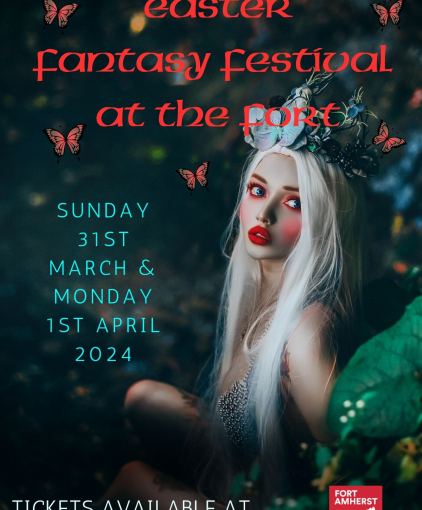
Easter Sunday, 31st March and Easter Monday 1st April, 10am-4pm
Delighted to confirm that I’ll be at the Fort Amherst Fantasy Festival on Easter Sunday/Monday! I’ll be seeing and signing books and hopefully not getting lost in the tunnels. Grab your early bird tickets here.
Fort Amherst Family Fantasy Festival
On Easter Sunday and Monday, the historic tunnels of Fort Amherst will be transformed into a child-friendly fantasy world of make believe and science fiction. The tunnels will be home to a spectacle of fairies and goblins, Star Wars characters, Pirates of the Caribbean, Doctor Who players, Fantasy Creatures and Dragons, and other exciting characters.
Joining the fun will be the amazing wacky performers of the Kentspectations Steam Punk Group bringing a Victorian science fiction element to the festival. Alongside them will be the sinister figures of the Vader’s Raiders cosplay group including a special appearance of the legendary Chewbacca.
In the Cave Yard Captain Jack Sparrow will enthral you with his Black Pearl ship display and piratical activities. Little pirates will be able to brush-up on their buccaneering skills with sword fighting and lessons in talking like a Pirate!
There will be a number of other engaging activities such as children’s activities, storytelling, and more. Also check out the ‘science fiction and fantasy worlds’ trade stands.
Children are encouraged to join in with the fun by dressing up as their favourite fantasy characters.
Around every corner you will encounter creatures galore, all of whom will provide the perfect photo opportunity for the young and at heart.
Merry Christmas! That’s if you celebrate, if not then Happy Monday! Mondays have been ‘New Podcast Day’ for the last seven and a bit years, and today marks the release of my last ever episode of The Bestseller Experiment as co-presenter. Why am I leaving? I explain myself in full here. And rest assured that this isn’t the end of the podcast: Mr D will continue and it’s going to be amazing.
What will I be up to in the meantime? Well, stand by for an update in the New Year. Until then, here’s our special Christmas episode where I share some of my favourite moments, outtakes, and we get a visit from a very special elf…
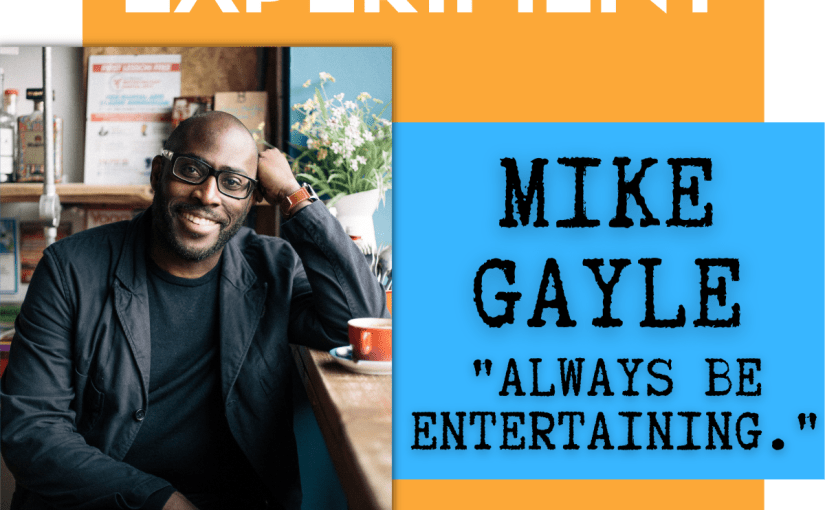
Can’t think of a better author to wrap up 2023 on the Bestseller Experiment with than Mike Gayle. He’s celebrating 25 years of his amazing debut novel My Legendary Girlfriend and he’s got a new one out, A Song of Me and You. We chat about keeping warm in the winter (we’re middle aged writers, so this is relevant!), how to make unlikeable characters engaging, and the really important lesson he learned from being the agony uncle for the teen magazine Bliss in the 90s…
It’s always great to have a guest on the podcast who was a listener who got a book deal, and Luke Chilton described himself as a “hardcore fan” when he dropped us a line pitching to come on the show. How can we turn down a request like that? Also, I had the pleasure of giving Luke feedback of an early draft of his debut novel ‘Don’t Swipe Right’ when it was called ‘Ex’. It’s a cracking read, a thriller with heart and humour and the rights have been sold in over ten countries and Luke has had the most amazing reviews.
Here’s the episode with our chat, and also enjoy the moment where I make a very inappropriate joke about the Joy of Sex with Mr D…








 Mark Stay Writes