This month’s special guest bestselling author Sarah Pinborough reveals when she knows that’s she ready to start writing…
TRANSCRIPT
MARK: What’s the thing that makes you think you’re ready to start writing on a project?
SARAH: When I’ve got the ending locked in place. I can’t start to write without… I have to see the final scene of the book in my head. So… Behind Her Eyes, the final chapter was in the pitch of the book. So I don’t have the whole book planned, obviously, but I tend to kind of have to have the characters names, a bit of a tent pegging. and the ending has to be locked so I know what I’m working towards. But you know, I’m great one for mulling… mulling for a long time. I think that’s the hardest part, isn’t it?
I’m delighted to be returning to the MCM Comic Con at the cavernous Excel Centre in London this weekend where I’ll be selling and signing m’books.
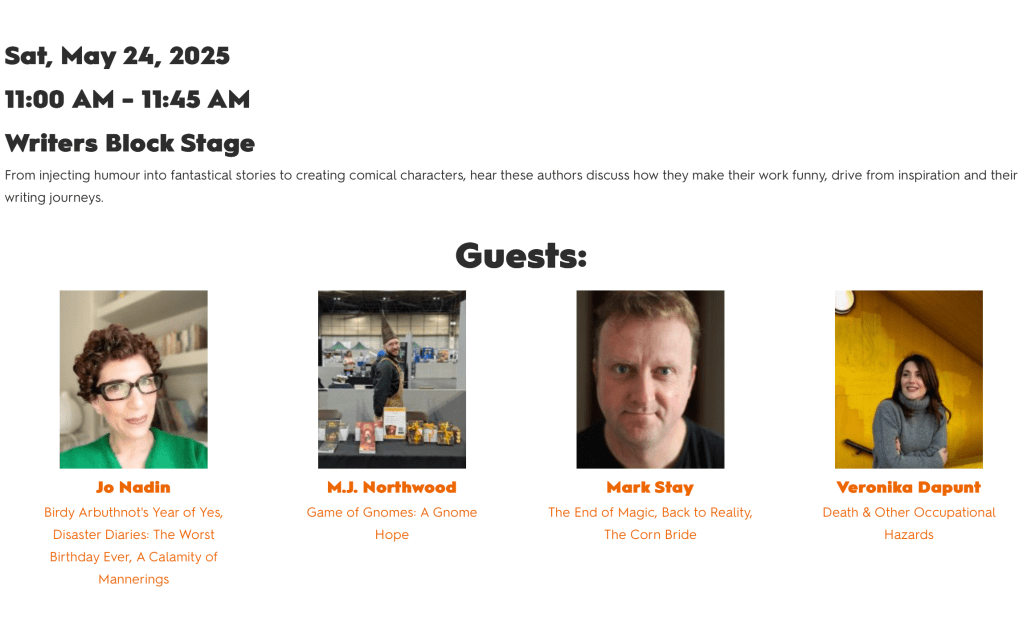
On the Saturday, I’ll be moderating a panel on writing comedy with these amazing authors: Joanna Nadin, MJ Northwood and Veronika Dapunt (click on the image for more details)…
If you’re one of the many thousands attending the MCM do please come along and say hello. I’ll be with all the fab authors in the WRITERS’ BLOCK where you’re bound to find a new favourite author.
I chat with Sarah Pinborough, the bestselling and award-winning author of Behind Her Eyes about her new thriller We Live Here Now, spooky houses, her method of ‘triple writing’, going on tour and the lies we tell each other…
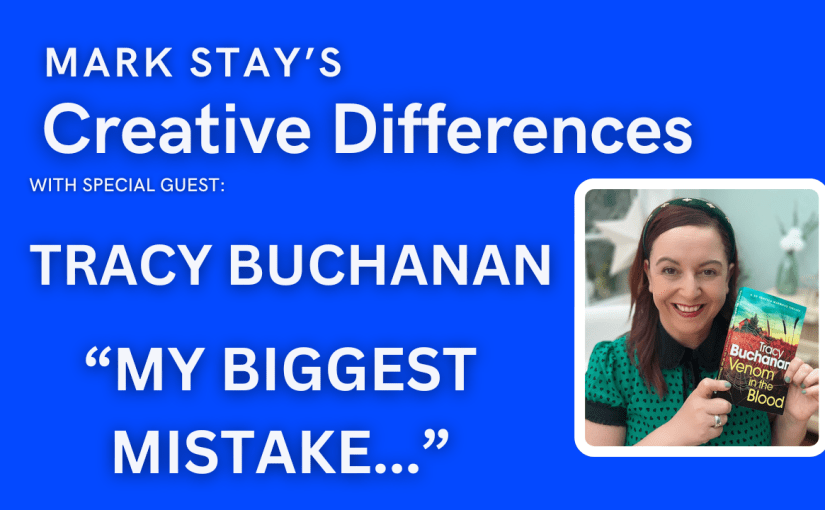
This month’s special guest bestselling author Tracy Buchanan reveals her biggest mistake in her career…
TRANSCRIPT
MARK: So what’s the biggest mistake you’ve ever made in your writing career?
TRACY: I think not being consistent and maybe pivoting too much sometimes. So, because I’m savvy I’m very aware of being careful with what publishers I’m with. I’ve learned that publishers are pretty much the same. A lot of publishers are the same. As in they’re great. A lot of publishers are great. And at the end of the day, you’re the one who’s in control. So they are helping you in a way. They’re almost like a freelancer for you. So staying with publishers, you know, I think there’s… it’s important to have that consistency. So I probably have, when I’ve been offered opportunities, jumped around a little bit too much. So, I think that’s, that’s something… I wouldn’t say it’s the biggest mistake I’ve made, but , you know, just being a bit more consistent.
This month’s special guest Tracy Buchanan reveals how her dog inspires her creativity…
TRANSCRIPT:
MARK: What small thing has made a big difference to your creative process?
TRACY: Oh, having a dog in my office. A small thing: it’s walks. I know that sounds really… Going out for walks when I get stuck on something or trying to come up with ideas. And that’s what my dog — my dog assistant is snoring at the moment — comes in. So that’s that is a small thing for me, because if I’m sat there and I cannot figure out this plot hole, if I go out into nature, walk around… It untangles. So I’d always recommend that to anyone: going out for walks.
Join me with bestselling author Sarah Pinborough on the livestream that looks at the little things that make a big difference to the creative process.
Sarah Pinborough is an award-winning and New York Times, Sunday Times, and internationally bestselling author and screenwriter who is published in over 30 territories worldwide. Having published more than 25 novels across various genres, her recent books include Behind Her Eyes, now a smash-hit Netflix limited series; 13 Minutes that’s she’s developing with Carnival/NBC, The Death House that she’s adapted herself for Compelling Pictures, and her most recent book Insomnia which she adapted herself and is now streaming on Paramount+ And she’s hilarious, wise and has a lovely dog called Ted. Do please join us live as you’ll have the opportunity to ask Sarah questions on the night (and just before her big America tour!).
It’s going to be so much fun. Put that date in your diaries now…
I had a great time talking to Tom Pepperdine about my writing process in great depth. This gets very nerdy, very quickly. This is an excellent podcast for writers, so do check out the backlist, too…
Join me with bestselling author Tracy Buchanan on the livestream that looks at the little things that make a big differences to writers.
Tracy writes gripping thrillers that delve into the darkest corners of family, psychology and forensic investigation. Her books explore secrets, lies and the dangerous choices people make when pushed to the edge.
And, as a child, she crafted stories using cut-outs from her mum’s Littlewoods catalogues! She also runs one of the best writers’ groups on Facebook and is a brilliant advocate for authors. It’s going to be a really lively one, so pop the date in your diaries now!
MARK: What small thing has made a big difference to your creative process?
NADINE: What I do now… Before I just used to write my first draft — and it sounds like a big thing, but it’s not, it’s a small thing — I write the first draft, and then after that, then do the rewrite, brief re-structure, whatever. That’s the second draft. But now I don’t. I write up to act two, and then once I finish act two in the first draft, that’s when I start doing the rewrite. Because now I’m doing the rewrite, I have a clearer idea of how… I’ve fixed everything now, so I know exactly how that last third is going to finish. And I started doing that. I think with… I think I did it with The Kill List, and I think it was just a timing issue I had. Like, a personal time finishing, I thought, I’m not going to get this done if I wait to finish it. I thought, let me just start rewriting it now. When I did that, I thought, this is a better way for me to work. So that’s what I do now.
MARK: And when you get to that two thirds point, you just plough on and get straight through to the end.
NADINE: Yeah, because I’m not thinking… When I’m writing that first draft, I’m already thinking, well, I already know I need to change this now. I need to change this character, put it in a different location, or I’m just going to get rid of that subplot. I just know these things aren’t going to work. And by the time I’ve done the second draft, I’ve already done that. And then I said, that last third is… I can’t say seamless, but it’s a lot smoother. I’m not fixing things.
MARK: Yeah, it’s so weird because I’ve just done that myself actually. You know, I’m talking about trilogies being hard. I got about I was 80,000 words on this, and the ending is there, and I’m kind of thinking, hmmm… And then I’m writing, I thought, ‘Oh, that’s what this is about!’ So I’ve realised, actually, what it’s about. So I’ve had to go back and sort of, you know, make changes. And now the ending just feels so much… Not, like you say, not easier, but I know where I’m going now. I know I’m going to do it. Yeah.
NADINE: You have a much clearer… There’s no debris in your path. That’s the best way.
MARK: Yeah, yeah, yeah, yeah, yeah. It’s a lot less cluttered, isn’t it?
This month’s special guest Gareth L Powell reveals the biggest mistake of his writing career, but how this particular disaster was a blessing in disguise…
MARK: What’s the biggest mistake you’ve ever made in your writing career?
GARETH: Oh, Lord. The worst thing — I don’t know if it’s a mistake, It could have been an Act of God — But was when the first half of the first draft of Descendant Machine vanished.
MARK: Oh, God, I remember this.Yeah, yeah, yeah.
GARETH: I’d been working on it for three months, I think. And then one day, it just wasn’t on my computer. It wasn’t in the recycle bin. It wasn’t, you know, anywhere. I used various kind of, programs to claw through the hard drive to try and find it. And… nothing. It just completely vanished. So if unless I just did something ridiculously stupid in my sleep or, you know… I don’t know what, I’ve no idea what happened to it. But this entire three months work just absolutely vanished. That was a big setback because, you know, that was when I, you know, you go in that feeling where you just go cold.
MARK: Yeah.
GARETH: You know in the, sort of Agatha Christie films from the 70s when there’s, like, a pistol blast or a scream, and then you’d get a shot of a load of crows flapping up from a tree. It’s kind of like that. I just uttered a curse. Venomous. It turned the air to glass and… And I lay on the sofa and thought, I’m never gonna write again. It’s all over.
MARK: And I remember talking to this, about this at the time, and it was just one of those complete mysteries. It wasn’t like you weren’t backing stuff up. It just absolutely vanished. Is it… because this happened to a friend of mine the other day, and I said, Oh, this happens to all sorts of writers, but every one of them tells me that when they go back and rewrite it, it’s so much better. Would you say that’s true, or am I just trying to make my friend feel good?
GARETH: No, that’s true, but the book I wrote was, substantially different from the first draft I had done, and much better for. So it was a blessing in a very, very heavy disguise.






 Mark Stay Writes