The edit has begun… Does anyone know anything about the genitals of merpeople?

The email from my editor Simon Spanton pinged into my inbox on Sunday evening. The edit for The end of Magic had arrived.

This is both a thrill and a moment of panic for the writer. The waiting is over and we can finally start on the final phase of the book before it is published, but this is also when we discover what our editor really thinks of it. Simon’s email alone was several thousand words long with a breakdown of what he liked and what needed work. It was clear, thorough and very encouraging.

The document itself is marked up with comments throughout. Structurally, the book is in good shape. No major cuts needed, no tone problems, and he identified an issue with the protagonist that has been eluding me since the beginning! This is everything a writer wants from an editor.

Of course, there are problems…

I have a character eating soup from a plate (messy)

I’m vague about the size of two armies in battle

I use the word ‘limestone’ fourteen times! (Who knew?)…

DhV2cS1WkAAjKCj.jpg-large

I have a character unable to swim one minute, and then happily treading water the next

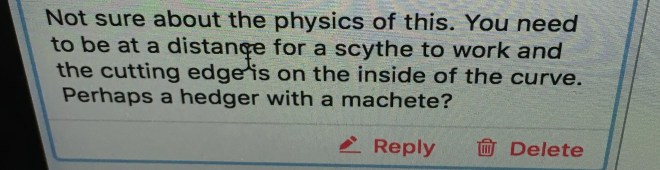
And there’s this moment with a scythe…

IMG_3260

Simon is great on military and historical accuracy, particularly anything naval. He’s picked me up on how many lashes a character has to endure, and the best way to survive a sinking ship.

Oh, and I have to make a crucial decision about the genitals of merpeople… Y’know, basic fantasy stuff.

Also, the short story I wrote to accompany the novel (available to all newsletter subscribers for free!) made me realise that I needed to change the timescale of a bit of my world’s history, so that will need to be threaded through the novel.

In all, I had about 320 comments and notes from Simon. I’ve spent the first few days triaging the easy stuff. The “delete this”, “trim that” suggestions, and the silly continuity errors and tiny plot holes. Now I have to knuckle down and do some serious character work, but I’m happy to do it because I know it will make the book so much stronger as a result. Also, this is my third novel, so going through the process a couple of times already has reassured me that the book won’t fall to pieces during the edit.

I reckon this will roll on for a couple of weeks and there might be even more revisions after that, and then we need to start thinking about the copy edit. Still a little way to go, but it promises to be fun!

PS. I also got a reader’s report on my middle grade novel Raygun (though that title will almost certainly change) from Karen Ball at Speckled Pen. Much like Simon’s edit notes, they nailed all the book’s issues, but have also inspired me to make some positive changes. I’ll be getting my teeth into that next. If you have a children’s novel that needs detailed and informed feedback, then I highly recommend Speckled Pen!


My current favourite podcasts

I’ve blogged about my favourite podcasts for writers before, but today I wanted to bang the drum for the other stuff I let into my earholes to on a weekly basis, and how it inspires me as a writer…

Ancient-History-Fangirl-Podcast-Website-Illustrated-Banner

Ancient History Fangirl is a gleeful run through the ancient world’s most gory bits. Every fortnight Genn and Jenn regale us with tales of sieges, cannibalism, war elephants and flaming pigs used as munitions. Almost every episode I find myself taking notes for some future story. The presenters’ enthusiasm is infectious and they’re already developing a nice line in running gags and in-jokes.

LkozbxSN_400x400

The Filmmakers’ Podcast (yes, I’ve added the apostrophe even if they’ve recklessly abandoned it) is essential for any aspiring filmmaker, especially if they live in the UK. The presenters, led by the very charismatic Giles Alderson have walked the walk in indie low-budget film and their passion shines through. A recent two-parter with actor Timothy Spall and director Stephen Cookson talking about how they developed the film Stanley, A Man of Variety is inspiring stuff and a great place to start.

XfvnVvGF_400x400

I probably look forward to my weekly dose of Smershpod more than any other, simply because of the number of times it has had me weeping with laughter when I’m supposed to be doing something constructive. Each week the wonderfully dry John Rain and a guest discuss either a Bond movie, or a movie with a tenuous connection to the Bond world. They’ve almost run out of Bond films (just Spectre to go), but my favourites have been the side episodes, with Meteor and Highlander being among my favourites, and I would not have discovered the classic horror flick Death Line (aka Raw Meat) were it not for Smershpod. Even if you hate Bond films (and a fair few of the guests do!) I would heartily recommend this weekly pleasure.

riNLTlNp

If your memories of ’80s movies are all Goonies and Ghostbusters, then you’re in for a shock. In ‘80s All Over, presenters and esteemed film nerds Drew McWeeny and Scott Weinberg trawl through every US release in the 1980s month-by-month, a boy there was a ton of crap released back then. Each episode is thoroughly researched and full of surprises and forgotten gems that you’ll want to watch (only to find that it’s only available in the bloody States). Their knowledge is second-to-none and though they’re currently suffering through the hell that is 1983, they have the joys of 1985 still to come.

soundtracking-with-edith-bowman-cillian-murphy-big

If you love movie soundtracks as much as I do, then we still have some way to go to meet the passion of Edith Bowman. Edith can sometimes be heard as a stand-in presenter on the Kermode and Mayo Film Review (another great podcast, but one that hardly needs introduction, surely?), but with Soundtracking she talks to actors, directors and, crucially, composers about their work and their favourite film scores. One of my favourite recent episodes featured the lovely Garth Jennings, and Edith also compiles a Spotify playlist for each episode. Every week, something new gets downloaded to my iPod.

Ku8l1Vza_400x400

Film Stories with Den of Geek‘s Simon Brew is the newest podcast – only two episodes released at the time of writing and I already love it. Simon is a delightful and enthusiastic presenter, and the podcasts are like gossipy chats with an old friend. He’s covered the tumultuous productions of The Addams Family, Tomb Raider, Patriot Games and Dirty Dancing and they’re choc full of great movie stories. I hope this one runs and runs.

31d9cc33-6136-47cf-acec-c264eb8e2a5b_junkfoodlogo

And finally an honourable mention for Junkfood Cinema with Brian Salisbury and C. Robert Cargill. Not one that I listen to every week, but they cover the films that no one else does. This gets a thumbs up for the episode on Sneakers alone. It’s nice to know that I’m not the only person who still loves that film.

Agree? Disagree? What are your favourites? Let me know below…

Oh, and don’t forget my podcast The Bestseller Experiment! Subscribe now and get scribbling.

SaveSave

Never meet your heroes (except when they’re awesome)

The podcast is a real treat this week as I got to interview a couple of my TV writing heroes. Rob Grant is co-creator of the legendary science fiction comedy series Red Dwarf, and Andrew Marshall is probably best known for the sitcom Two Point Four Children, though my favourite show of his was a black comedy he co-wrote with David Renwick called If You See God, Tell Him… It was so pitch black that it was only ever screened once, here’s a horrifying trailer…


Rob and Andrew have been working on The Quanderhorn Xperimentations. A very funny parody of The Quatermass Xperiment, which they’ve produced as a BBC radio comedy and as a novel. I was lucky enough to speak to them at the MCM Comic Con in London recently and it was like my own personal comedy writing masterclass. Luckily, I recorded it for you, dear listener, so you can hear the podcast here, which includes an exclusive clip from the audiobook.

There’s a busy month ahead on the podcast, and we have some fantastic authors, including a 90-year-old eBook pioneer. Here’s a quick trailer…


So don’t miss out and subscribe on your podcatcher of choice!

Also this week I interviewed Sam Missingham. She runs Lounge Books, which provides expert marketing advice for authors both indie and trad for £10 per month. The episode is absolutely fascinating and won’t go live for about a month, but our Patreon supporters will be getting the episode later this week. It’s so good I want them to hear it right away (once Dave has done the editing bit!). Check out our Patreon page here.

Oh, and I’ve had a few people tell how sorry they are that they missed the crowdfunding for The End of Magic. To them, and to you, I say YOU CAN STILL PRE-ORDER THE BOOK AND GET YOUR NAME IN IT AND ALL SORTS OF OTHER COOL STUFF. Just click here and hit “Pledge” – thank you!

Scrivener Features: Auto-Complete

Very handy tip for any screenwriters using Scriv…

Kay Hudson's avatarKay Hudson

I stumbled across the Auto-Complete function the other day when I was doing a menu-crawl around Scrivener’s nooks and crannies.  It’s not the same as Auto-Correct, which I’ve had to turn off.  Either Auto-Correct is too imaginative or I am: when I had the feature turned on, Scrivener kept changing my characters’ names and “correcting” other words that I didn’t notice until I reread my pages.  Or worse, until I read them to my critique group.

Auto-Complete, on the other hand, only does what you’ve told it to do, offering up long or difficult-to-type words or phrases when you type the first letter.  For novelists, I imagine this would most often be character or place names.  In my collection of unpublished novels, I have a parallel worlds tale set partially along a Texas Coast dominated by the Aztec Empire.  Tenochtitlán popped up from time to time, and I was glad…

View original post 238 more words

The Benefits of Being a Squeaky Hinge (as opposed to being unhinged)

What a week… firstly I went with the Gollancz gang to Secret Cinema’s Blade Runner, an incredible immersive experience that I’m still thinking about now. You can read about what happened (including my arrest and interrogation) here!

I also had a great time at the Herne Bay Sci-Fi By The Sea convention at the weekend. Not only was I with my brothers-in-ink Kit Cox and Thom Burgess, but it had a wonderful family atmosphere and I sold and signed quite a few books. I hope to return next year.

IMG_3201

Some of you might understandably cry, “You jammy sod, how do you get those cushy gigs?” Well, one thing I’ve learned over the years is to be a bit shameless and make a bit of noise, and I’ve tried to apply this to every avenue of life, and generally it works. Back when I was starting out as an actor, a friend put me in touch with the film director Vadim Jean. Vadim was hot off Leon the Pig Farmer and, incredibly, he returned my call… but I was out. He left a message with my dad to call back. I had already summoned up all my courage to have left a message for him in the first place, and a weird crippling shyness and fear prevented me from calling him again, and so I never did… God only knows what opportunities I missed because I felt that I was being a needy pain. It’s something I did a few more times in my youth, and I never really remedied it until I had a bit of success and younger writers started contacting me for advice! I was delighted and only too pleased to give whatever encouragement I could to steer them in the right direction… They weren’t being a pain. They were starting out and were bold enough to ask for a bit of help. Ever since I’ve overcome any doubts and been the first to volunteer myself for all sorts of endeavours. It’s one of the reasons I’m presenting a podcast, it’s how I got my agents, it’s how I summoned the nerve to invite myself to various comic cons and pretend to be in Blade Runner.

The world will not come to me, so I need to make a bit of noise to attract its attention.

The same rule applies for my agents and work life: book, TV and film people already have far too much to do, but if you want their attention you need to be a bit of a squeaky hinge. Not too taxing, not rude or obnoxious, but the squeaky hinge that can be sorted quickly so they can get on with their other stuff. Just this week, I politely chased a TV production company for an update and, as a result, I have a meeting with a director next week that could prove to be life-changing (or it could just be a nice chat over coffee… who knows?).

As I discovered with the Blade Runner experience, the more you put into something, the more you’ll get out. Be bold!

Speaking of bold, if you haven’t pre-ordered my fantasy novel, The End of Magic you can do it right now and still get your name in the book. Click here!

And you can download a short story set in the same universe. In How Drust Krax Lost Two Fingers you meet the novel’s main antagonist and it’s all seen from the POV of a defeated warlord who awaits execution, but also really, really needs to use the privvy… It’s available exclusively for my newsletter subscribers, and you can sign up for that here!

Until next time!

Mark

Blade Runner Secret Cinema – MASSIVE SPOILERS

I was lucky enough to be invited by the Gollancz gang (pictured above – photo courtesy of Kate Williams) to the latest Secret Cinema immersive experience, and this one was based on one of my favourite films, Blade Runner. I had been tempted by Secret Cinema in the past – particularly the Star Wars one last year – but the expense and commitment to costume and character was always offputting. But, as a guest of Gollancz, there was no way I could refuse the opportunity.

For the uninitiated, Secret Cinema offers an interactive evening where you essentially become part of the film. An extra in the movie’s universe. And it begins from the moment you sign up. They email you with the name of the character you’ll be playing and your role in the greater story. You’re given instructions on how to dress and a selection of props to bring. I was Nathaniel Woodville (spooky, as I went to a school called Woodville and the name ties into one of my forthcoming books). I was scavenger and chose to bring photos (precious currency in the Blade Runner universe), and an umbrella. I wore a paper suit, covered with a plastic poncho, decorated with fairy lights borrowed from my daughter, and topped off with my wife’s snood and some goggles. It cost about thirty quid in total and I have to say I looked rather fetching…

IMG_3183

From the moment you arrive, the immersive experience begins. We were abused by the LAPD outside the venue (a warehouse near Canning Town tube), the security bag checkers inside, and the ticket inspectors. They tore up my ID and stole one of my photos! It was clear that we were scavengers. The lowest of the low.

This is where you have to make a choice. Sit back and enjoy the silliness and retain your own identity, or go full method and immerse yourself in your character. Well, I bloody went for it, dodgy American accent and all. I gripped by umbrella with both hands, shuffled aroud, hunched up and twitchy as Nathaniel Woodville. Poor Nathaniel had been ground down by the system and he just wanted to get offworld. I was into it, exercising acting muscles that had been dormant for some time and loving it.

Once inside, we became embroiled in a mission to overthrow the powers-that-be and create a blackout. We had to go to Taffy’s bar and find a singer called Luna. She gave us a photo to deliver, and a message to pass on, but we were busted by the LAPD and thrown into a cage. Then I was singled out and interrogated by the cops. They were led by an actor who kept the scene on track with the story, but all the dialogue was improvised. They wanted to know why I had been speaking to Luna, and I told them I was a fan. “Then sing one of her songs…” So I then started a nervous rendition of “One more kiss, dear” from the film’s soundtrack. That seemed to help things and I continued to deny everything. Then, after bribing the cops with two photos, I was set free… But they were tailing me and I had to lose them by doubling back, scurrying into a crowd and turning my fairy lights off. This was thrilling stuff.

I sort of lost track of the story at that point, but by then I was already immersed in the world. All around me were sights and sounds familiar from the movie: ads for off-world colonies, sweeping searchlights, and a rain machine that doused Chinatown in “acid rain”. The sets were incredible: Taffy’s bar, the police station, and various eateries were all pretty faithful facsimiles of the film’s originals.

The anticipation to the promised blackout was building and we poor, oppressed scavengers began to gather in the main square, dancing in unison, raising our umbrellas in protest and getting absolutely drenched. I never went raving in my youth, but I imagine it must have felt something like this: a crowd chanting and moving as one, and thinking that anything was possible.

Once the story was over we were directed to the three movies screens where we watched the Final Cut of the film. This for me was the least successful part of the evening. The sound and picture wasn’t the best I’ve ever seen, the crowd was restless, a few were inebriated, many got up for drinks, stomping up and down the metallic seating.

Actors moved about in front of the screens and the scaffolding during key scenes, miming the dialogue – erstaz Roy Battys and Rick Deckards… It didn’t really work for me. Stage acting and film acting are two different disciplines and it all seemed a bit silly and unnecessary after what we had just been through. The flashes of lightning and red pulsing lights as the spinners flew over the Tyrell Corp buildings were much better at building the atmosphere, but it was pale in comparison to the intensity of the main event.

I had a long journey home, and lost patience with the boozed-up chatterers behind us, so I left about an hour into the film, returned to my locker, got out of my costume and put on some dry clothing. Then came the strangest bit of the evening… returning to the real world, walking through Canning Street tube station knowing that if I tried to interact with any of the real people in the same way that I had interacted with my fellow Secret Cinemagoers, they would have veered away from me, called the police, or thumped me. Part of me wanted to turn around and go back in.

From talking to friends who have been to a few of these, the Blade Runner Secret Cinema had the most successful version of the interactive element. My scavenger story was competing with the cops’ stories, with the replicants’ stories, and yet it all came to a head with a transformative moment where, for a moment, lost in time, we were all in the Los Angeles of 2019, seeing things that you people would never believe…

A free short story!

Ahead of the publication of The End of Magic (and while I wait for the dreaded edit notes to come back) I’ve been writing a short story set in the same world.

How Drust Krax Lost Two Fingers introduces the novel’s main villain Haldor Frang, and it’s told from the point of view of the hapless Drust Krax. A defeated warlord, awaiting certain death, who really, really needs to use the privvy…

I’m offering it first and exclusively to anyone who subscribes to my newsletter! To download a copy for your Kindle or any other eReader device, just sign-up here.

Please note: I’ve had all my GDPR jabs and I will never sell your information on to any third parties. It’s all safely tucked away by Mailchimp!

Big thanks to Jack Logan and Julian Barr for reading my early drafts the story, taking them down a dark alley and giving them a good kicking. Thanks also to Kit Cox for the map image used on the cover art.

I really enjoyed writing it and can’t wait to hear what you think of it!

In other news, I spoke to the wonderful Gareth L Powell on the podcast this week. We discussed the slow death of Facebook and how to sing a space opera. Listen here.

There’s also a fab Deep Dive on adaptation this week with Julian Barr (second mention in the blog today). One of us has a PhD. It won’t take you long to figure out which one of us doesn’t… You can listen to a teaser here.

And I’m on BBC Radio Kent tonight (or in the past, depending on when you read this). I’ll be talking to Dominic King on his new arts show about the podcast, Robot Overlords, The End of Magic and more. Listen or catch-up here.

Dominic King

Son of a Beach

It’s been a fun week with a trip to the beach at Whitstable to interview Julie Wassmer. I had hoped to get some lovely audio atmosphere with waves lapping on shingle and gulls screeching overhead, but the tide was out so I had to settle for a gentle breeze buffeting the microphone. Fortunately, Julie is great fun to chat to and she told me all about working on EastEnders, bumping off the locals in her novels, and why all writers should live in fear of a cup of tea and bacon sandwich. Listen here.

I finished the John Yorke Story for Screenwriting course. 16 weeks of pretty intense work. Was it worth it? Check out my thinkings over here…

I also got to visit Hachette’s new warehouse in Didcot. While this may not sound like everyone’s idea of a fun day out, I did get to ride on one of their pickers, which went some 25 metres in the air and the queues were shorter than Disney…

Also, if anyone’s concerned that print books are on the decline, this vast palace of storage and hi-tech distribution should allay those fears. This place was built to pump books out into the world and they’ve left plenty of room for expansion.

IMG_3103

I finished a short story this week. It’s a prequel to The End of Magic in which we meet our antagonist. My agent Ed read it and enjoyed it, though he did have one note: “Maybe the humour could be a little less lavatorial…? But that’s probably my shit to deal with.”

I do seem to have a thing about bodily functions… What do you say? Should I take this crap?

Also, I’m going to be on the new Dominic King arts show on BBC Radio Kent next Tuesday 12th at around 8pm. He asked me to put together a montage of voices from the podcast, which I did, but I’ve also made a “Guess the voice” quiz, which you can play here…

Till next time!

Mark

What I Learned on the John Yorke Story for Screenwriting Course…

I’ve just completed the John Yorke Story for Screenwriting course. A seven-session course, spread over 16 weeks with the ultimate aim of producing your own original treatment for a feature film or TV pilot.

Full disclosure: I was given free access to this course by John’s team after he appeared on the Bestseller Experiment podcast. It’s usual cost value is over £900, which is a fair chunk of change and something I kept in mind throughout the duration of the course.

The course covers story analysis to build your own understanding of story structure, it looks at the essential elements of story, the five-act structure, how to build stories, countless story tips, and all the time you are submitting your own work, which is reviewed by your peers on the course. You submit everything through the course website, which is a clunky thing that’s starting to show its age with a sometimes confusing user interface. Once you get used to it, it’s okay, but I found myself working with several browser tabs open as that was easier than trying to find your way through the menus.

Make no mistake, this is a big commitment, and people dropped off the course, most likely overwhelmed by the level of work required. It’s not for beginners or hobbyists. I would say this course is ideal for writers who are serious about making a career of writing: maybe they have an agent, or a credit, or have been optioned and want to hone their craft. You need to manage your time for this course carefully. I generally carved out time over the weekend. Be prepared for it to impinge on your regular routine.

The first couple of weeks ease you in and are deceptively simple. You’re asked to watch well-known feature films and complete exercises on structure based on your observations, while referring to John’s book Into The Woods. This was all good narrative theory and great fun: I get to watch Aliens for homework! Though, I have to confess that this was the point where I wondered if the course was going to be a bit lightweight for me, but looking back it was a good way to limber up before the main event.

As the course progresses the exercises become more involved and complex. You’re asked to rewrite scenes from films and TV shows (and due to John’s connection with EastEnders, I found myself watching more of that show than at any time in the last 20 years!) and your writing will be compared to the final show that was screened. Our course tutor was Kieran Grimes (script editor on shows like Red Rock, The Clinic and Fair City) who was firm and fair in his critiquing of our work and went into considerable detail with his observations and was always constrcutive and encouraging. You really felt that he was reading your work properly!

And it’s not all about structure. There’s excellent work on character, and self-analysis. Indeed, one of the most useful things I took away from the course were tools for critiquing my own work (something I’ve often struggled with). There were also opportunities to have live chat Q&As with Kieran and Ashley Pharoah (Life on Mars), which I managed to miss, being stuck on the train home when these were scheduled, but there was always an opportunity to post questions beforehand and read the transcripts afterwards (I never did, to be honest).

In the final stage of the course, you write and submit your own treatment for a feature film or TV pilot based on what you’ve learned. Like many writers, I can’t stand treatments and find them reductive and nigh-on impossible to write from scratch, but the guidance from the course on treatments was very helpful.

However, from the very beginning of the course I knew that I would be writing a treatment, so I decided to start writing a TV pilot script in parallel with the coursework, re-writing as I went as per the lessons learned. Having a completed script to hand at the end of the course made writing the final 4 page treatment was much less painful.

A couple of weeks after the deadline for submission you receive your final feedback on your treatment from both your course tutor (Kieran) and John Yorke himself. It totalled about 1300 words. As with any notes, I didn’t 100% agree with everything they said, but having two perspectives from two seasoned pros revealed common bumps in the road, and highlighted a couple of issues with my treatment, and gave me very clear and actionable notes for my next pass.

I’m always very suspicious of creative writing courses and contests and the like. They’re often nothing more than a way to part wide-eyed noobs with dreams of Hollywood from their hard-earned cash. But John’s course is designed to be practical and has tons of useable advice and tools for professional writers. It’s also unusal in that it’s not just Hollywood-focused. There’s so little for UK-based writers out there and this course fills a much-needed gap in the market. Once the course has run, you have access to all the materials used in the course, and you become part of the course alumni online, which is great for making new writer friends. So, yes, this is an expensive course, but put in the context of certain screenwriter conventions where you might pay hundreds of pounds to passively watch panels it provides good value for money.

While I was on the course, I had a TV show of mine optioned based on a pitch doc (a “Look book” rather than a treatment), and the lessons I took from the course helped me navigate my development meetings with the TV production company, and the TV pilot I produced for my final exercise is one of the strongest things I’ve written, so I’m quietly confident that it will make some noise and get me some attention. Watch this space for more…

In the meantime, here’s a link to the course.


Come and see the sci-fi by the sea shore…

Ahoy!

It’s been a couple of weeks since I’ve blogged and one reason for the delay is that I flopped into an exhausted heap after completing the crowdfunding for my novel The End of Magic. A huge thank you to everyone who pledged, spread the word, banged the drum, stopped strangers in the street etc. I could not have done it without you.

The next stage is the edit, which should take until mid-September, and I would reckon the book would be published Jan/Feb next year. In the meantime, here are all the things I learned from crowdfunding.

Oh, and there’s still time to pre-order the book and get your name in it. Just click here and choose from the list of options.

The Bestseller Experiment podcast has had an eventful few weeks: a live show with Orion Fiction editor Ben Willis where we went deep into metadata while eating cheese and onion crisps, I caught up with my filmmaking friend Deborah Haywood and talked about how she wrote and directed her fantastic debut feature film Pin Cushion (and it’s the only episode of the podcast where a guest has meowed like a cat), and I talked about being buried alive with Sharon Bolton (as you do). Never let it be said that we don’t offer a varied platter of awesomeness.

If you love a bit of sunshine and sci-fi, then I’ll be with my brothers in ink Kit Cox and Thom Burgess at the Sci-Fi by the Sea convention in Herne Bay on June 17th (Father’s day). It promises to be a fab day for geeks of all ages. Kit, Thom and I will be there signing our books and happy to chat about all things sci-fi and fantasy. We’d love to see you there, and you can get tickets here…

sci fi by the sea

sf sea 1

kit large

thom large

sf sea 2