Writing Villains. How to create the Best Baddies.

How can you write more effective bad guys? Give them a bigger sword? A more evil cackle? Or could the key to unlocking great villains be in your hero? Shock twist!

TRANSCRIPT:

Hello, folks, I’ve got to the point in the draft of this book when my traitor is about to be revealed and to be honest, the identity of this villain has ping-ponged back and forth in my head up to now. And it’s only really today I’ve got to know who they are that I’ve decided, yup, this is who it’s going to be. I’m glad to say I was surprised by the choice and that hopefully will translate into a nice surprise for the reader, too.

Of course, this means that for the next draft, I’ll have to go back and make sure it all makes sense and ensure that I leave just enough clues for the reader to allow them to add two plus to slap themselves on the forehead and realise that the answer was in front of them all along. Because that’s what you want from your readers. You want them involuntarily slapping themselves. It’s what all great writers aspire to. And what it did get me thinking about is what makes a good villain.

In earlier videos you will have heard me banging on about how theme is story fuel, how once you figured out what your central dramatic argument and theme is, you can use that to drive the protagonist’s story forward. If you’ve not seen that video, I’ll pop a link in the description below. Knowing what theme is really helps me whenever I get stuck. So for this novel, my theme is — and I always like to post theme as a question — are we better off working with others or alone?

It’s a simple question, but one that can’t be answered with a yes or no. Nothing too mind boggling, but good story fuel. And that question is what I challenge my protagonist Faye with in every chapter of this story. The funny thing is, listeners, this principle can also apply to writing your antagonist. Writing a good villain can be really tricky. You can spend so long focussing on the motives of your protagonist that when it comes to the villain, the temptation is to go, 

“Ah, whatever they just abadie dress them in black, make them do terrible things. The reader will get the idea. But there is a way to make your villains much more effective in a way that the reader will find a lot more satisfying. And it comes back to theme. So if your hero represents the thesis of a dramatic argument, your antagonist can represent the antithesis. In other words, your villain can be motivated by the opposite of your hero’s position on a theme.

So if I think of an example, in the case of my book, for example, if Faye thinks she can achieve her goals by working with others, the antagonist might do better by working alone. They might have had a terrible experience working in a team, and have struck out solo to get revenge. Also, having a thematic motivation will add a dollop of dimension to your villain that might just appeal to the reader and your hero. So the hero can’t just walk away from the villain because the baddy’s argument might at some point tempt our hero to jump ship to the other side.

The theme is a connection between the two of them that will make for compelling reading. So they might they might be a mirror of our hero and share many of their values. You see this in a lot of romances, so Elizabeth Bennet and Mr. Darcy in Pride and Prejudice, for example. The villain could be a dark shadow. Darth Vader is exactly what Luke Skywalker might become if it gives in to his anger. Or they might even be their own worst enemy. Think of George Bailey in It’s a Wonderful Life.

There’s countless ways of playing with this, but whatever direction you choose to go in, if you try and make you heroes and villain connect thematically, it will be a much more satisfying experience for you and the reader. Of course, this is all much easier said than done, and I now need to figure out how to make this work in my book. Wish me luck. Any questions on this? Is there anything you’d like me to cover in future videos? Drop me a line or leave a comment below. Until next time, happy writing.

Writing Tipping Points and How to make your Scenes Work Harder

Each scene or chapter in your story should have some kind of tipping point where a decision is made. How can you use these to make give your characters more agency and drive the story?

TRANSCRIPT

Hello, folks. I’m now about halfway through the first draft of the third Witches of Woodville book, and I’m still in that muddy middle, that middle act where it’s so important that we writers try not to get too bogged down by wondering what happens next. In previous videos I’ve talked about using theme as story fuel and writing with urgency so as not to bore the reader. And today I want to talk about the tipping points of scenes. And I was recently reading about this in John Badham’s book “On Directing”.

Badham is the director of such classic films as Saturday Night Fever, WarGames, Stakeout, The Hard Way. A really great director. And this book is a cracking read. I’ve no ambitions to direct film. I’ve directed short films many years ago, and have some idea of just how all consuming directing a feature film is. But as a writer, I like to get different perspectives on the creative process and this one’s been a really refreshing read. And in here, Badham talks about how he and the actors will often look for the tipping point of a scene.

He defines it as the most important dramatic moment in a scene. It’s the moment where, like  a seesaw, the situation can tip in favour of one character or another. However, unlike a seesaw where the tipping point is usually in the middle, the tipping point of a scene comes very close to the end as the dramatic argument comes to a peak. And these dramatic arguments don’t have to be major turning points every time in the story. It can be something as simple as deciding where to go for coffee.

What is important is that the characters — and most often your protagonist — is the one making those decisions and driving the story. From the perspective of a director like Badham and the actors that he works with, they’ll spend time looking for the tipping point in the scene in order to underpin that moment. Now, for a film director, that means close ups, or making it clear to the viewer that an important decision is being made. It’s also important for them to identify the tipping point because after that decision has been made by the character… the scene is done. Decision made. Onto the next scene.

That’s not to say the tipping point should be rushed. Badham quotes the writer-director Elia Kazan, who says, “One thing I always do, and I think that’s important in film, is to stretch climaxes.” So don’t feel you have to rush these things. I mean, one extreme is… How many comedies you’ve seen where a character will argue over something, say, “I’m not going on a date with him. I’m definitely not going on a date with him. You can’t make me go on a date with him.”

There’s a beat. You can feel the tipping point as a decision is about… to… be… maaaaaaade. And then you cut to that same person on a date with “him”. And that’s how close to the end a tipping point can be. Coming back to Kazan’s remark about stretching climaxes. Think of all those spaghetti westerns where the gunslingers face off… Staring at one another, slowly reaching for their guns, waiting for someone to make a move. That’s really great tension, really gripping.

And you can have great fun drawing that out for as long as you can. So how does this help you as a writer? Well, first of all, it can really help you with your editing. If you’ve got a scene that’s running too long, then look for a potential tipping point to get out early. Or your scene might be missing a tipping point. Which case does it need one? Can you add one? Or does the fact that it doesn’t have a tipping point make the scene redundant?

Also, try and think of your entire story as a dramatic argument with a tipping point. The central dramatic argument — that’s the theme of your story —  shouldn’t be resolved until the very end. Once it is, the story’s over. Roll credits. Turn the page. The end. I hope you found that useful. And until next time, happy writing.

Writing with Urgency, or How not to bore the reader…

The middle act of a story is where it can really start to lose its energy. So how can we keep writing with a sense of urgency that will keep the reader turning the page?

TRANSCRIPT:

Hello, folks. As discussed last week, I’m still in the middle act of this novel, still in the muddy middle, and this is where a story can really start to lose its energy. So how can we keep writing with a sense of urgency that will keep the reader turning the page? I mean, part of the problem is our characters might not want to change. They might want everything just to stay the same, keep the status quo. It’s a perfectly reasonable thing for them to want.

But you, the author, have to be an Old Testament God and make it so that they don’t have any choice but to take action and change. Sometimes we can love a protagonist so much we don’t want any harm to come to them. Stuff that. Make their lives hell and do it with a big grin on your face. It’s often only by testing these characters that we really come to love them. We tell stories about people and those stories are about change.

A story where a character overcomes challenges to become a different person is often the most satisfying. Even in a series where the protagonist doesn’t change fundamentally — say a detective series where they’re solving different crimes with each story — that will have some important element of their personality challenged by the kind of crime they’re solving. Change is an essential element of both story and character. So ask yourself whose story is this and how do they change? And also that thing of keeping the status quo isn’t wanting nothing.

It’s a desire to keep things as they are. A stable, safe life, which is totally understandable, but it must be challenged, otherwise why are we reading this story? So, for example, once upon a time there was someone who was perfectly happy, didn’t do anything, stayed the same. The end. Contrast that with Once upon a time there was someone who was perfectly happy, but something threatened that happiness. And so they had to take steps to preserve that happiness.

But in the course of doing so, made discoveries that created a new balance and a new happiness in their life. The end. There’s also a crucial difference between an active and reactive protagonist. One seeks a change in their life and goes looking for a solution, and the latter has change thrust upon them and has no choice but to change. And one of the most important elements for a protagonist is agency, that is they are the ones who, when things go awry, do the difficult thing and make decisions that will mean there’s no turning back.

They can have mentors who advise them. But in the end, it’s the protagonist who takes action. Of course, this all comes with a big, chunky caveat. What I’m talking about here is very much a Western, European, Hero’s Journey, Monomyth way of storytelling. For contrast, if you look at stories from, say, Asian cultures, it can be very different and makes for really compelling storytelling. There’s a couple of wonderful Twitter threads by the brilliant writers, Malinda Lo and Aliette De Bodard on this.

Malinda’s thoughts on this: https://twitter.com/malindalo/status/1182265991243403265

Aliette’s thoughts: https://twitter.com/aliettedb/status/1085310575113134081

I hope that was useful and until next time. Happy writing.

First Drafts… What needs to be right, and what can I fix later?

Is it okay if the first draft of your novel or screenplay is a little rough? I like to think so. Here are few tips that will help you get to the end of a messy first draft, not least the one thing you should try and get right first time…

TRANSCRIPT:

Hello, folks, when writing a first draft, is it OK if it’s, well… a little rough? I’ll be honest with you, I don’t know how to do it any other way. My first drafts are rough as sandpaper. And long ago I came to terms with the fact that I’ll probably rewrite a novel or script at least three, four or five times before it’s anything like as good as it needs to be. If this sounds like you, then rest assured you are not alone.

In over three hundred episodes of the Bestseller Experiment podcast, I’ve interviewed two, maybe three authors who are happy with their first drafts. The rest of us have to put up with the poor, wretched Frankenstein’s monsters that we will create out of pain and suffering. Here’s a question: with the first draft, what needs to be right and what can be fixed later? Well, what needs to be right? Well, none of it, really. I mean, it can be a complete disaster.

There’s a reason that first drafts are called — and apologies if you’re eating — first drafts are sometimes called vomit drafts. So please don’t overburden your first draft with your expectations. Nobody’s first draft will read like a published novel. The sooner you accept this, the more liberating it will be for your writing. I mean, I still stop myself and fix typos as I go, which is one of the reasons I’m writing more and more by hand, actually, because I scrub it out.

But if you can just burn through, and not look back, the chances of you finishing that first draft increase exponentially. You might be big outliner, but don’t feel that you need to slavishly stick to an outline, as that can create all sorts of problems, not least shoehorning your protagonist into situations simply because the Hero’s Journey or Save the Cat says so. Permit yourself the flexibility to change your story when writing. Be open to the story opportunities that will emerge as you get to know your characters.

So I’m currently working through my first draft of my next book now, and there are things that change and evolve in the characters in the story. And the temptation to go back and fix them now is really overwhelming. But… experience tells me that’s a rabbit hole that creates more problems than it solves. If you start tinkering with stuff back there, then you start second guessing stuff that you haven’t written yet, and you end up being dragged into a swirling vortex of despair.

And no one needs that. Not these days, especially. I simply leave myself a little note in the comments and I’ll focus on fixing it in the next draft, because my priority is to finish this first draft, because nothing is more important at this stage than finishing a draft. I can make fixes on the next pass to the one after that or the one after that.

Or… You get the idea. However, if you want to concentrate on one thing and get that right first time round, make it your protagonist. Your entire story hinges on their journey. So if you haven’t figured out what they want and how the journey would change them, then maybe take a second to suss that out. Start with the simple stuff. How do they start the story and how they change by the end? Some of you out there will have heard me say this a million times before, and I’m quoting screenwriter Craig Mazin here.

But if you can figure out how your protagonist goes from “this” to “the opposite of this”, then you have the through line and central dramatic argument of your story.

Now, of course, there are authors out there who write painstaking first drafts that are as good as ready for publication, but they are rare as hen’s teeth. So if you think your first draft is ace. Fantastic. Good for you. But please don’t be discouraged if you feel your first draft is lacking. I think 90 percent of writers out there will be with you in solidarity. You are not alone. I hope that was helpful. Happy writing. See you again soon.

Here’s One Way To Write A Novel (Part 2): Three-Act Structure

I’ve just hit 22,000 words on my new novel, and this is where things can get a bit sticky. To make our way through the muddy middle of a novel, it helps to understand the basics of three-act structure, so here are a few pointers…

Here’s a link to part 1… https://youtu.be/A9u0SFjv3N8

And here’s the thematic video I mention… https://youtu.be/vD64WDtWsV8

TRANSCRIPT

Hello, folks. It’s been a couple of weeks since the last update. Since then, I’ve had a haircut and my first vaccine and I’m just getting over the side effects…

I’m still using the same method to write the first draft of this book, so scribbling in a notebook one day, then switching to the laptop and bringing it to life the next. And it’s been working pretty well so far. I’ve just hit 22,000 words, which is about a quarter of the way through this book. I want it ultimately to be somewhere between 80- and 90,000 words tops. So I’m about to hit what is possibly the most difficult part of the novel.

The second act, the muddy middle. As I said in the first video, and I’ll pop a link below if you haven’t seen it: https://youtu.be/A9u0SFjv3N8 — openings are relatively easy. Everything’s exciting. The world is your oyster. But when you get to the end of the first act, your characters will have started making choices that have consequences. Story consequences. So how do you navigate this? Well, let’s take a moment to talk about the basics of structure. All stories have this in common: a beginning, a middle, and an end. This is the three act structure at its simplest, used by the ancient Greeks in their storytelling, still used by Hollywood today.

Now, you may have read all sorts of fancy stuff about four-act, five-act, seven-act structures, pyramids, diagrams, all sorts of stuff. But in the end, it all comes down to these three essential beats: a beginning, a middle, and end. And why are we even talking about acts? We’re writing a novel. Well, this is largely because the language of theatre and screenwriting has seeped into the bigger conversation about narrative. But it really does help to think of your story in these terms, not least because an understanding of story structure will help you identify the strengths and weaknesses of your writing and enhance your self-critical skills. Here’s a simple breakdown of how the acts work. So, Act One is all about the set up, and that’s what I basically just completed. I’ve introduced my main characters. The setting, the themes, the tone and the rules of the story are established. There will be some kind of incident that will trigger the story and set the protagonist on the path of the story. The First Act usually ends with a turning point that will launch Act Two. Act Two is all about confrontation. Your protagonist will be tested as they strive to achieve their goal, the action rises and rises, leading to a midpoint that then becomes a crisis. The final events of Act Two, which often herald disaster or certain failure for our hero, will trigger the events of Act Three. Act Three is all about resolution. The stakes are raised to the point where we think it’s going to end in disaster. But the protagonist will take the lessons learned by the tests of Act two and find a resolution. They will almost certainly have changed from the person they were in Act one. And that’s it. The building blocks of story.

You can apply this not only to your overall story, but to each chapter which will have its own beginning, middle and an end. So this is what I have ahead of me next. Act Two. This is where I test my characters like an Old Testament God making their lives increasingly difficult. The good news is I have a pretty good idea of how I want Act three and the ending to pan out. So I just need to bridge that gap with some fun shenanigans.

And if I get stuck, then I need to take a moment just to think thematically. I covered that in a previous video… https://youtu.be/vD64WDtWsV8

Again, I’ll pop a link below. Sounds easy, doesn’t it? Hmm. I’ve just written a scene where they come to a door and I have only the vaguest idea of who is on the other side. So, yeah, we’ll see. It’s never easy. But here goes. There’ll be another update a couple of weeks and until then, happy writing.

Here’s One Way To Write A First Draft

I’ve been working on a new way of writing the first draft of my novel. And it’s been working really well… so far…

TRANSCRIPT:

Hello, folks. Apologies for the hair. Still in lockdown and two weeks till I get a haircut, so this is going to get worse before it gets better. Anyway, I’m working on the first draft of Skyclad, the third Witches of Woodville book.

Regulars will know that I used to be a big outliner when it came to writing, but I’m becoming more and more of a pantser or discovery writer, whatever you want to call it.

That is, I’m making it up as I go along. Well, sort of. I do have a rough idea of where I’m going and I know how I want the story to end. And I have a few key notes on a few key moments, but I thought you might be interested to know how I’m working with this one. Again, regulars might know that I have a different notebook dedicated to each project. Here’s the one for Book Three of the witches of Woodville, Skyclad.

This was bought at the National Trust Gift Shop at the White Cliffs of Dover, which is a little clue as to where some of the book will take place. What I’ve taken to doing with this story is switching from day to day between paper — the notebook — and the screen — the laptop — and it’s really working for me. So to give you some idea… On, say, Monday, I will start noodling ideas for what happens next in the story in The Notebook.

So here I’ve written in big letters, “How can the Poltergeist exorcism go wrong?” Slight spoiler, but it’s the opening scene. I’ve made notes on what can happen in that scene and they are imperfect notes. I’ve given myself permission to wander off, and noodle and try different scenarios, and scribble stuff out, and put other things in boxes and underline them, and highlight them. And what I find is that by the end of the writing session, I have a really good idea of how that chapter pans out.

The level of detail varies from session to session. But the next day, Tuesday, when I open up the laptop, I’m not victim to the tyranny of the blinking cursor. You know that feeling when you look at a blank page of Word or Scrivener that bastard cursor is flashing at you, “Go on, write something. What are you waiting for? Call yourself a writer?” Well, now I just go to my notes and start typing, and before I know it I’m up and running. I used the less formalised version of this with The Crow Folk and the second book, Babes in the Wood, available to pre-order now.

And it worked really well. So this is an evolution of that. A few caveats. I’m only 10,000 words into this novel and, in my experience, openings are pretty easy when compared to the rest of the book… not least the middle section, which can lead to much wailing and gnashing of teeth. So I’ll check in with this in about a month’s time and see if I’m feeling quite so smug still. Also, I’m writing the third book in a series.

I know the characters and situations really well. I have a very good idea of how people will react when presented with challenges. And that makes a writer’s life much, much easier and makes me wonder why it’s taken me so long to write a series. This is so much fun. Anyway, I hope you found that helpful. How is your writing going? Does this sort of method work for you? Pop a comment below or drop me a line. In the meantime, happy writing.

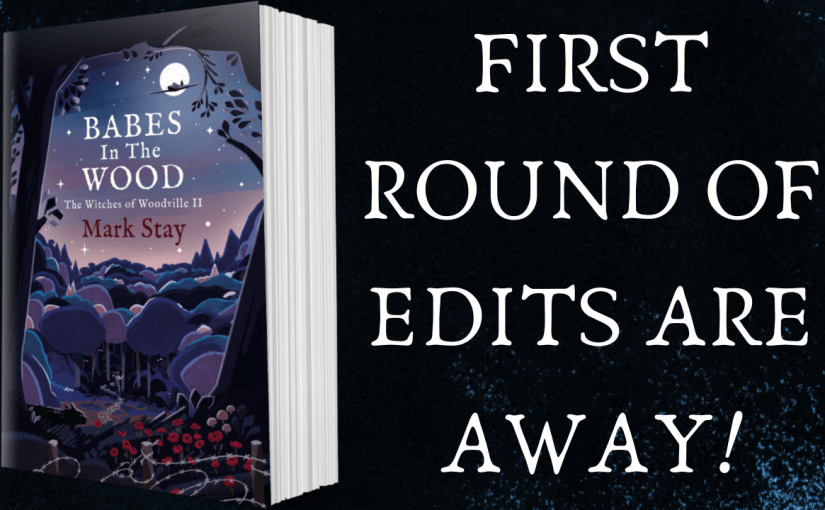
The First Round of Edits Are Away!

Why do I love editors? Because they help me create a better book. I’ve spent the last week or so in the first round of edits for my next book Babes in the Wood, and here’s what I learned…

Apologies in advance for… the wind…

TRANSCRIPT:

Hello, folks, Mark Stay here. Last time we talked, I’d just started the edits on book two of the
Witches of Woodville: Babes in the Wood. Well, after a week and a bit
of intense editorialising they’re done.
They’re off to my… Well, I say “done”. This is probably the first round, but they’re off to my editor, Simon & Schuster, Bethan, for her to have a look at. Lessons learned? Well, um, this took longer than the first book. Now, the first book was Alpha-read and Beta-read up the wazzoo. Lots of eyes on that before it went off to any publisher. So it was in very, very good shape.
This one was in good shape, too. But, uh, there is a murder mystery element to it.
Which… Writing any kind of mystery like that is, is storytelling with the hood off, you know, everyone can see the working parts because you put them there on display for people to… To notice things. And if everything doesn’t quite make sense, then it really stands out in a way that other stories, you know, you can probably get away with the odd teeny weeny plot hole. So this one, most of Bethan’s notes were just little clarifications. Can you make this a bit clearer? Can you hang a lantern on this? You know, can you emphasise this a bit more? Uh, of course, during, uh, during my edit, I realised one massive plot hole was that I have a murder and never once explain how the murder was done. Only I could do that. Um, this is why you have editors, folks. So, uh, that was handy. I was able to… The thing is I’d written it down. I put it in my notebook. This is one good reason why you should have a notebook, folks, for each project that you’re doing, because I had actually written it down. I just hadn’t put it in the actual novel. Small point. But, you know, we always catch it in the end, which is good.
So, yeah, really happy with it.
And it gave me the opportunity to add a few extra layers, a few extra flourishes that… Particularly towards the end I wanted to ramp up the tension a little bit more. So I’m really happy with it. Really happy with it. So that’s gone off to Bethan. She’s in the middle of editing another book. So it might be a few weeks before I see it again.
But until then, I’ve got a short story to edit. I’ve got a short story to finish. These are the Miss Charlotte Quartet stories. So, I’m gonna spend this weekend… Beautiful… I’m gonna spend this weekend rereading that and giving that a final polish, and getting that ready. So if you subscribe to my newsletter, you can get these stories for free. Free! Number one’s out already.
I know.
Good, innit?
Number two is coming on the fourth of April in ebook and audio… Got to record that too. And then
three and four are on their way. So that’ll keep me busy. That’ll keep me out of trouble. So yeah. If I hear any more on the edit…
I’ll let you know. I’ll get back to you. In the meantime, I’m just going to pop into my local library.
Happy reading.
Happy writing. See you again soon.

FIVE TIPS: BEFORE YOU EDIT YOUR NOVEL

I’ve got the notes from my editor on my manuscript. Now what? After a week of avoiding my edits, it’s time to knuckle down. Here are five quick tips to help you sort through editor notes before you start your next draft…

TRANSCRIPT:

Hello folks, about a week ago, I put up a video talking about how I just got my edit notes from my editor, Bethan at Simon & Schuster, for the next book in the Witches of Woodville series, the The Babes in the Wood book.
And if you were watching that video, you might think, oh, he’s got his notes. And we talked a bit about things like the edit triage and and, you know, just looking at headlines, bullet points
and making notes and stuff like that. And you’d be perfectly forgiven for thinking that immediately upon me, you know, finishing that video, I would jump straight into the edit. So what have I been up to since then? Procrastination, mainly, we can talk about procrastination, if you like,
maybe later. But, actually to be fair, I have had a couple of rewrites on two short stories and also some light rewriting on a horror movie which essentially took all week. So, you know, I’ve been doing that. I think, to be honest, it is a good thing not to jump in with both feet. As soon as you get your edit notes, you know those ideas, you know, you read and review those notes that your editor has sent you. Let them simmer in your brain, gain some acceptance from that time. Procrastinating.
That’s my excuse. And I’m sticking to it, During the meanwhilst, here are five tips on the first things to do before you start your edit…

Save a copy.
Seriously, save it. The original one that your editor sent you. Save it, file it away, leave it untouched. Don’t change anything because there will come a point in the edit where you’ll come across something and you think, oh, what did my editor say about that? And you won’t have any way of knowing…

Accept all changes.
I’m going to show a little video here. There’s a thing in Word and other similar word processors called “track changes” where the editor will turn that on and every single change that they
make comes up as a change. And you have a choice to accept or reject that change. Frankly, when it comes to the punctuation and grammar changes, there will be hundreds of them. Just “accept all”, you know, there’ll be a way of doing that easily on your bit of software. Google it. You’ll find a YouTube video that will tell you how to do that just “accept all” because frankly, they know their
punctuation and grammar. Just accept it.
They may make changes to a sentence or may make changes to a particular word. A good editor will leave a note saying, “I’ve changed this… Is that OK?” Or “Does this make more sense?” And, you know, you can maybe go back to your original document, which you will have saved, and have a look and see if that change is harmful or gratuitous in some way. But frankly, in my experience, they don’t make any crucial difference. These these are words that, you know, just there for clarity… Changes
are just there for the reader. This draft is not for you. It is for the reader. Hence, all drafts from now will be for the reader as well. Just ask yourself, “Is this a hill I’m willing to die on?”
Because in my experience, by the time you got round to the copy edit and the proof edit you’re kind of… You can’t even remember what that word was anyway, so just accept all changes.

So after that, you’ll be left with the comments. I’ve got about three hundred and thirty comments left on my document now from down from five hundred something. Go through those comments, read, make notes, reply to yourself, you know, make quick fixes if you want. Sometimes, you know, you’ll have duplicated word in a sentence or a paragraph and they’re pretty easy to fix. But don’t be tempted to make any big changes yet. Wait till you get to the end, because sometimes editors will see something that bumps them out of the story, make a comment about it, suggest changing it, and then later on, when they get to the end, they realised that was actually part of a plot twist all along. So don’t change it because it may be something that just needs a little bit of clarification or might be fine, just as it is. So read the comments, make notes.

Don’t just focus on the criticism. Look at the praise, too, because a good editor will leave you praise. It’s called the praise sandwich. It’s like, “This works.” “This is a bit rubbish.” “This is wonderful.” Fragile egos of writers strikes again. But actually praise is really helpful because it tells you what’s working. Lean into that when you rewrite.

And don’t feel you need to reply to the editor’s comments. You know, sometimes they’re just posing a question just to prompt a thought from you. You know, they’ll say, is this really necessary? Do you really… Does this make sense? Did they really do that back then? So the editor isn’t necessarily asking for a reply when you send back the next draft, although if you feel you would just want to clarify a point, that’s fine. But it’s usually a good sign that it’s something that’s bumped them out of the story. Might need a quick fix. So think of it that way.

So, folks, five tips. I think that was five. Pretty sure it’s five… Five tips for when you start your edit. I hope that was useful. If it was, give us a thumbs up, leave a comment. All that jazz. Share with writing groups, all that good stuff. If you’ve got any comments pop them below and I will reply. Stay tuned for some goodnews coming about the next book. Some cool news coming on Friday (cover reveal). So, yeah, stay tuned for that. And in the meantime, happy writing.

The First Edits for Babes in the Wood…

I’ve just got my first set of notes back from my editor for the next Witches of Woodville book BABES IN THE WOOD, so this is a great time to take you on the journey with me from editing a book to publication. I run through what a marked-up manuscript from an editor looks like and how I plan to tackle over 500 changes and comments…

TRANSCRIPT:

Hello, folks, Mark Stay here.
The second Witches of Woodville book Babes in the Wood, is coming in October 2021, October 28th, I think, just in time for Halloween. And it’s March now, March the 5th. And I’ve just had my first round of line edits turn from my editor, Bethan, at Simon and Schuster. So I thought what I’d do on the ol’ YouTubes is start a whole new thread of the road to publication for Babes in the Woods, starting now. So where I am now, I’ve already written a couple of drafts which have gone to friends, beta readers who’ve made comments and sent thoughts back to me, and I’ve made changes before sending it off to Bethan. I’ve also had… This book involves Kindertransport children, so Jewish children fleeing the blitzkrieg and the Holocaust and coming to England. And I’ve already had a reader, a Jewish reader, go through that and give me all sorts of feedback and notes on that as well. So it’s in pretty good shape. Bethan has come back with a marked-up Word manuscript, which has got… 560 comments or changes, which I’m pretty happy with, actually, I think my first book Robot Overlords had well over 3000 comments and changes on there, so that’s doing pretty, pretty good. So, yeah, we got the first round of edits. I got this marked up manuscript of all sorts of little bumps in the road. So we have a look at some of these on screen. So Bethan’s… uh… Just if you’ve never done this before, we have a thing on Word and Pages and bits of software like that could tracked changes where any changes or comments that your editor makes is marked up so you can see it and easily recognise where a change has been made and accept or reject that change. And also, she’s left comments. And Bethan is brilliant because she doesn’t miss a thing. She notices all the little bumps, all the little things I got wrong,anything that bumps her out the story. But she also does the old “praise sandwich” as well, which is where you say, “Oh, this is good, this needs work, but this is great.” So the author’s poor, fragile, ego isn’t too bruised. What I’ve got now is what I call the edit triage, which is where I go through the comments. I make my own notes in a notebook. I try and take it off the page. And also Bethan has sent me a separate document as a kind of summary of her editorial notes of the big, big problems to solve, which is why the triage thing comes in. If you’ve got you know, do you think of your book as a patient lying on a gurney, you know, what do you have to fix first to save their life? You know, what’s the what’s the biggest injury? So rather than worrying about, you know, slightly… Any punctuation or grammar or anything like that, at the moment, you look at the bigger picture, start wide and move in and move in. So, yeah, really, really good notes. I’ve got a month to sort this out, which should be plenty of time. So we’re in March now. Book is published in October…

Yes, October.
Babes in the Wood is book two of the Witches of Woodville series and available to pre-order from retailers now. Visit your retailer of choice or go to the bookshop at WitchesOfWoodville.com and now back to your regular programming

… which if you’re an indie author thinking, well, why are you taking so long? Why does it take so long to get the book to market? Well, part of that is that we’re working to retailer critical paths. So someone like Simon & Schuster will be selling in two retailers, six, seven, eight, nine months in advance of publication. For some retailers, they ask for a lot longer ahead of publication or sometimes over a year. So, yeah, that’s one of the reasons. And of course, you know, a publisher Simon & Schuster will be doing it in forty, fifty, sixty books a month depending on the month. So the marketing departments, the publicity, the art departments, they’ve all got to you know, they’ve got huge, huge workloads to work through. So better to give yourself plenty of time to do it properly, then have it as a last minute rush. So, yeah, I’m looking forward to this. I’m going to I’m going to dig in and start figuring out the big changes I need to make. There’s a murder mystery element to this, which I’ve never done before. And what’s been great with Bethan’s notes is, you know, she just said: a bit of clarity here, a little bit more mystery here. Wouldn’t she have thought this here, stuff like that. So it’s it’s been very, very helpful. So, yeah, I’m going to jump in and maybe check in in a week or maybe two weeks to give you an idea of how I’m getting on. And then after that, we’ll go through the whole rest of the process.

Things like looking at bits of cover art, looking at the blurb, looking at how we might publicise this one, what with lockdown, hopefully not being a thing by the time this comes out. So, yeah, first step on the path to publication. I hope you’ll join me further down the road.

How To Market Your Book On YouTube – Episode 14

In this series author Mark Stay & video marketer Jeremy Mason lift the lid on how to market a book. The series is a real-life case study – as we catalogue the book marketing journey of Mark’s latest book The Crow Folk (Simon & Schuster). Each episode comes laden with book marketing tips, offers insights into book publishing as well as ideas about author marketing.

In this episode we cover: book blog tours (and why they’re critical to a post-launch book marketing strategy) – how to find your dream book editorbeta readers (why you need them, and how to find them) – using StreamYard for virtual book launches