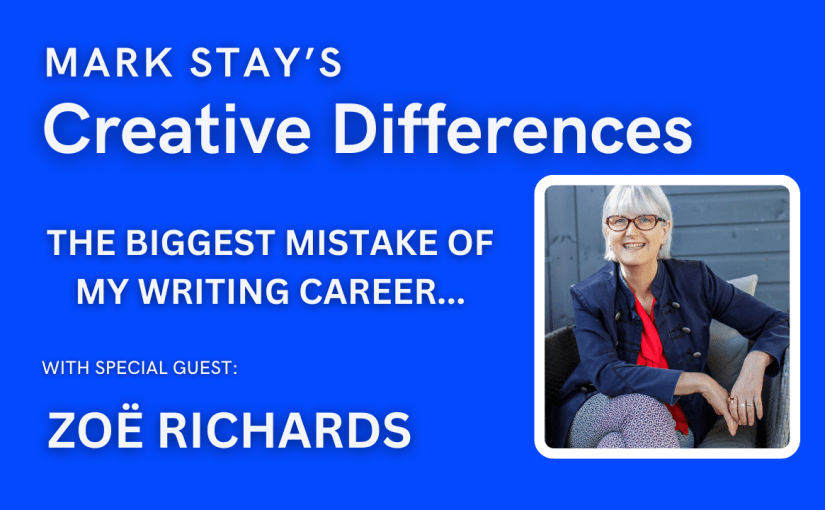
My Biggest Mistake as a Writer: Zoë Richards

This month’s special guest Zoë Richards reveals the biggest mistake in her writing career…

TRANSCRIPT

MARK: What’s the biggest mistake you’ve ever made in your writing career?

ZOË: Doubting myself. So, many years ago, and I’m talking. I think, around about 22 years ago,
Writing Magazine had an offer from an agent that you could send in up to 3000 words. So I sent off to her 3000 words, and she came back. And now I reflect backwards and it’s like, oh, she gave me such incredibly good advice, but I didn’t get the “Well done, Zoë, you are a Gold Star student.” So because because I was brought up with the coercive control of “you are not good enough unless you are the star student.” When I came home second in the year, I’m sure you can guess where this is going. Second in the year out of 145 kids and I said I came home I came second in geography,
and my dad’s answer was, “What are you going to do next year to be first?” And there wasn’t a smile
in that response. So I was always expected to be the best in class. So this agent didn’t
make me best in class. So I believed I wasn’t a writer and I didn’t write for a few years. So I would say, anybody who gets rejection, remember, first off, if they give you a nuggets, store the nugget. You might not be able to accept what they’ve told you today, but at some point you’ll be ready to accept what they’ve told you. And she told me, was write what you know. I can tell that you’re writing something now that you don’t know anything about it. So either write something
you already know about or go and research what you’re trying to write about. And I took it as being, I’m no good at writing. She wasn’t telling me I was no good at writing. She was telling me it was obvious I didn’t know what I was writing about. And they’re are two distinctly different things. So anyone listening who’s thinking, oh, I’m useless because I’ve had a rejection: what are they telling you? And then secondly, it’s only their opinion. And if you are 100% sure you’re right
and you’ve written good stuff, keep going. But I think we’ve always got room to improve.

MARK: Now, listeners, if you’re thinking this is incredibly good advice where I can get more of this? You have a podcast, don’t you? So let’s give that a quick plug. Zoë, tell us about Write, Dammit.

ZOË: Well, yeah, it’s called Write, Dammit because I needed to remind myself to write, dammit. And I actually did the podcast because the government created something called Integrated Care Boards, and the one I worked for was told it was over establishment and needed to reduce its numbers. So a load of us were made redundant. Nobody’s ever made redundant in the NHS, so it was a bit of a shock to us all. And I was doing a job I loved with colleagues I adored. And so I thought, well, I can’t sit around and do nothing whilst I’m looking for a job and bear in mind; my kind of job, I was the only one in the country, so not the kind of job that you can get lots of work doing. So it was very, very difficult for me to find an identical job. I was having to reinvent myself. So what I did instead was start a podcast, and I learned what I could and discovered that if I could do seven, no, if I could do eight podcast episodes I was doing better than most because the majority of people stop at seven episodes or three months of running a podcast. So I said, right, I’m doing it for four months, and I’m going to do eight episodes. So we’re now on episode 127 and it’s 18 months old.

MARK: Yeah, this is episode three and I’ve still got the will to live, so I think we’re doing alright.

ZOË: Yeah, you’ve done one before though. I think you’ll keep this one
going for sure.

We had one of those Youtube live show thingies on the podcast this week…

I’m often stopped in the street and asked, “Hey, Mark. How do those Youtube live show thingies work on the podcast? They look so much fun. How can I get involved, man?”

And I say, “Dude, it’s an exclusive for our Patreon thingy supporters. They get first dibs on all sorts of cool stuff, like the Youtube live shows where they can ask me and Mr. D questions about writing and publishing and stuff, and interact with us via the miracle medium of the Youtubes. We talked about how long your project should be, how to find other writers who will give you feedback, the kinds of deals a debut author can expect from a publishers and tips on building your mailing list, and there’s a whole long debate about swearing. It’s a fuckin’ gas, baby.”

“But can’t I just download the edited highlights a week later on the podcast?”

“Yeah, and that’s a stone groove, but nothing beats actually being there, and you get live pictures on the Youtube and sometimes people get naked.”

“Really?”

“No. Tell you what just check out the highlights of the last show here, and then sign up to our Patreon. It’ll totally wang your doodle.”

*

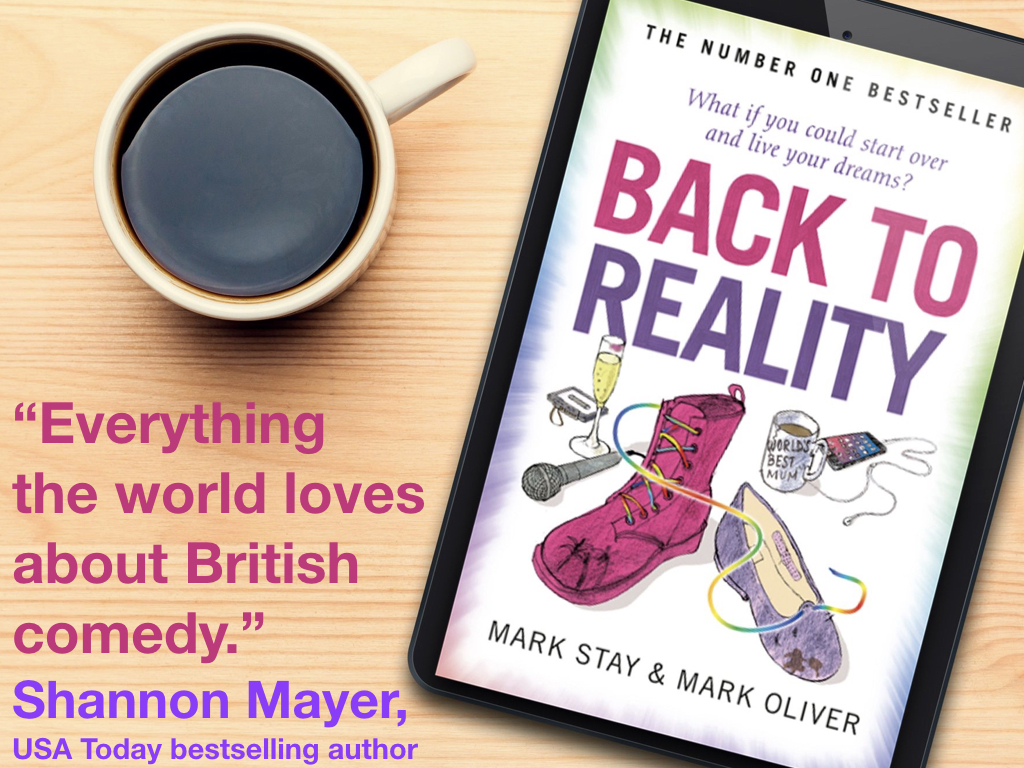
PS. We wrote a book. You might like it. Others do…

SHANNON MAYER

Film London Microschool, My Writing Diary, Ten Years On, Thursday 12th & Friday 13th October, 2006

Ten years ago, my script Waiting For Eddie had a producera director and had been chosen for the first ever Film London Microwave scheme, which was designed to produce at least two debut films with a budget of £100k.

After three days of intense workshopping (see previous blog entries), we were given a day away to prepare our pitches for the real thing on Friday…

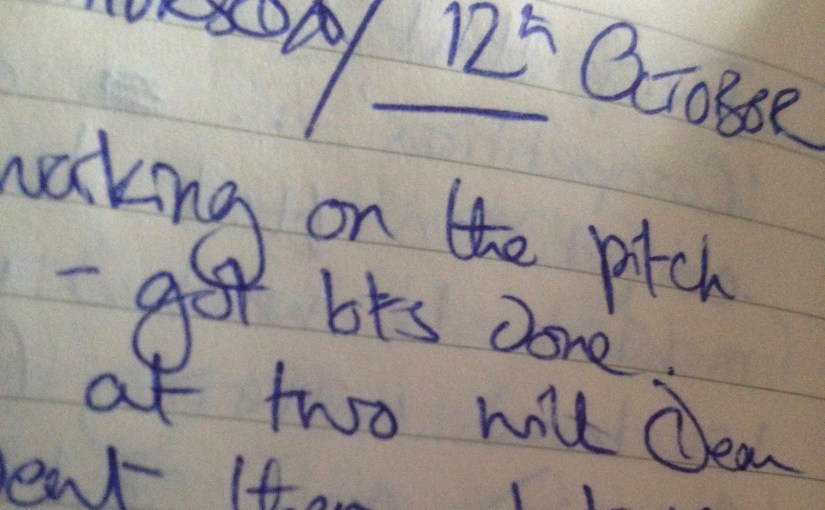
Thursday 12th October, 2006

A blissful day at home working on the pitch and the script for Eddie. Got lots done. Had a conference call with Dean and Jon. I was confident then, but nerves are starting already.

Friday 13th October, 2006

Dean, Jon and I pitched to Film London this morning. As pitches go, it was textbook stuff and we covered everything. However, Dean called a little after to nine to say that we didn’t get the green light. No reason was offered and he didn’t ask. The positive spin is that we can now go and raise a proper budget instead rather than be constrained by the strict £100k that Film London insisted on. Dean’s right: at least this way we get to make it on our terms. Still, I can’t help but feel really disappointed. The green light from Film London could have meant that the film would be in cinemas next year and would have got us all some quick recognition.

Dean also reminded me that Film London’s remit is to support independent/arthouse film, and our script is very much mainstream and commercial and much more likely to get funding elsewhere than some of the other projects on the Microwave scheme. There’s no news yet on who actually did get through. Apparently an announcement will be made in the next ten days.

Aah, can you hear it? The post-disappointment rationalisation? There is some truth in our reasoning: the script is a ghost story, with a far more substantial VFX budget than any other script on the scheme (a habit I can’t seem to shake!), and it would have been nigh-on impossible to make effectively on such a small budget. All that fluff about arthouse versus commercial is balls, though. Looking back at my script ten years on, it’s far too idiosyncratic to be commercial, and the films that were selected by Film London were both eminently marketable and, while not runaway box offices successes, earned their money back, were highly acclaimed, and successfully launched careers.

The first I saw was Eran Creevy’s Shifty, which is a fantastic debut with terrific performances from Riz Ahmed and Daniel Mays. The second was Mum and Dad, a nicely twisted horror directed by Steven Shiel.

We eventually learned that we were ultimately rejected because my script was “too TV”, which burned at the time (and felt a bit of a flannely excuse), though now it’s got my cogs whirring and wondering if there’s mileage in a London-set TV series about a haunted house and guy called Eddie trying to figure out who murdered him. TV execs: you know where to find me!

Ten Years On: My writing diary – Saturday 15th April 2006

I started keeping a diary ten years ago this month! It was partly to help me sleep at nights (I had a theory that putting the day’s events on paper would help… which it does… a bit) and partly to keep track of writing projects I’d submitted.

I mention two projects. A play called BAN THIS FILTH! which I had staged at my local theatre and thought I could adapt for radio, and a children’s book called MORRIS MINOR AND THE ABOMINABLE CHALET OF DOOM.

This was at an exciting but uncertain time for me. I had two agents – one for books, one for scripts – but was still struggling to figure out what kind of writer I was (something I’m still trying to work out, to be honest), hence the identity crisis.

There’s some light editing here, and some names have been changed or redacted to protect the innocent.

SATURDAY 15th APRIL, 2006

Two – count ’em – two! rejection letters in the post this morning. The first was for a pitch I sent to BBC radio for ‘Ban This Filth’. Fair enough. I only have the fuzziest memory of sending the pitch, so I’m not too fussed about that one (although… the shite they have on the radio sometimes…).

The second one was the real gutter. <A MAJOR PUBLISHER> said no to ‘Morris’. It was a pleasant enough rejection (‘We liked it… however…’ – I’m going to put those words on my bloody gravestone) but my agent is comparing me to Jeremy Strong (too young!) so anyone reading it is prepped for a completely different kind of book. Mind you, the rejecting editor did use words like ‘crazy’ and ‘zanier’ (is that even a word?), so I reckon I’ve had a lucky escape.

I’m not entirely sure my agent likes me, either… the rejection letter was forwarded with a blank compliment slip… No ‘Chin up… there’s plenty more fish in the sea!’ Nothing. It’s almost like an ‘I told you so’ from them. Someone needs to work on their people skills.

Ah, rejection. I like to think I cope with it a little better these days. For me, there are four stages to rejection: furious anger, blind denial, dismal depression, then a calm acceptance. I try to skip straight to the final stage if possible.

Needless to say, I’m no longer with that agent (stay tuned for the diary entry when they drop me!). And, despite my bitter accusatory tone, it’s not a fault of theirs that it wasn’t working. We were just wrong for each other. They had a fixed idea of what kind of writer I was, and I didn’t have the first clue. No wonder there was a clash. Finding your voice is one of the most important things for a writer. I clearly had some way to go…