MARK: What small thing has made a big difference to your creative process?
NADINE: What I do now… Before I just used to write my first draft — and it sounds like a big thing, but it’s not, it’s a small thing — I write the first draft, and then after that, then do the rewrite, brief re-structure, whatever. That’s the second draft. But now I don’t. I write up to act two, and then once I finish act two in the first draft, that’s when I start doing the rewrite. Because now I’m doing the rewrite, I have a clearer idea of how… I’ve fixed everything now, so I know exactly how that last third is going to finish. And I started doing that. I think with… I think I did it with The Kill List, and I think it was just a timing issue I had. Like, a personal time finishing, I thought, I’m not going to get this done if I wait to finish it. I thought, let me just start rewriting it now. When I did that, I thought, this is a better way for me to work. So that’s what I do now.
MARK: And when you get to that two thirds point, you just plough on and get straight through to the end.
NADINE: Yeah, because I’m not thinking… When I’m writing that first draft, I’m already thinking, well, I already know I need to change this now. I need to change this character, put it in a different location, or I’m just going to get rid of that subplot. I just know these things aren’t going to work. And by the time I’ve done the second draft, I’ve already done that. And then I said, that last third is… I can’t say seamless, but it’s a lot smoother. I’m not fixing things.
MARK: Yeah, it’s so weird because I’ve just done that myself actually. You know, I’m talking about trilogies being hard. I got about I was 80,000 words on this, and the ending is there, and I’m kind of thinking, hmmm… And then I’m writing, I thought, ‘Oh, that’s what this is about!’ So I’ve realised, actually, what it’s about. So I’ve had to go back and sort of, you know, make changes. And now the ending just feels so much… Not, like you say, not easier, but I know where I’m going now. I know I’m going to do it. Yeah.
NADINE: You have a much clearer… There’s no debris in your path. That’s the best way.
MARK: Yeah, yeah, yeah, yeah, yeah. It’s a lot less cluttered, isn’t it?
This month’s special guest GB Ralph reveals when he’s ready to start writing a draft…
TRANSCRIPT
MARK: What’s the thing that makes you think you’re ready to start writing on a project?
GB RALPH: When I back-calculate from my deadline and find that I’m already behind schedule. (laughs) I don’t know, where is even the start line? Is it jotting down ideas, sketching them out? Plotting? Is it start writing, ‘It was a dark and stormy night.’? I’m ready to start drafting my next book now. Like, as in, chapter one, scene one as of this week. I have a victim. I have a handful of suspects, each with their potential motives, and that’s about it. But I have I have about two novels’ worth of content and that I want to fit into one novel. So we’re bursting at the seams, and I need to start writing to see what ideas are actually smaller than I thought they were. Ones that don’t fit in at all. Ones that are maybe bigger than I had originally thought and will spark more ideas.
I’ve just got my first set of notes back from my editor for the next Witches of Woodville book BABES IN THE WOOD, so this is a great time to take you on the journey with me from editing a book to publication. I run through what a marked-up manuscript from an editor looks like and how I plan to tackle over 500 changes and comments…
TRANSCRIPT:
Hello, folks, Mark Stay here. The second Witches of Woodville book Babes in the Wood, is coming in October 2021, October 28th, I think, just in time for Halloween. And it’s March now, March the 5th. And I’ve just had my first round of line edits turn from my editor, Bethan, at Simon and Schuster. So I thought what I’d do on the ol’ YouTubes is start a whole new thread of the road to publication for Babes in the Woods, starting now. So where I am now, I’ve already written a couple of drafts which have gone to friends, beta readers who’ve made comments and sent thoughts back to me, and I’ve made changes before sending it off to Bethan. I’ve also had… This book involves Kindertransport children, so Jewish children fleeing the blitzkrieg and the Holocaust and coming to England. And I’ve already had a reader, a Jewish reader, go through that and give me all sorts of feedback and notes on that as well. So it’s in pretty good shape. Bethan has come back with a marked-up Word manuscript, which has got… 560 comments or changes, which I’m pretty happy with, actually, I think my first book Robot Overlords had well over 3000 comments and changes on there, so that’s doing pretty, pretty good. So, yeah, we got the first round of edits. I got this marked up manuscript of all sorts of little bumps in the road. So we have a look at some of these on screen. So Bethan’s… uh… Just if you’ve never done this before, we have a thing on Word and Pages and bits of software like that could tracked changes where any changes or comments that your editor makes is marked up so you can see it and easily recognise where a change has been made and accept or reject that change. And also, she’s left comments. And Bethan is brilliant because she doesn’t miss a thing. She notices all the little bumps, all the little things I got wrong,anything that bumps her out the story. But she also does the old “praise sandwich” as well, which is where you say, “Oh, this is good, this needs work, but this is great.” So the author’s poor, fragile, ego isn’t too bruised. What I’ve got now is what I call the edit triage, which is where I go through the comments. I make my own notes in a notebook. I try and take it off the page. And also Bethan has sent me a separate document as a kind of summary of her editorial notes of the big, big problems to solve, which is why the triage thing comes in. If you’ve got you know, do you think of your book as a patient lying on a gurney, you know, what do you have to fix first to save their life? You know, what’s the what’s the biggest injury? So rather than worrying about, you know, slightly… Any punctuation or grammar or anything like that, at the moment, you look at the bigger picture, start wide and move in and move in. So, yeah, really, really good notes. I’ve got a month to sort this out, which should be plenty of time. So we’re in March now. Book is published in October…
Yes, October. Babes in the Wood is book two of the Witches of Woodville series and available to pre-order from retailers now. Visit your retailer of choice or go to the bookshop at WitchesOfWoodville.com and now back to your regular programming
… which if you’re an indie author thinking, well, why are you taking so long? Why does it take so long to get the book to market? Well, part of that is that we’re working to retailer critical paths. So someone like Simon & Schuster will be selling in two retailers, six, seven, eight, nine months in advance of publication. For some retailers, they ask for a lot longer ahead of publication or sometimes over a year. So, yeah, that’s one of the reasons. And of course, you know, a publisher Simon & Schuster will be doing it in forty, fifty, sixty books a month depending on the month. So the marketing departments, the publicity, the art departments, they’ve all got to you know, they’ve got huge, huge workloads to work through. So better to give yourself plenty of time to do it properly, then have it as a last minute rush. So, yeah, I’m looking forward to this. I’m going to I’m going to dig in and start figuring out the big changes I need to make. There’s a murder mystery element to this, which I’ve never done before. And what’s been great with Bethan’s notes is, you know, she just said: a bit of clarity here, a little bit more mystery here. Wouldn’t she have thought this here, stuff like that. So it’s it’s been very, very helpful. So, yeah, I’m going to jump in and maybe check in in a week or maybe two weeks to give you an idea of how I’m getting on. And then after that, we’ll go through the whole rest of the process.
Things like looking at bits of cover art, looking at the blurb, looking at how we might publicise this one, what with lockdown, hopefully not being a thing by the time this comes out. So, yeah, first step on the path to publication. I hope you’ll join me further down the road.
She was deluged with replies, some from some very big names, and one from me. Only last week, I had a book pitch rejected by a publisher. The response I got was, “We pissed ourselves laughing, we loved it, we just don’t know how to sell it.” And that’s fine. I appreciate the honesty and know that there would be nothing worse than slogging away on a novel for however many months only for the publisher to give a shrug on publication.
And the big treat for the week is the Bestseller Experiment live show with Orion editor Emad Akhtar (pictured above). He answered all sorts of listener questions on writing, editing, storytelling and WWE wrestling… Yes really. You can listen here.
We had the excellent Alex T Smith on the podcast this week. He’s one of those children’s authors who gives so much back to the community, not least when it comes to talks and interviews that are choc full of great writing tips. I was lucky enough to talk to him at the Society of Children’s Book Writers and Illustrators‘ conference last year (a big thanks to the organisers for letting me crash the party!). I particularly enjoyed hearing about Alex’s influences, which included the likes of Frankie Howerd, Frank Spencer and ‘Allo, ‘Allo. Not the most obvious starting points when writing for young children, but he makes it work. It’s a fun interview and you can hear the whole thing when you click here.
And I say, “Dude, it’s an exclusive for our Patreon thingy supporters. They get first dibs on all sorts of cool stuff, like the Youtube live shows where they can ask me and Mr. D questions about writing and publishing and stuff, and interact with us via the miracle medium of the Youtubes. We talked about how long your project should be, how to find other writers who will give you feedback, the kinds of deals a debut author can expect from a publishers and tips on building your mailing list, and there’s a whole long debate about swearing. It’s a fuckin’ gas, baby.”
“But can’t I just download the edited highlights a week later on the podcast?”
“Yeah, and that’s a stone groove, but nothing beats actually being there, and you get live pictures on the Youtube and sometimes people get naked.”
Okay, maybe the answer to the latter is obvious as it’s the one episode that we go on about more than any other, but I think you’ll enjoy the countdown of our top five as it contains some of my favourite moments. Have a listen here.
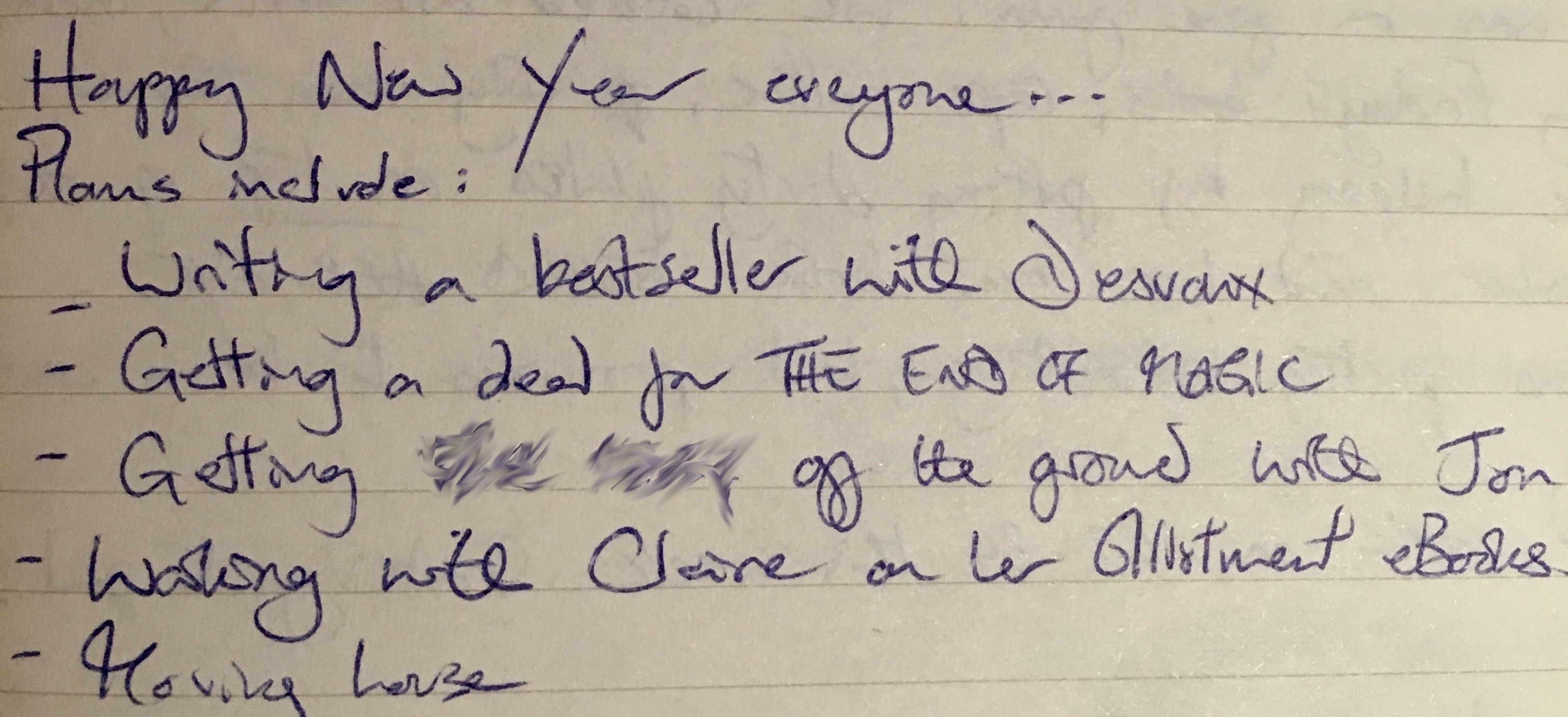
And there’s a little mini episode introduced by our editor Dave (who has a great trailer voice!), where you can hear clips from the Deep Dive extras for Patreon supporters. Me and Mr. D talk about New Year’s Resolutions, which I don’t really do, but last year I did make a list in my diary of the things I wanted to achieve with my writing in 2017. They were…
BOOM! Managed to get a tick on all of those… There might be something in this list making stuff after all…? The smudge is a top secret film project that I’m working on with Jon Wright, and there’s definitely been some action on that front, though the problem with film and TV is that so much of it is out of your hands (especially if you’re the writer) that you can make all the lists you want, it ultimately comes down to all sorts of ducks and stars aligning, so I find it’s less stressful to just go with the flow.
So what do I want from 2018? Here’s the current wish list…
Get my fantasy novel The End Of Magic published (more on that soon!)
What are your writing plans for 2018? Whatever they are, I’d love to hear about them. Sharing the pain is half the fun of being a writer. Until next time, keep writing!
If you follow the Bestseller Experiment podcast you might have noticed that we recently finished our first draft. This is always a cause for celebration, even if the draft is a big old mess (which it is) and will need a ton of work (which it will). Simply finishing something is an achievement.
I celebrated by getting a summer cold, and diving straight into rewrites of a TV pilot script. This was huge fun, as this was the script that had been give such a kicking a while ago, but I had spent the time since working on solutions that I couldn’t wait to try out.
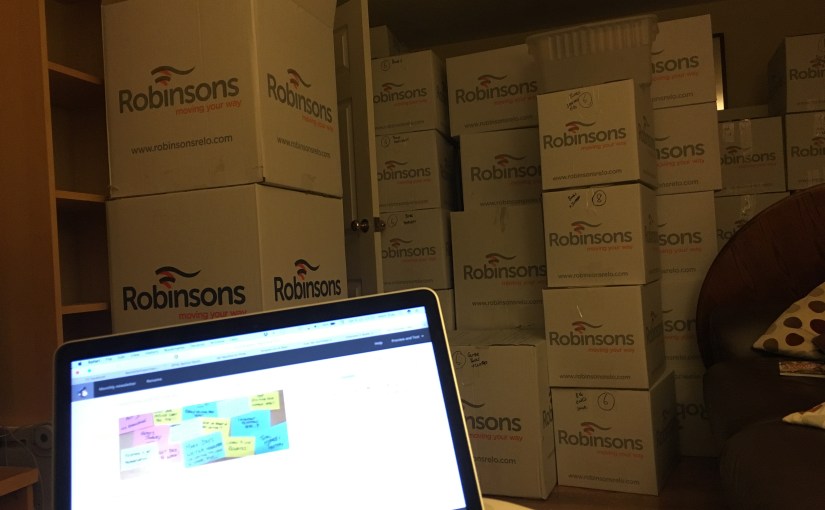
The other reason for the hurry is that I’m moving house. The Stay family is leaving the suburbs and heading to the country… Well, maybe not the country, but it’s next to a farm, and for a boy born in the city that counts as the countryside. All this means lots of packing (so many books!), and a break in my usual routine, which means I haven’t written anything other than emails to utility companies in three days.
I’m a ‘write every day’ guy. If I don’t write anything during the working day, I get twitchy. So much so, that I just snuck out of bed in the middle of the night to sit among the boxes and compose this blog…
… and that feels good, even though it’s not the full dose of happiness that I get from a bit of creative writing. But I am reassured by the response we got from Sarah Pinborough on the podcast when we asked her if she wrote every day. ‘No,’ she said. ‘That’s bollocks.’ She went on to clarify that even though she might not actually be writing her latest work in progress, she’s always thinking about it. Well, I’ve been doing lots of thinking, and I’m allowing myself to call that work, even if it’s just for a few days.
The other thought that keeps me going is that when we move I will finally have a writing room. I hate to use the phrase ‘man-cave’, due to all the icky connotations, but it will almost certainly be the very definition of male writer mid-life crisis decor: film posters, books, Lego, and I might even succumb to the lure of vinyl LPs again… Lordy, what have I become…?
In the meantime, keep writing, my friends. I love hearing about your work and news (my friend Graeme Williams just had some amazing news!) and it’ll keep me going till I see you on the other side once I’ve unpacked…





 Mark Stay Writes