I join forces with video creator & video marketer Jeremy Mason to implement digital marketing techniques to drives sales and pre-orders of my new book The Crow Folk! Join us in our adventures in video marketing and book publishing …
In Episode 9 you’ll learn: – WHY persistence is key in book marketing and book publishing – YouTube’s algorithm changes WHAT it means & WHAT you should do as a video creator – HOW to keep motivated and keep consistently creating video marketing content – HOW to deal with rejection in business and as an author – The evolution of ‘The Witches of Woodville’ book series – HOW to use YouTube Live for book marketing – What NOT to do on Facebook and YouTube Live – Brainstorming virtual book launch ideas – ACTIONABLE ideas of how to promote your book with video – HOW to use content calendars to create PR-able ideas…
Writers live in fear of a leaky story, but I’m okay with plot holes. And here’s why…
TRANSCRIPT:
Hello folks, Mark Stay here. I’m going to tell you why I’m completely okay with Plot Holes…
What is a plot hole exactly? Well, in a story, it’s one of those little bits that doesn’t quite make logical sense, doesn’t really stand up to any scrutiny.
For example, in The Godfather, just how does Tom Hagen cut that horse’s head off without anyone noticing? So in the Ewok village, Princess Leia’s dress… Where did that come from? Just how did Andy’s poster stay on the wall in his prison cell after he broke out? Just what did Bruce Willis do when he wasn’t talking to the scary ghost kid? Who exactly heard Charles Foster Kane say “Rosebud?” The entire final act of this, and every James Bond film ever made.
All of these films are bona fide classics, films that most of us love and adore. And they get a pass. We gloss over their plot holes. And why is that? Because we respond to stories on an emotional level.
As a writer, this doesn’t mean you now have license to write a story that’s full of plot holes and we all vary in our tolerance of plot holes. And you have to work hard to make sure that your story makes sense and not just, you know, paper over the cracks and hope we don’t notice.
Always write on the assumption that your readers are smarter than you are, you know, work as hard as you can to iron out all those little holes. But the thing is, when you’re dealing with stuff that doesn’t exist, you know, fantastical stuff like time travel, magic, warp speed, that sort of thing, you’re not going to be able to… One or two will inevitably slip through. However, ask yourself this: What’s more important to you? A watertight logic puzzle-style story, or something that’s going to have some emotional oomph? I know which end of the spectrum I veer towards, although none of my books have plot holes, none of them, if you doubt that you should buy them all, and read them from cover to cover and make copious notes and then drop me a line if you spot any. Anyway, hope that’s helpful. A little note on plot holes, and sleep tight in the knowledgethat when Dorothy wakes up from a trip to Oz, Toto will still be put down by Mrs. Gulch
Are you an indie author, or a seasoned writer looking to promote your book with video? TV pro Jeremy Mason joins author and screenwriter Mark Stay as they deep dive into book marketing -revealing book marketing strategies and tips for authors that will get your book discovered.
We talk cover art, vlogging for beginners with lighting tips, and how to hook your viewers in just a few seconds…
In Episode 8 you’ll learn – –
WHY you MUST invest in QUALITY cover artwork as an author – WHY book cover design is CRITICAL to your book success – WHERE you can source quality book cover design for $350 – WHAT are successful Indie Authors doing to build their success? – Deep dives into best vlogging setup for beginners – YouTube Vlogging lighting tips and tricks from a TV professional – Lighting for YouTube videos at home – YouTube Vlogging mic’s and sound setups – YouTube audio recording tips – HOW to create your YouTube home vlog set up – Basic framing guide for YouTube vlogging – The structure of an ‘ideal’ YouTube video – HOW to hook in your viewers from the start of your video – HOW to keep viewers engaged by using different backgrounds – The importance of involving your audience – HOW to use Calls To Action in your video
When you write, do you prefer to outline beforehand? Or write by the seat of your pants?
I go for a walk without a map and discuss plotting versus pantsing. Beware: heavy-handed metaphors ahead!
TRANSCRIPT:
Hello folks, Mark Stay here. I’m on a walk today. One of the things I want to talk about today is plotting versus pantsing. Something that’s been on my mind quite a bit. And I’m on a walk because, and you should be aware of this, there are some heavy-handed metaphors on their way, because I’m going on this journey today and I have no idea where I’m going. Hey, hey, hey. Plotting, pantsing, eh?! Anyway, so let’s get on with it.
So, yeah , let’s define some terms first. So, a plotter is someone who outlines before they write. A pantser is somebody who writes by the seat of their pants. And this term was completely new to me before I started the podcast I hadn’t heard of it before. I think it’s an Americanism, frankly. But yeah, it kind of makes sense. You know, there are people who make it up as they go along. And I’ll be honest, I was, uh… the idea of that always kind of terrified me and I was always a very big outliner. And anyone who’s listened to the bestseller experiment podcast will know that I got quite a bollocking for that from Ben Aaronovitch, because my outline was, well, for Back to Reality that I’d written with Mark Desvaux was some 50-odd-thousand words long. Which is, to be fair, is quite a lot. And it was quite a wake-up call for me. In my defence my background’s in screenwriting and in screenwriting, you have to outline everything because you need to serve stuff up to directors and producers, pitching stuff that you haven’t actually written yet. I’ve done it. Just this week, I put together a 10-page outline for a TV show for the director to see. Now, I’d rather write that 10-page outline than a 50-page pilot show that he then doesn’t like at all, you know, so it makes a lot of sense to do that, certainly in the film world. And certainly if you have a deal with a publisher, they’re gonna ask to see synopses upfront, but not big ones, usually just three paragraphs tops, usually. So, you know, you do have to outline a bit and certainly Ben Aaronovitch says he does, like, a page. You know, before he writes anything and other authors we’ve spoken to, people like Martina Cole, you know, they do a page. The important thing is they have an ending. They know where they’re going. They know where the protagonist is going. Anyway, back to me. and my fifty thousand word outline.
Ben’s bollocking was quite a wake up call because it made me think, actually should I really be… is this is the right way to do this? Is there a right way or wrong way to do this? So the book I’d been working on before the podcast that I put aside to write Back to Reality was my fantasy novel, The End of Magic, which I had outlined very, very heavily. You know, I had three plot strands going on and I needed to know where they were going. And I felt outlining would really, really help me. And I’d done it. I’d finished the draft before starting the podcast, put it away. And then sort of a year later, after we wrote Back to Reality, I picked it up again, had a look at it and realised two of the threads were fine, really, really good. There was one character that just wasn’t working. A character called Oskar, and he needed work. I had a choice, then. I could have sat down and outlined it very heavily. Or I could have pantsed it. Fly by the seat of my pants. Well, that’s what I did and I loved it. It was great. I mean, I had the safety mat in that I knew everything that was going on all around him, you know, I knew what’s happening with the other characters. I knew how the story was going to end. I had a very good idea of how I wanted his story to end. So I approached the rewrites of his chapters just with the attitude of “What happens next?” What can be the most interesting thing that happens to poor old Oskar? I made his life hell. Very difficult. And I loved it. I had a great experience. And what’s interesting is in a lot of the reviews, people single out Oskar’s thread as their favorite bit. So that was a lesson learned, you know, and I took that to heart. So when I started working on my next project, which was the Woodville books, I figured, you know what? Let’s pants this one. And I did.
The Witches of Woodville Books, starting with The Crow Folk. OK, I figured, you know what? Let’s pants these. A little bit of history on the books. I’d been writing them on and off for about ten years, basically as contemporary fiction set in the current day. You know, with magic and what have you. It just wasn’t working. And so I put them away and it was my TV agent who said, you know, why don’t you set them in the Second World War? He figured I could sell a TV series like that to the Americans. Much to his annoyance, probably, I started writing it as a book series. And it all clicked into place. But what I did was abandon any previous story ideas. I worked on the characters, particularly the character of Faye, and just figured where I wanted her to end up and headed towards that ending. So I did kind of a one-page outline and got to know Faye. I wrote the book up and around her. And I would ask the question, what happens next? How can I test her? How can I make life difficult for her? How will she recover? And pick herself up? And dust herself off and become a better person? And it was fun. It was really freeing.
The other habit I started was I got a notebook and at the end of my writing day, which is only a couple of hours each morning, I would write what happens next or write down sort of half baked ideas, “What happens next?” Or finish mid-sentence. And the old brain— Wow, look at this. The old brain would be ticking away. And I would usually have ideas at some point during the day. Send them to myself. And the next morning I knew what I was going to be writing. So, in a weird way I was still outlining. But just, you know, one nibble at a time. And it worked and it needed surprisingly few rewrites as well. Because that’s the thing with outlining. I think I always viewed it as a safety net. I always viewed it as that thing… How rude. I always viewed it as that thing of, you know, at least I know where I’m going. But, you know, I’ve been writing for so long now, I kind of know story structure. I kind of have a good idea of what should happen next. And then I heard on the Script Notes podcast, a brilliant talk by the screenwriter Craig Mazin, where he said what he uses is, he knows where he wants his character to end up. He kind of has his ending in place. And then he writes from the opposite of that, you know, so he knows how they’re going to change over the course of the story. So he says, whenever I got stuck, I would just think, OK, I’m going from “this” to “the opposite of this”. How is this chapter affecting that? How is my character changing in this part of the story? And it’s such a simple rule and it works. So I use that. And I’ve used it for the second book in the Woodville books, which I’ve just handed in to my agent. You know, that’s kind of been my method. But that’s not to say that I’ve abandoned plotting altogether. I have to do it with screenplays. It’s just like I said, I’ve just done a TV thing. So this idea that it needs to be an either/or thing is hooey. I think George R.R. Martin says, you know, writers are either architects or gardeners. You know, they build something or they let it grow organically. I don’t see why you can’t be an architect with a garden, frankly. Why the hell not? Yeah. By the way, this is where we shot the video for The Crow Folk. It’s changed a bit since the summer, hasn’t it? There’s normally a path here. These are new!
That’s not to poo poo people who outline, you know, outlining, I’ve done it and it’s been successful for me, you know, if that’s the way you do it, go for it. All power to you. But I don’t think you have to define yourself as one or the other. You know, allow your writing style to evolve over time, allow yourself the flexibility to change the outline, because, by all means, study the Hero’s Journey, Save the Cat, all of those seven point story things or whatever. Understanding structure is important. Definitely important because it allows you when you are stuck to maybe fix things. But what I would say is all those books, you know, on why Thelma and Louise and Silence of the Lambs is, you know, the greatest structured screenplay ever. They’re all done from a point of analysis. After the fact. The screenwriters weren’t thinking like that. You know, they were just thinking what happens next? And either through experience or their own insight, they were able to come up with great solutions. And believe me, they didn’t come up with it first time. They would have rewritten and rewritten until they got it right. See, don’t let anyone define what you should be as a writer. You have to figure it out for yourself. That takes time. It’s taken me over 20 years.
So here’s the heavy-handed metaphor bit. When I left the house this morning. I didn’t know which way I was going to walk. I knew that I was going for a walk, but I didn’t have a preplanned route. But I know the area really well. I didn’t realize it was going to be so muddy back there. But I got through it because I’ve been here before and I sort of know the way. Huh? I told you. It’s heavy-handed, didn’t I? I’m a writer. I do metaphors, me. Oh, yeah. But, you know, I’ve ended up here. I’m pretty happy with that. Yeah, it’s not bad. All things considered, at the end of it, I’m going to reward myself with a cup of tea, maybe a little cookie or something. Here we go. Till next time, happy writing. And if you get lost, don’t worry. There’s usually a path somewhere.
Are you a writer who’s struggling to get your book seen online? Are you looking for new book marketing strategies? In this series, we cover the basics of marketing your book, social media marketing for authors and all sorts of book marketing strategies and tips for authors.
This week, Jeremy and I are joined by filmmaker and animator Kai Newton who shot and edited the book trailer for my book The Crow Folk. We cover the video production process from beginning to end – covering script development, video shoot planning, how to make a YouTube video on a budget – and plenty more book marketing advice to boot.
Want to write a novel, but juggling a day job, commute and other such commitments? I’ve written novels and screenplays while shuttling back and forth to London, and here are five tips that helped me make the most of my limited time…
Are you a debut author or seasoned writer needing to know HOW to market your book? Or HOW to promote your book on YouTube?
In this in deep-dive, they talk candidly about WHICH video marketing strategies have worked, and which have not been as successful. WILL they hit their 1000 target for pre-sales before Feb 2021? WHICH digital marketing techniques will they enlist? WHICH book marketing strategy will be put to the test next on their ambitious (some may say foolhardy) quest?
In Episode 6 you will learn:
The definition of a blurb and how a few words on your book cover can make all the difference.
How to run a blog tour (or get someone to organise it for you).
Why categorisation is important, but ultimately it’s the reader who decides.
The kind of pre-publication publicity that a publisher can organise for you, including features in trade magazines like The Bookseller, and interviews in store magazines like Booktime.
Why an author should be a “squeaky wheel”!
And we take a look at other AuthorTubers and why they are so successful.
Blurbs are hard and I’ve been tweaking mine (ooh, Matron!)…
Transcript:
Hello folks, Mark Stay here. I’m sure you’ll be delighted to learn, I’ve been tweaking my blurb. Ooh, Matron. What does that mean? Well, the blurb is the book description. It’s that three paragraphs that you see on the back of the paperback or on the online retailers’ book description. And it’s one of the most powerful selling tools you have, because it’s usually the first thing that people see, and it helps them make up their mind if they actually want to read on and buy the book, and what have you. So, I got some feedback from Simon and Schuster’s sales department. They felt the blurb was reading a little bit too young… skewing a little bit too young. Let me just read it out to you to give you an idea. So here’s the blurb as was, and then I’ll talk about how I’ve tweaked it and how it’s changed.
So here’s the original blurb: As Spitfires roar overhead, and a dark figure stalks the village of Woodville, a young woman will discover her destiny. Faye bright always felt a little bit different. And today she’s found out why. She’s just stumbled across her late mother’s diary, which includes not only a spiffing recipe for jam roly poly, but spells incantations, runes and recitations… a witch’s notebook and Faye has inherited her mother’s abilities. Just in time too… the Crow Folk are coming. Led by the charismatic Pumpkinhead, their strange magic threatens Faye and the villagers. Armed with little more than her mum’s words, her trusty bicycle, the grudging help of two bickering, old ladies and some aggressive church bell ringing, Faye will find herself on the front lines of a war nobody expected. Now, the things that jump out there are references to jam roly, poly, which is in the book, and the word spiffing.
I felt they may be felt a little bit too Famous Five. This all sort of begs the question: who is this book for? You know: do you want it read by a YA market or middle grade market? And let’s define what they are: middle grade is kind of up to about… Sort of from about eight to about 12 years old. YA is anywhere from mid teens, right up to mid thirties. Actually that older, mid thirties market I think would really, really enjoy this, but you don’t want to put off a whole corner of the market that might read that and think, Oh, that’s a bit young for me. It’s a bit childish, perhaps. I mean, this book doesn’t have any swearing, because of the period really, uh, there’s, there’s no violence. Certainly not as violent as my previous books.
There’s no sex. So it could genuinely be read by anyone from the age of 10 upwards. But, it does deal with the second world war. There are demonic forces at work here. So, you know, you don’t want to put people off, but you want to sort of capture the tone of the book. So I went back and forth with my publisher on this. We removed those words like spiffing, words, like jam roly poly, and tried to make it just a little bit darker. We went a bit too far with some of our efforts, but then we dialed it back a bit. So, here’s what we got. So, uh, this is the new blurb: War rages in Europe, but in a quiet village in rural Kent, there is another battle to be won. Faye Bright has always known she was different, but when she discovers her late mother’s diary, she realizes why. It’s full of spells incantation, runes, and recitations.
It is a witch’s notebook and Faye has inherited her mother’s abilities. Just in time too. The Crow folk are coming. And they want that book. Led by the charismatic pumpkinhead, their strange magic threatens Faye and the villagers. Armed with little more than her mum’s words, the grudging help of two bickering witches, and some aggressive church bellringing, Faye will find herself on the front lines of a war with demonic forces. So you see, there are slight differences. You know, we got rid of jam roly poly, spiffing. We’ve got demonic forces in there, so it’s darker, but not too dark. And hopefully this will have that kind of crossover appeal. What’s really helped in the last week or so is I’ve started getting quotes from other authors, which is just amazing. So we’ve got a quote from Rowan Coleman. Thank you, Rowan.
This is amazing. She says it’s full of magic and delight, and we’ve put that on the front cover. And Julie Wassmer, has said it’s warm, witty, witchy, wartime fun, which again adds the fun element to it. So we don’t have to put that in the blurb. So you’ve got those two things working together. You’ve got the kind of the darkness of the blurb, but reassuring voices, other authors saying: you know what, it’s fun as well. So, yeah, we’ve also put a little shout line on the cover as well, which is: June, 1940 rationing blackouts, witchcraft. Which again, you know, combines all the, all those elements of the story. Blurbs are hard. They’re really, really hard. I mean, we’ve, uh, we’ve gone back and forth on this for months and they’re never kind of set in stone either. They’re things that evolve over time. Certainly my robot overlords blurb, has been updated recently with references to quarantine… Rather than being stuck inside. You know, you are in quarantine, lockdown, they’re using words that are very topical. That just happened. I didn’t have anything to do with that, but I think it’s very smart on the part of Gollancz to do that. So yes, blurbs: ever-evolving, ever-changing. I hope you’ve enjoyed this, hope you find it useful and, uh, speak to you again soon. Bye.
Are you a debut author or seasoned writer needing to know HOW to market your book? Or HOW to promote your book on YouTube?
In this 5th episode author Mark Stay and video marketer Jeremy Mason reveal more book marketing strategies and tips for authors.
WHICH of their video marketing strategies have worked so far? WILL they hit their 1000 target for pre-sales before Feb 2021? WHICH digital marketing techniques will they enlist? WHICH book marketing strategy will be put to the test next on their ambitious (some may say foolhardy) quest?
In Episode 5 you will learn: Lots of book marketing strategies, finding the route to market for your book, insider hints and tips that will help you with marketing your book. We talk about: Tweetdeck, Canva, Goodreads, BookFunnel, Groovepages, book events, pre-orders, book signings, pitching yourself for publicity and more…
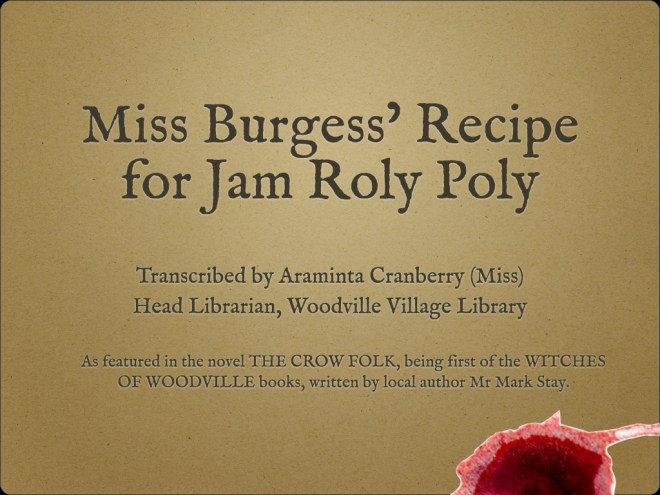
As you may know, at the start of my forthcoming book The Crow Folk our young heroine Faye Bright finds a book left to her by her late mother. In this book are spells, recipes, incantations… and a recipe for Jam Roly Poly (translation for non-British folk: Jam Roly Poly is a much-loved pudding that has the same density as a sock stuffed with pastry, but filled with jam and tastes lovely with custard).
I am delighted to announce that the recipe featuring rationed ingredients from 1940 is finally available for lovely subscribers to my newsletter. It was compiled by Miss Burgess, a baker of some repute in the village.




 Mark Stay Writes